Whitman Cross had faced boardrooms full of men who wanted to swallow him whole.
He had sat across from investors who smiled while trying to cut his company apart. He had stood before city councils, banks, contractors, and angry neighborhood committees without so much as loosening his tie. He knew how to keep his face unreadable. He knew how to measure every word before it left his mouth.
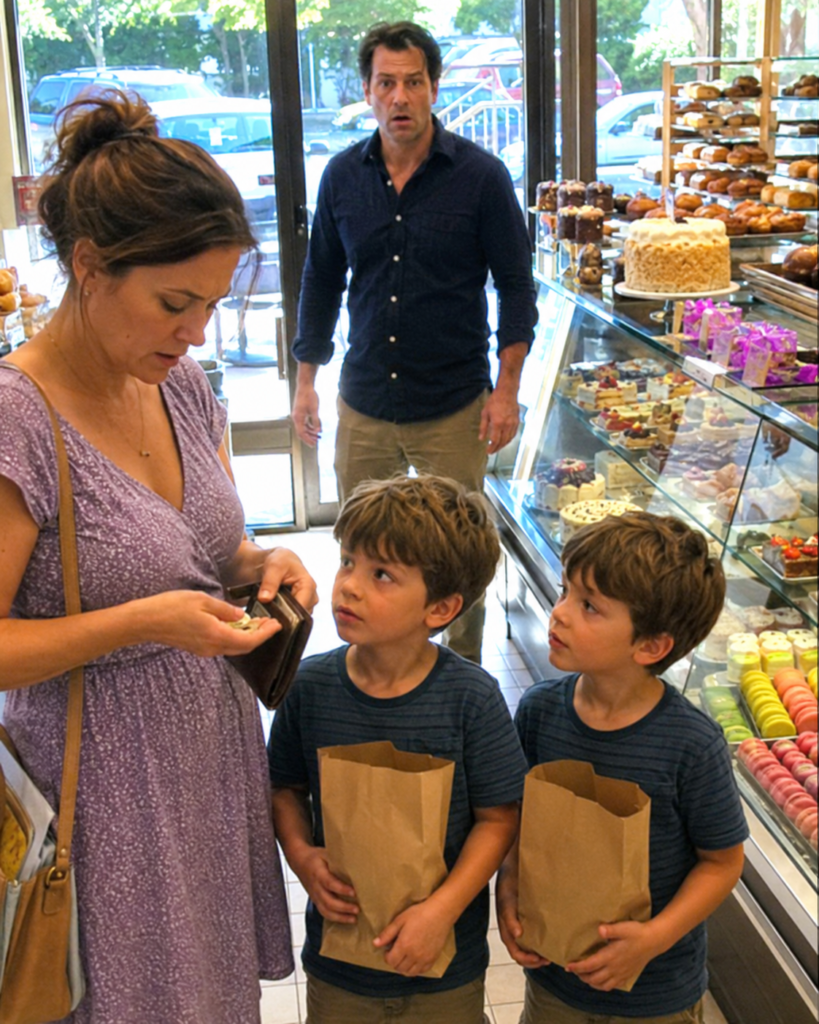
But standing inside that small bakery, watching Lillian Moore count coins in the palm of her hand while two little boys waited beside her, Whitman felt every skill he had spent years perfecting abandon him.
One coin slipped from Lillian’s fingers.
It bounced once against the tile floor, rolled in a half circle, and came to rest near Whitman’s polished shoe.
The smaller of the two boys noticed first.
He looked down at the coin, then up at Whitman.
Whitman saw his own eyes looking back at him.
Not similar eyes.
Not eyes that reminded him of a distant cousin or some vague family resemblance.
His eyes.
The exact same shape. The same pale hazel ring around the iris. The same slight crease at the corners that Whitman remembered seeing in old photographs of himself as a child.
The boy stepped forward and picked up the coin.
“Mom,” he said softly, holding it out.
Lillian turned.
And the color drained from her face.
For a moment, nobody moved.
The bakery continued around them as though nothing had happened. The young woman behind the counter tied a box with string. A man at a corner table typed on a laptop. Somewhere in the back, trays clattered and an oven door closed.
But to Whitman, the whole world had gone silent.
“Lillian,” he said.
Her hand closed around the coins.
“Whitman.”
She did not sound surprised. Not exactly. She sounded like someone who had always known a day would come and had spent years hoping it would choose another time.
The boys looked between them.
“Do you know him?” the one with the rocket notebook asked.
Lillian’s throat moved.
“Yes, Noah,” she said carefully. “I know him.”
Noah.
Whitman heard the name like a bell struck in a distant room.
The other boy leaned against Lillian’s leg, studying Whitman with quiet seriousness. He was holding the coin he had rescued, rubbing it between his thumb and forefinger.
“What’s your name?” the boy asked.
Whitman had negotiated billion-dollar contracts without hesitation, but he found himself unable to answer a child’s simple question.
Lillian answered for him.
“This is Mr. Cross,” she said.
Mr. Cross.
The title landed between them like a wall.
Whitman’s eyes shifted to the boys again. Twins. Four, maybe five years old. No, older than that, he realized after a second look. Their limbs had that stretched-out beginning-of-childhood look. Six. Perhaps just turned six.
Six years.
His chest tightened.
“When were they born?” he asked.
Lillian’s expression changed. Not anger. Not fear. Something quieter. Something that had been carried too long.
“That is not a conversation for here,” she said.
Whitman glanced at the counter. At the coins. At the two small backpacks. At the boy’s worn sneakers, one with a loose strip near the toe.
“What are their names?” he asked.
Lillian hesitated.
The boys answered together.
“I’m Noah,” said the one with the notebook.
“I’m Oliver,” said the other.
Oliver lifted the coin toward his mother again.
“We have enough if we don’t get drinks,” he said.
Lillian’s cheeks flushed.
Whitman felt something inside him twist.
He turned to the counter before she could stop him.
“Whatever they want,” he said to the cashier. “And coffee. For her. For me. Put it on my card.”
Lillian stiffened.
“No.”
The word was quiet, but it had the same force as a slammed door.
Whitman looked back at her.
“It’s a cinnamon roll, Lillian.”
“It’s not about the cinnamon roll.”
The cashier froze, uncertain.
Noah’s eyes moved from his mother to Whitman. Oliver lowered his gaze to the floor.
Whitman recognized that look. The look children got when adults tried to be calm and failed. He had seen it in restaurants, in hotel lobbies, in airports.
He stepped back.
“You’re right,” he said.
Lillian seemed surprised by the words.
Whitman took a breath and tried again.
“May I at least buy my own coffee and sit down? I’d like to talk to you.”
Her hand tightened around the coins until her knuckles paled.
“Not in front of them.”
“Then let me wait.”
She looked toward the boys. Noah had gone back to staring at the cinnamon rolls, but he was no longer smiling. Oliver was watching everything.
Lillian turned to the cashier and placed the coins on the counter.
“One plain roll,” she said. “Cut in half, please.”
Whitman stared at the coins.
The cashier’s expression softened. “I can do that.”
Noah looked disappointed for half a second, then quickly hid it.
Oliver whispered, “We can share the big piece.”
Lillian touched his hair. “We’ll make it fair.”
Whitman wanted to say something. He wanted to insist. He wanted to fix the whole scene with one motion of his hand, one card, one signature, one impossible sweep of money.
But he was beginning to understand that money was not the point.
Or maybe money had always been the point, and he had been too blind to see how much damage it could do when offered without love, without trust, without understanding.
He ordered black coffee he did not want and sat at a small table near the window.
Lillian took the boys to another table across the room. She cut the roll carefully into two equal halves, then broke a little piece from each and placed both pieces on a napkin in front of herself, pretending that was enough.
Whitman watched Noah open the rocket notebook.
Oliver leaned close, and the two boys began drawing something together. Their heads bent toward the page, identical crowns of sandy hair under the golden bakery light.
Lillian looked at them as if they were the only reason she was still standing.
Whitman remembered her like she had been at twenty-eight, laughing in a blue dress on the balcony of their first apartment, wind tangling her dark hair around her face. Back then, she had wanted a small house with a garden. Sunday pancakes. A dog that shed too much. Children, eventually.
He had wanted expansion.
He had wanted New York investors, land acquisitions, his name carved into the skyline.
When she brought up children, he told her they had time.
When she brought it up again, he told her they were too busy.
When she cried after one of his late-night calls from a hotel in Chicago, he told her not to turn his ambition into a crime.
And near the end, when the distance between them had become something neither of them knew how to cross, he had said the sentence that came back to him now with unbearable clarity.
“I never wanted to be a father, Lillian. You knew who I was when you married me.”
He had said it with exhaustion. With frustration. With the cruelty of a man who thought truth excused carelessness.
She had gone quiet after that.
Two months later, they were divorced.
He had told himself it was clean. Mutual. Mature.
Now he sat in a bakery watching two little boys who looked exactly like him split a cinnamon roll their mother could barely afford.
After fifteen minutes, Lillian rose.
“Boys,” she said, “pack up. We need to get to school before the office closes.”
“Are we late?” Noah asked.
“Not yet.”
Oliver tucked the coin into the little front pocket of his backpack.
Whitman stood before he could stop himself.
“School?”
Lillian did not answer.
He lowered his voice. “Please. Five minutes.”
She looked toward the door, then back at him.
The boys were watching again.
“Boys,” she said gently, “stand by the window. I can see you from here.”
They obeyed, though Noah kept glancing over his shoulder.
Lillian stepped closer to Whitman, leaving enough distance between them for six years of silence.
“You shouldn’t be here,” she said.
“I stopped for coffee.”
Her mouth moved in a humorless almost-smile. “Of course you did. You always did have a way of arriving where you weren’t expected.”
“Are they mine?”
The question came out too fast.
Lillian closed her eyes.
For one second, Whitman thought she might deny it.
When she opened them, they were bright but dry.
“They are children,” she said. “Not evidence.”
“I didn’t mean it that way.”
“But that is how you asked.”
He swallowed. “Lillian.”
She looked at the boys, then back at him.
“Yes,” she said. “They are yours.”
Whitman felt the floor shift beneath him.
It was not surprise. Not entirely. His body had known from the moment Oliver looked up at him. But hearing the words gave them weight. It gave them names. Noah. Oliver. His sons.
His sons.
He reached for the back of a chair.
“You never told me.”
“No,” she said. “I didn’t.”
“Why?”
Her eyes sharpened, not with rage, but with something older and more tired.
“Because the last thing you said to me before I signed the papers was that becoming a father would feel like a cage.”
Whitman flinched.
Lillian continued, her voice still low.
“Because your lawyer made it very clear you wanted finality. Because your mother called me three days after the divorce and told me that if I tried to use a pregnancy to reopen the marriage, she would make sure everyone knew what kind of woman I was.”
“My mother did what?”
Lillian’s expression changed just enough to tell him she had not meant to reveal that part.
Whitman’s pulse beat hard at the base of his throat.
“My mother called you?”
“It was years ago.”
“That doesn’t answer me.”
“Yes,” Lillian said. “She called. More than once.”
He stared at her.
His mother, Evelyn Cross, had handled the divorce with the icy efficiency she brought to charity boards and social invitations. She had told him Lillian needed space. She had said emotional entanglements after a divorce only created confusion. She had even offered to make sure all communication went through attorneys so no one got hurt unnecessarily.
Whitman had accepted that because it was easier.
Because he had been tired.
Because some part of him had wanted Lillian to be the one who walked away completely, so he would not have to carry guilt for letting her go.
“I didn’t know,” he said.
Lillian’s face softened for the briefest moment, then closed again.
“There were many things you didn’t know.”
The words were not spoken cruelly. That made them worse.
Whitman looked toward the boys. Noah was making Oliver laugh by pressing his nose against the window. Oliver’s laugh was quiet, almost careful, like he was used to checking whether joy cost too much.
“How old are they?”
“Six. They turned six in April.”
April.
Whitman counted backward without wanting to.
The timing fit.
He ran a hand over his mouth. “I missed everything.”
Lillian looked away.
“I need to take them to school.”
“Let me come.”
“No.”
“Lillian—”
“No.” This time her voice trembled. “You do not get to walk in from nowhere, buy coffee, ask one question, and then come to their school as if that won’t turn their whole world upside down.”
He went still.
She was right.
Again.
The realization burned.
“What do they know about me?”
Lillian glanced at the boys.
“They know their father and I were married a long time ago. They know grown-up relationships can be complicated. They know they are loved.”
“Do they know my name?”
“No.”
Whitman felt the answer like a door closing.
Then Oliver turned from the window and called, “Mom, the office closes at four!”
Lillian lifted a hand. “I know, sweetheart.”
Whitman looked at her. “What office?”
She hesitated.
“School registration,” she said.
“They aren’t in school?”
“They were. We moved.”
“Moved from where?”
“Arlington.”
“Why?”
Her face warned him not to push in front of the boys.
But Whitman could not stop seeing the worn shoes, the coins, the tired eyes.
“Are you in trouble?” he asked softly.
Lillian’s jaw tightened.
“No.”
It was the kind of answer that meant yes, but not in a way she was ready to explain.
She gathered the boys.
Noah walked past Whitman first, then paused.
“Are you famous?” he asked.
Whitman blinked. “No.”
Noah frowned. “Then why does Mom look like she saw somebody from television?”
Oliver whispered, “Maybe he owns the bakery.”
Despite everything, Lillian let out a small, broken laugh.
The sound nearly undid Whitman.
“No,” Whitman said, looking at the boys. “I don’t own the bakery.”
“What do you do?” Noah asked.
“I build buildings.”
Noah’s eyes brightened. “Like skyscrapers?”
“Sometimes.”
Oliver stepped closer. “Can you build a rocket building?”
Whitman looked down at him. “I suppose someone could.”
Noah opened his notebook and flipped to a page. “We made one. It has a launchpad on the roof, but Mom said the fire marshal would probably not like that.”
Lillian’s cheeks warmed. “I said it might be impractical.”
Whitman leaned slightly, just enough to see the drawing.
It was detailed. Much more detailed than he expected from a six-year-old. The building had labeled floors, arrows, windows, and a roof that opened like petals around a rocket.
“You drew this?”
“Noah did the building,” Oliver said. “I did the rocket.”
Whitman looked between them.
“It’s very good.”
Noah beamed before remembering he was supposed to be cautious.
Lillian touched his shoulder. “Come on. We need to go.”
Whitman took a step after her, then stopped himself.
“Lillian.”
She turned at the door.
“Can I see them again?”
The boys looked up at their mother.
Lillian’s face held a dozen answers. No. Not yet. You should have asked six years ago. I don’t know. I’m afraid.
Finally, she said, “I’ll think about it.”
Then she pushed open the bakery door, and the late afternoon sun wrapped around the three of them.
Whitman watched them walk down the sidewalk.
No car waited for them.
They turned the corner on foot.
Whitman stood there long after they disappeared.
His coffee went cold on the table.
Only when the cashier cleared her throat gently did he realize people were staring.
He left a hundred-dollar bill beneath the untouched cup and walked outside.
His driver was parked half a block away.
“Back to Dallas, sir?” the driver asked.
Whitman looked toward the corner where Lillian and the boys had vanished.
“No,” he said. “We’re staying in Fort Worth.”
The driver hesitated only a second. “Yes, sir.”
Whitman got into the back seat, pulled out his phone, and called the one person in his company who knew how to find anything without asking foolish questions.
“Marisol,” he said when his assistant answered. “I need information.”
“On a property?”
“No. On a school registration office near Magnolia Avenue. And I need you to do something else.”
“What?”
Whitman looked out the window at families crossing the street, at ordinary people carrying grocery bags and pushing strollers and holding small hands.
“I need you to clear my weekend.”
There was silence.
“Your entire weekend?”
“Yes.”
“You have the Austin investor dinner tomorrow.”
“Cancel it.”
“They flew in from Toronto.”
“Send apologies. Blame me.”
Another silence.
Then Marisol said carefully, “Is everything all right?”
Whitman watched a little boy about Noah’s age race ahead of his mother, laughing.
“No,” he said. “But I need to make it right.”
By the time Marisol called back twenty minutes later, Whitman was sitting outside a public elementary school in a neighborhood he had never noticed before.
The building was old but clean, with faded murals near the entrance and a flag moving lazily in the warm air.
“I found the school,” Marisol said. “But there’s something strange.”
Whitman sat forward. “What?”
“Lillian Moore filed transfer paperwork today for Noah and Oliver Moore. First grade. Emergency placement request.”
“Emergency?”
“That’s the word on the district form.”
Whitman’s fingers tightened around the phone.
“Can you access the document?”
“Not legally.”
“Then don’t.”
Marisol paused. She knew him well enough to understand the restraint cost him effort.
“There’s more,” she said. “Lillian has been working at a medical records office in Arlington for the last two years. Before that, part-time bookkeeping. No criminal records. No lawsuits. No remarriage.”
Whitman closed his eyes.
No remarriage.
“Address?”
“She listed a temporary address in Fort Worth. A short-term rental.”
“How temporary?”
“Month to month.”
Whitman looked at the school entrance. Through the glass doors, he could see Lillian at the front desk, filling out papers while the boys sat in plastic chairs.
Noah swung his feet. Oliver hugged his backpack.
“I see them,” he said.
Marisol’s voice softened. “Whitman, who are they?”
He did not answer immediately.
Saying it aloud to Lillian had been one thing. Saying it into the structure of his own life was another.
“My sons,” he said finally.
On the other end, Marisol went completely quiet.
Then, very softly, “Oh.”
Whitman did not trust himself to speak.
After a moment, she said, “What do you need from me?”
“Find out if my mother knew.”
Marisol drew in a breath.
“That may be difficult.”
“I know.”
“And personal.”
“It is.”
“Then I’ll be careful.”
“Thank you.”
He ended the call and remained in the car, watching through the school doors like a man outside his own life.
Twenty minutes later, Lillian came out holding a folder.
The boys trailed behind her.
Whitman stepped out of the car.
Lillian stopped when she saw him.
The boys stopped too.
For a moment, no one spoke.
Then Noah whispered, “Mom, the building man is here.”
Whitman nearly smiled.
Lillian did not.
“I told you I would think about it,” she said.
“I know.”
“And you followed us.”
“Yes.”
“That is not helping your case.”
“I know that too.” He took a step closer, then stopped at a respectful distance. “I’m sorry.”
The apology seemed to disarm her more than any argument could have.
He continued before he lost courage.
“I don’t know how to do this. I don’t know what I have the right to ask. I don’t know what you need from me, and I know I don’t deserve an answer today. But I cannot go back to Dallas and pretend I didn’t see them.”
Lillian looked down at the folder in her arms.
Noah tugged lightly at her sleeve. “Mom, is he in trouble?”
“No,” she said, though her eyes remained on Whitman. “Not exactly.”
Oliver looked at Whitman. “Did you break a school rule?”
Whitman shook his head. “I hope not.”
“Because the office lady said no running.”
“I wasn’t running.”
Oliver nodded, satisfied.
Lillian sighed. The sound held exhaustion more than irritation.
“I have to get them dinner,” she said.
“Let me take you.”
“No.”
He nodded once. “Then let me walk with you.”
Her answer was immediate. “No.”
The boys both looked disappointed, which startled everyone.
Noah hugged his notebook to his chest. “But I wanted to ask about skyscrapers.”
Lillian’s expression flickered.
Whitman saw the struggle in her face. She had protected them for years by keeping him away. Now the boys were curious, and curiosity was harder to guard against than fear.
“Another time,” she said.
“When?” Noah asked.
“Soon.”
Children had a way of finding the weakest part of a promise.
“How soon?”
Lillian closed her eyes briefly.
Whitman said, “Would Saturday morning be all right? Somewhere public. A park. You choose. One hour.”
Lillian looked at him sharply.
He held up both hands slightly. “Only if you decide it’s all right.”
Noah whispered to Oliver, “Parks have benches. We can draw buildings.”
Oliver whispered back, “And maybe ducks.”
Lillian looked at her sons.
Then she looked at Whitman.
“Saturday,” she said at last. “Trinity Park. Ten in the morning. One hour.”
Whitman felt something loosen in his chest.
“Thank you.”
“This is not a promise beyond that.”
“I understand.”
She gave him a look that said he probably did not, but she was too tired to argue.
As she turned away, a paper slipped from the folder and fluttered to the sidewalk.
Whitman bent automatically and picked it up.
It was a school district form, partly filled out in Lillian’s neat handwriting.
Student names. Birth dates. Previous school. Emergency contact.
Then his eyes landed on a line halfway down the page.
Father’s Name: Unknown.
A strange cold passed through him.
He knew he had no right to feel wounded. Not after what Lillian had told him. Not after six years. Not after his own words had helped write that line.
But seeing himself reduced to absence on paper made something inside him crack.
Lillian reached for the form.
He handed it back without comment.
She saw where his eyes had been.
For a moment, her face softened.
“I didn’t know what else to write,” she said.
He nodded.
His voice came out rough. “I know.”
She tucked the paper away.
“Saturday,” she repeated.
Then she took the boys’ hands and walked away.
This time, Whitman did not follow.
That night, he did not return to his penthouse in Dallas. He took a room at a quiet hotel in Fort Worth and sat by the window while the city lights blurred below him.
He tried to work.
He opened his laptop, stared at site plans, financial projections, lease terms, and acquisition notes.
None of it held.
His mind kept returning to a hundred small things.
Noah’s careful drawing.
Oliver’s solemn questions.
Lillian breaking off pieces of cinnamon roll for herself so the boys would not notice she had none.
He thought of six birthdays.
Six Christmas mornings.
First words. First steps. Fevers. Nightmares. School pictures. Lost teeth.
All of it had happened somewhere beyond the walls of his life.
And he had been busy.
At nine thirty, Marisol called.
“I found something,” she said.
Whitman stood.
“What?”
“I checked old correspondence logs from the divorce. Your mother’s office requested copies of all certified mail sent to Lillian’s apartment after the final decree.”
“Why?”
“I don’t know. But there are references to a returned envelope from Lillian addressed to you.”
Whitman’s heart slowed.
“What envelope?”
“It was logged by your building concierge six weeks after the divorce. A personal letter from Lillian Moore to Whitman Cross. It never appears in your private mail records after that.”
Whitman stared at his reflection in the dark window.
“I never received it.”
“I thought you should know.”
“What happened to it?”
“I’m still looking.”
He already knew.
Not the details, but the shape of them. His mother’s careful hands. Her quiet arrangements. Her belief that the Cross name was a structure to be protected at all costs.
“What else?” he asked.
Marisol hesitated.
“There was also a check issued from a family office account around the same time. Fifty thousand dollars. Payable to Lillian Moore.”
Whitman frowned.
“She never mentioned money.”
“The check was voided.”
“By whom?”
“Your mother.”
The room seemed to narrow.
Marisol continued, “There’s a memo attached. It says, ‘Recipient declined further contact. No disbursement necessary.’”
Whitman closed his eyes.
He could hear his mother’s voice in those words. Polished. Final. Unbothered.
“Thank you,” he said.
“Whitman,” Marisol said gently, “be careful.”
“With Lillian?”
“With everyone.”
After they hung up, Whitman called his mother.
She answered on the third ring.
“Whitman,” Evelyn Cross said warmly. “This is unexpected. Are you still in Austin?”
“No.”
A pause.
“Is something wrong?”
“I saw Lillian today.”
Silence.
Not confusion.
Not surprise.
Silence.
Whitman gripped the phone.
“You knew,” he said.
His mother exhaled softly. “I wondered when this might happen.”
The calmness of it was almost unbearable.
“You knew she was pregnant.”
“I knew she claimed to be.”
“She had my sons.”
Another pause, shorter this time.
“So it’s true.”
Whitman sat down slowly.
“Do not choose your words carefully with me right now,” he said. “Tell me what you did.”
Evelyn’s voice cooled.
“I protected you.”
“From my children?”
“From manipulation.”
“Lillian wrote to me.”
“She wrote many things.”
“You took my letter.”
“I intercepted a situation that would have destroyed the future you were building.”
Whitman laughed once, but there was no humor in it.
“My future.”
“You were thirty-two. You were closing the largest deal of your career. You had just freed yourself from a marriage that made you miserable.”
“That is not your decision to make.”
“You were not thinking clearly.”
“I wasn’t given the chance to think at all.”
His mother’s voice sharpened. “You told everyone you never wanted children.”
“I told my wife that in anger.”
“And she believed you. As any sensible person would.”
Whitman pressed his fingers against his brow.
For years, he had mistaken his mother’s control for strength. Her interference for protection. Her certainty for wisdom.
Now he saw the cost.
“What happened to the letter?” he asked.
“I don’t know.”
“Don’t lie to me.”
“I am not lying. I don’t know where it is now.”
“Now?”
There was a small pause.
“I gave it to Harold.”
Whitman went cold.
Harold Vance had been the Cross family attorney for thirty years. He had retired the previous winter after a stroke and moved to a private care facility in Tyler.
“What did Harold do with it?”
“You would have to ask him.”
“I will.”
“Whitman, listen to me. This woman kept children from you for six years. Do not romanticize her because you saw a touching scene in a bakery.”
His voice dropped. “You kept me from them first.”
“She could have gone to court.”
“With what money? Against our family?”
Evelyn said nothing.
Whitman knew his mother well enough to recognize when silence was not defeat, but calculation.
“I am going to know them,” he said.
“You may regret that.”
“I already regret everything else.”
He ended the call.
For a long time, he sat motionless in the quiet hotel room.
Then he opened his laptop and searched for Harold Vance’s care facility.
At ten the next morning, Whitman arrived at Trinity Park early.
He had not slept much.
He wore jeans and a simple blue shirt instead of a suit, then changed shirts twice because every option seemed like a costume. Too expensive. Too casual. Too calculated. In the end, he felt like a man trying to pass as ordinary and failing.
He brought nothing except a sketchpad, colored pencils, and four coffees from a nearby café. Then he realized children should not have coffee, cursed under his breath, and went back for hot chocolate.
When Lillian arrived with the boys, Noah spotted the sketchpad immediately.
“You brought paper?”
Whitman held it out. “I did.”
Oliver pointed at the drink tray. “Is that all coffee?”
“Two hot chocolates,” Whitman said. “One with whipped cream, one without because I didn’t know which you liked.”
Oliver looked amazed. “You can choose without whipped cream?”
Noah gave him a serious look. “Why would you?”
Lillian tried not to smile.
It was a small thing, but Whitman saw it.
For one hour, they sat beneath a sprawling oak tree while the boys drew impossible buildings.
Noah designed a tower with slides between floors. Oliver drew a library shaped like a moon. Whitman answered questions about cranes, elevators, concrete, windows, and whether a building could have a secret room only children could find.
“It could,” Whitman said.
Lillian looked at him over her coffee. “That sounds like a safety violation.”
Noah groaned. “Mom.”
Whitman smiled. “Your mother is probably right.”
Oliver looked up. “Is she always right?”
Whitman’s smile faded just a little.
“More often than I knew.”
Lillian looked down at her cup.
The boys did not notice.
They were too busy arguing about whether ducks would prefer a pond on the roof or in the lobby.
Whitman learned things in fragments.
Noah liked space, numbers, and asking questions that had three more questions hidden inside them.
Oliver liked stories, animals, and noticing when people were sad.
Noah spoke first and thought second.
Oliver thought first and spoke only when he was sure the words mattered.
They were alike in face but different in spirit, like two songs played on the same instrument.
When Noah spilled hot chocolate on his sleeve, Whitman reached for napkins at the same moment Lillian did. Their hands brushed.
Both of them froze.
Once, that touch would have meant nothing. Once, it had meant everything.
Lillian pulled back first.
“It’s fine,” she said quickly.
Whitman handed Noah the napkins.
At eleven, Lillian began gathering the boys’ things.
Noah protested. “But we didn’t finish the duck elevator.”
“One hour,” she said.
Whitman stood.
“May I see them again?”
Lillian glanced toward the boys, who were now chasing a leaf as if it were a wild creature.
“I don’t know.”
He nodded, though disappointment moved through him.
“I’ll wait for you to decide.”
She studied him.
“You keep saying the right things,” she said quietly.
“I’m trying to mean them.”
“That’s different from knowing how to live them.”
“I know.”
Lillian looked toward the boys.
“They ask questions,” she said. “Hard ones. And they get attached. I won’t let them become something you visit when guilt gets loud.”
The words struck cleanly.
“That won’t happen.”
“You don’t know that.”
“No,” he admitted. “But I know I don’t want my old life back. Not the way it was.”
Lillian’s eyes searched his face, perhaps looking for the younger man who had once promised change after every argument and then returned to work by sunrise.
Before she could answer, Noah ran back holding a leaf shaped like a star.
“Mom, can we show Mr. Cross our school papers? He knows buildings, so maybe he knows forms too.”
Lillian’s face changed.
“Noah.”
“What?” Noah asked. “The office lady said one paper was missing.”
Whitman looked at Lillian.
“What paper?”
“It’s nothing.”
Oliver came up beside Noah. “The father paper.”
The air shifted.
Lillian closed her eyes.
Noah looked confused. “That’s what she called it.”
Whitman kept his voice gentle. “What did she say?”
Lillian answered before the boys could.
“She said because their records are incomplete, I need to provide either a birth certificate update, a custody statement, or a notarized explanation. It’s standard.”
“But you filled out unknown,” Whitman said.
Her gaze sharpened. “Because legally, that’s what the documents say.”
His breath caught.
“I’m not on their birth certificates.”
“No.”
He absorbed that.
Of course he was not. Why would he be? He had not been at the hospital. He had not signed anything. He had not even known.
But the fact still landed heavily.
“I can fix that,” he said.
Lillian’s eyes flashed. “You cannot just fix people’s lives like paperwork.”
“I meant—”
“I know what you meant. But you need to understand something. Every time you say you can fix it, I hear that you think I failed.”
Whitman went still.
The boys had wandered a few feet away, but Lillian lowered her voice anyway.
“I kept them fed. I kept them warm. I read to them when I was too tired to see straight. I held Noah through asthma attacks and Oliver through nightmares. I worked jobs that made my feet ache so badly I cried in the shower where they couldn’t hear me. I made mistakes. I made choices you may not forgive. But I did not fail them.”
Whitman felt shame rise hot behind his ribs.
“I don’t think you failed them,” he said. “I think I did.”
Lillian’s expression trembled.
For a moment, the wall between them thinned.
Then Noah called, “Mom, Oliver is putting leaves in my backpack!”
“They’re for science!” Oliver said.
The moment passed.
Lillian turned away, wiping at one eye before the boys could see.
“I’ll message you,” she said.
“You don’t have my number.”
“I still know it.”
Whitman stared at her.
She gave a faint, sad smile. “Some things don’t leave just because people do.”
Then she took the boys home.
That afternoon, Whitman drove to Tyler.
Harold Vance’s care facility sat behind a line of crepe myrtles, quiet and expensive and smelling faintly of lemon polish. Harold was thinner than Whitman remembered, his once-commanding frame reduced by illness, but his eyes remained alert.
“Whitman,” Harold said, his voice raspy. “Your mother said you might come.”
Whitman sat beside the bed.
“Then you know why I’m here.”
Harold turned his face toward the window.
“Lillian’s letter.”
“What did it say?”
The old attorney’s fingers moved against the blanket.
“I did not read it.”
“Don’t give me that.”
Harold closed his eyes. “I did not read all of it.”
Whitman leaned forward. “Where is it?”
“Gone.”
“Destroyed?”
“I don’t know.”
“Harold.”
The old man looked at him then, and for the first time Whitman saw not the family attorney, not the man who had protected Cross interests for decades, but someone carrying the weight of a decision he could no longer defend.
“Your mother asked me to handle it. She believed Lillian was trying to force contact. There was a medical bill attached. A prenatal appointment receipt. And a note.”
Whitman’s throat tightened.
“What note?”
Harold’s voice lowered.
“She wrote that she was pregnant. That she did not expect marriage. That she did not want money if it came with control. But she believed you had a right to know.”
Whitman looked down at his hands.
He could almost see the younger Lillian writing those words, afraid but determined, offering him a chance he had never received.
“There was something else,” Harold said.
Whitman looked up.
“What?”
Harold hesitated.
“The letter included a second page. Not from Lillian.”
Whitman frowned. “From whom?”
“I don’t know. It was unsigned.”
“What did it say?”
Harold breathed slowly, as if each word had to travel a long distance.
“It said the pregnancy was not safe. That Lillian needed help. That if the Cross family ignored her, there might be consequences none of us could undo.”
Whitman’s blood chilled.
“Who wrote it?”
“I told you, I don’t know.”
“Do you still have it?”
“No.”
“Then why tell me now?”
Harold’s eyes shifted toward the bedside table.
“Because I received something last month.”
Whitman followed his gaze.
On the table sat a worn Bible, a glass of water, and a small manila envelope.
Harold nodded toward it.
Whitman picked it up.
His name was written across the front in black ink.
Whitman Cross.
The handwriting was unfamiliar.
“When did this come?”
“Three weeks ago,” Harold said. “No return address. I should have called you, but after the stroke, some days I…” He looked away, embarrassed. “Some days I lose track of what is real and what is memory.”
Whitman opened the envelope.
Inside was a single folded sheet of paper and a photograph.
The photograph showed Lillian outside a hospital, heavily pregnant, one hand resting on her stomach. She looked pale and frightened. Beside her stood a woman Whitman did not recognize.
On the back, someone had written:
She tried to tell him.
Whitman unfolded the paper.
It was a copy of a school form.
Noah and Oliver’s registration form.
But not the one he had seen yesterday.
This one was older, from kindergarten enrollment the previous year.
Most of the information matched.
Names.
Birth dates.
Mother: Lillian Moore.
Father: Unknown.
Then Whitman noticed a note written at the bottom in blue ink.
Possible hereditary cardiac concern. Family history requested. Mother unable to provide paternal medical information.
Whitman stopped breathing.
His father had died at fifty-one from an undiagnosed heart condition.
Whitman had inherited the same genetic marker and managed it quietly with medication and regular monitoring. Very few people knew. His mother. Harold. His doctor. Marisol, only because she scheduled his private appointments.
He stared at the words until they blurred.
“Who sent this?” he asked.
Harold did not answer.
Whitman turned the page over.
There, written faintly in pencil, was one final sentence.
Ask Lillian what happened the night Oliver stopped breathing.
Part 3:
The drive back from Tyler to Fort Worth felt less like a journey and more like a fall into a silent abyss.
The sheet of paper from Harold’s envelope rested on the passenger seat of Whitman’s car, the soft pencil marks looking like a shadow across his ruined life.
Ask Lillian what happened the night Oliver stopped breathing.
The sentence repeated in his mind with the rhythm of a failing heart.
He didn’t return to his hotel. He didn’t call Marisol. Instead, he drove straight to the address Marisol had found for Lillian—a quiet, run-down apartment complex in Fort Worth, surrounded by dry oak trees and aging brick. It was the kind of place where people lived when they were trying hard to stay invisible, or when they had run out of other choices.
It was twilight when he parked.
The streetlights flickered on, casting long shadows across the pavement. Up on the second-floor balcony, a small wind chime clinked against iron railings.
Whitman climbed the stairs. Each step felt heavy, like carrying the burden of six years he could never recover.
When he reached Apartment 204, he stood outside the wooden door for a long minute. From inside, he could hear soft muffled sounds—a television playing a cartoon, the sharp giggle of a boy, and the clatter of a pot on a stove.
He knocked.
The laughter inside stopped.
A few seconds later, the lock clicked, and the door opened a crack, caught by a safety chain.
Lillian looked out. When she saw Whitman standing in the dim hallway, her eyes widened.
“Whitman?” she whispered, her voice laced with immediate alarm. “What are you doing here? I said I would message you.”
“I need to speak with you,” he said. His voice was raw, stripped of all the executive polish he usually hid behind. “Please, Lillian.”
She looked at him closely, taking in the shadow of stubble on his jaw, the dark circles under his eyes, and the quiet desperation radiating off him. She looked down at the paper clutched tightly in his hand.
“Are the boys asleep?” he asked softly.
“Noah is reading in their room. Oliver is watching TV,” she said, her guard still up. “Whitman, you can’t just show up here.”
“I know,” he said. “I know I have no right. But I went to see Harold Vance today.”
Lillian went rigid. The color drained from her face, exactly as it had in the bakery.
“Harold?” she breathed.
Whitman held up the photograph—the one of her outside the hospital, pregnant, pale, and looking like the world was crushing her.
“He had this,” Whitman said. “And he had a note from a school form. Lillian… why didn’t you tell me about the heart condition?”
Lillian’s breath caught in her throat. She unlatched the chain and opened the door, stepping out onto the small, cold balcony and pulling the door shut behind her so the boys wouldn’t hear.
“You went to Harold?” she said, anger rising through her fear. “After six years, you go digging through the trash of the Cross empire?”
“I went looking for answers because my mother lied to me!” Whitman’s voice rose before he quickly caught himself, dropping it back to a whisper. “She took your letter, Lillian. She hid it. She voided the check. She made sure I never knew.”
Lillian laughed, a bitter, hollow sound that cut through the night air.
“Do you think that changes anything?” she asked, tears suddenly springing to her eyes. “Do you think it matters who kept you away? The result was the same, Whitman! I was alone!”
“I didn’t know,” he pleaded, reaching out a hand, though he didn’t dare touch her. “If I had known—”
“If you had known, what?” she demanded, stepping closer, her chest heaving. “You would have sent a lawyer! You would have sent a trust fund manager! You would have tried to buy them out of my hands because you didn’t want a family, you wanted control!”
“That’s not true!”
“It IS true!” Lillian cried, wiping a tear angrily from her cheek. “You told me children would be a cage, Whitman. You said it to my face before I left. So when I found out I was pregnant three weeks later, I was terrified. I wrote you that letter not to ask for your money, but to give you a choice. And when I got a call from your mother’s attorney telling me to stay away or face legal action… I realized I had to protect my babies from a family that saw them as a liability.”
Whitman felt a cold lump form in his chest. “I am so sorry, Lillian. God, I am so sorry…”
“Sorry doesn’t fix the night Oliver stopped breathing,” she said, her voice dropping into a dangerous, dark whisper.
Whitman froze. The air left his lungs.
“Tell me,” he begged quietly. “Please.”
Lillian turned her back to him, gripping the balcony railing until her knuckles turned white.
“He was eleven months old,” she said, her voice shaking violently. “A cold turned into a fever. Then his breathing changed—shallow, fast, like he couldn’t get air. I rushed him to the emergency room in Arlington. They hooked him up to monitors. His heart rate was spiking, erratic. The doctor asked me about family medical history. ‘Is there heart disease in the family?’ they asked.”
She turned back to face him, tears streaming down her face under the amber light of the apartment bulb.
“And I had to sit there, watching my eleven-month-old baby gasp for air, and tell the doctor ‘I don’t know.’ Because his father was a billionaire who was too busy building skyscrapers to give me his medical records!”
Whitman took a half-step back as if he had been struck. The guilt was a physical pain, crushing his chest.
“They stabilized him,” Lillian continued, wiping her face with the back of her sweater. “It was SVT—supraventricular tachycardia. Brought on by a high fever and a genetic predisposition. The doctor told me we were lucky. Lucky. I spent three nights in an ICU chair holding his tiny hand, praying to a God I hadn’t talked to in years, wondering if my baby was going to die because I was too proud to fight your mother’s lawyers.”
“Lillian…” Whitman’s voice broke completely. Tears blurred his vision. “I would have given everything. Every tower, every dollar, my own life—I would have given it to save him.”
“But you weren’t there,” she said simply. “I was.”
Silence fell over the balcony. The noise of distant traffic hummed below them.
Whitman looked at the door leading inside. Beyond it were his two sons—boys who carried his face, his eyes, and his blood, but had grown up in the shadow of his absence.
He knelt down on the cold concrete of the balcony.
Lillian gasped, taking a step back. “Whitman, get up.”
“No,” he said, looking up at her with raw, unfiltered truth. “I spent my whole life building things out of concrete and steel so I wouldn’t have to feel fragile. But standing here, I realize I built a fortress around an empty room. I am empty, Lillian. Without them… without making this right… I have nothing.”
He looked at her, his hands trembling on his knees.
“I don’t want to buy my way into their lives. I don’t want to take them from you. You are an incredible mother. You saved them. You raised them. But please… let me be their father. Don’t let my past mistakes keep them from having a dad who would burn the world down to keep them safe.”
Lillian looked down at the powerful Whitman Cross—the titan of Dallas real estate, reduced to kneeling on a second-floor apartment balcony in Fort Worth.
She saw no pride left in him. Only a broken man trying to put together the pieces of a life he had accidentally shattered.
The balcony door slid open with a soft squeak.
Both of them turned.
Oliver stood in the doorway, holding a stuffed rabbit with one floppy ear. He rubbed his eyes, looking between his mother and the man kneeling on the floor.
“Mom?” Oliver asked softly. “Is the building man crying?”
Lillian swallowed hard. She looked at Whitman, then looked down at her son.
She slowly walked over and dropped to her knees beside Oliver, pulling the little boy into her arms.
“No, sweetie,” Lillian said, her voice shaking as she looked up at Whitman with a mixture of sadness, forgiveness, and cautious hope. “He’s just… finding his way home.”
Oliver looked at Whitman for a long moment. Then he stepped away from his mother, walked over to Whitman, and held out the stuffed rabbit.
“You can hold Barnaby if you’re sad,” Oliver offered innocently. “He helps.”
Whitman reached out with trembling hands and took the small, worn toy. He looked at Oliver, seeing his own eyes looking back at him—not with judgment, but with simple, unearned kindness.
“Thank you, Oliver,” Whitman whispered, tears spilling over his cheeks. “Thank you.”
For the first time in six years, Whitman Cross didn’t look at the sky. He looked down at the small hands in front of him, knowing that the hardest structure he would ever have to build wasn’t made of steel—it was a family, rebuilt from the ground up, one day at a time.