My father demanded ten thousand dollars to walk me down the aisle.
He did not say it like a joke, or a bluff, or some tasteless attempt at tough love.
He said it the way he talked about used cars at his dealership in Jacksonville—clean, flat, final.
“Ten thousand dollars, Dorene.
That’s what it’ll cost if you want me to walk you.”
For a second I thought I had misheard him.
We were standing in his office at Delaney Auto Sales, the same place where I had spent part of high school filing paperwork for free because he said family should help family.
His desk was covered in financing folders, coffee rings, and a little gold calculator he liked to smack with one finger whenever he was proving a point.
He leaned back in his chair after naming the price, like he had just quoted me on an upgraded transmission.
I stared at him.
“You’re serious?”
He folded his hands over his stomach.
“You want the honor, you pay for it.”
“The honor?” I repeated.
He shrugged.
“You think walking a bride down the aisle is just automatic? After the way you’ve treated me?”
The way I had treated him.
That almost made me laugh.
My father had spent most of my life acting like affection was a privilege I needed to earn.
Approval came in tiny portions, usually after I had done something useful or obedient.
If I pushed back, he withdrew warmth like a bank freezing access to funds.
By the time I was old enough to understand the pattern, it had already shaped me.
I was the daughter who overexplained, overworked, overachieved, and still felt one mistake away from being unworthy.
My younger cousins called him charming.
Customers loved him.
At church, he shook hands, remembered names, and told people he was proud of me for becoming a nurse.
In private, everything cost something.
I looked at the framed family photo on the shelf behind him.
It had been taken when I was seventeen.
I was smiling in it because he had told me to.
Even then I had known how to perform peace for other people.
“I’m not paying you to be my father,” I said.
His expression hardened instantly.
“Then I’m not walking you.”
The conversation could have ended there.
It should have.
But he wanted to twist the blade.
He leaned forward and smiled—a thin, ugly smile that never reached his eyes.
“Don’t worry,” he said.
“I’ll still come.
I’ll sit in the front row and watch you walk by yourself.
Let’s see how you handle it when everyone’s staring.”
I left his office with my ears ringing.
Outside, the Florida heat hit me like a wall.
Cars shimmered in the lot.
Somewhere nearby, a salesman laughed too loudly.
I got into my car, shut the door, and sat there gripping the wheel until my hands cramped.
I had seen trauma that week.
Real trauma.
I worked as a trauma nurse at one of the busiest hospitals in Jacksonville.
I had cleaned wounds, called time of death, and stood through fourteen-hour shifts with blood drying on my sneakers.
I knew what catastrophe looked like.
Yet I drove home shaking because of a sentence about a wedding aisle.
That was the worst part of people
like my father.
They made small humiliations feel life-threatening.
Marcus found me sitting on the edge of our bed that night still wearing my scrubs.
He didn’t ask what was wrong right away.
He just sat beside me and put one hand between my shoulder blades.
“Talk to me,” he said.
So I did.
I told him about the ten thousand dollars.
About the front-row threat.
About the way my father had said it with complete confidence, as if he knew exactly where to place the pressure and exactly how hard to press.
Marcus listened without interrupting.
That was one of the first things I had loved about him.
He did not rush to fill silence because he was never trying to control the shape of my feelings.
He let people finish.
By the time I was done, it was after two in the morning.
The room was dark except for the dim glow of the digital clock.
Marcus lay back against the pillows and pulled me with him.
“If you want to pay him, I’ll write the check,” he said.
I turned my head.
“You cannot be serious.”
“I am serious,” he said.
“If that’s what you want.
If you want to walk alone, I’ll be waiting at the end.
If you want to cancel the wedding and run off to the courthouse, I’ll find a pen.”
I let out a weak laugh at that.
Then his hand tightened around mine.
“But you are not making a decision because you’re afraid of a man who has used fear on you your whole life.”
I did not answer right away.
I stared into the dark and thought about how simple he had made it sound.
Not easy.
Never easy.
Simple.
I had choices.
That realization felt strangely foreign.
Two days later, I called my father.
He answered on the second ring.
“Well?” he said.
“I’m not paying you,” I told him.
There was a beat of silence.
Then he laughed once, without humor.
“Then I’m not walking you.”
“I understand.”
He sounded almost disappointed that I wasn’t arguing.
“But I’ll still be there,” he said.
“Front row.”
“Okay.”
I hung up before he could say anything else.
Afterward, I sat very still at our kitchen table.
Marcus came in, read my face in one glance, and set a mug of coffee in front of me.
“It’s done?” he asked.
“It’s done.”
He kissed the top of my head.
“Good.”
I wish I could say I felt strong after that.
I didn’t.
I felt sick.
Wedding planning went on around me like a machine that didn’t care what my chest was doing.
Florist confirmations.
Seating charts.
RSVP counts.
My mother kept texting me photos of centerpiece options as if normality could be arranged with hydrangeas.
A few relatives heard some version of the conflict and came to me with that same patronizing tone people use when they are asking you to accept mistreatment gracefully.
“Just pay him.”
“It’s your big day.”
“Why make this into a thing?”
“Men of his generation are stubborn.”
“Be the bigger person.”
No one ever told him to be the bigger person.
That instruction almost always lands on the one being hurt.
Marcus never pushed.
But one evening, as we were finalizing the ceremony program, he
asked, “Has your father even looked at the invitation?”
“I doubt it,” I said.
“Why?”
His mouth twitched slightly.
“No reason.”
I narrowed my eyes.
“Marcus.”
He kissed my forehead and changed the subject.
I let it go, mostly because I was exhausted.
There were things my father did not know.
He knew Marcus as a quiet, broad-shouldered man who didn’t brag, didn’t flash money, and didn’t bother trying to impress him.
In my father’s universe, that registered as ordinary.
A man’s value, to him, had to be displayed.
Expensive watch.
Aggressive handshake.
Loud stories.
Marcus offered none of that.
My father had once called him “just some soldier” while carving Thanksgiving turkey.
Marcus had smiled and asked someone to pass the potatoes.
What my father never bothered to learn was that Marcus Webb was a lieutenant colonel in the United States Marine Corps.
He had a Bronze Star with Valor.
Men who had served under him still called for advice years later.
Generals wrote about his leadership in language that sounded almost unreal to me when I first read it.
He had built a life around discipline, integrity, and loyalty so steady that it changed the emotional temperature of every room he entered.
He also understood something about ceremony that I did not.
You can reclaim stolen ground.
On the morning of the wedding, I woke before dawn.
The hotel room was still blue with early light.
For a few precious seconds, I forgot.
Then I remembered the aisle.
My stomach dropped.
I sat up too quickly and pressed a hand over my ribs, trying to slow my breathing.
In the next room, my bridesmaids were still asleep.
The ocean beyond the balcony doors looked gray and endless.
A soft knock came at the door.
Marcus wasn’t supposed to see me before the ceremony, but his best man slipped an envelope underneath.
Inside was one card.
It said: You will not walk into shame today.
That was all.
No explanation.
No signature.
I read it three times.
At the venue, everything moved too fast.
Hair.
Makeup.
Steam.
Satin.
Pearls.
Someone fastening buttons.
Someone crying over how beautiful everything looked.
Someone asking where the extra safety pins were.
I smiled when expected.
I nodded when spoken to.
Underneath it all, the old fear kept breathing.
When my coordinator said it was time, my hands went cold.
I stood behind the closed ballroom doors and listened to the faint hum of nearly two hundred guests settling into their seats.
I could hear the string quartet shifting into the prelude.
Through the narrow gap near the hinge, I caught a glimpse of the front row.
My father was there.
Dark suit.
Polished shoes.
Arms crossed.
He looked pleased.
Something ancient and terrible rose in me then.
Not because I needed him anymore, but because a part of me still knew what it felt like to be a little girl hoping he would suddenly choose tenderness.
The doors opened.
For one split second, the scene in front of me was exactly the nightmare he had designed.
A long aisle.
Hundreds of eyes.
No father at my side.
My throat tightened.
Then boots struck the floor.
One row on the groom’s side rose.
Then another.
Then another.
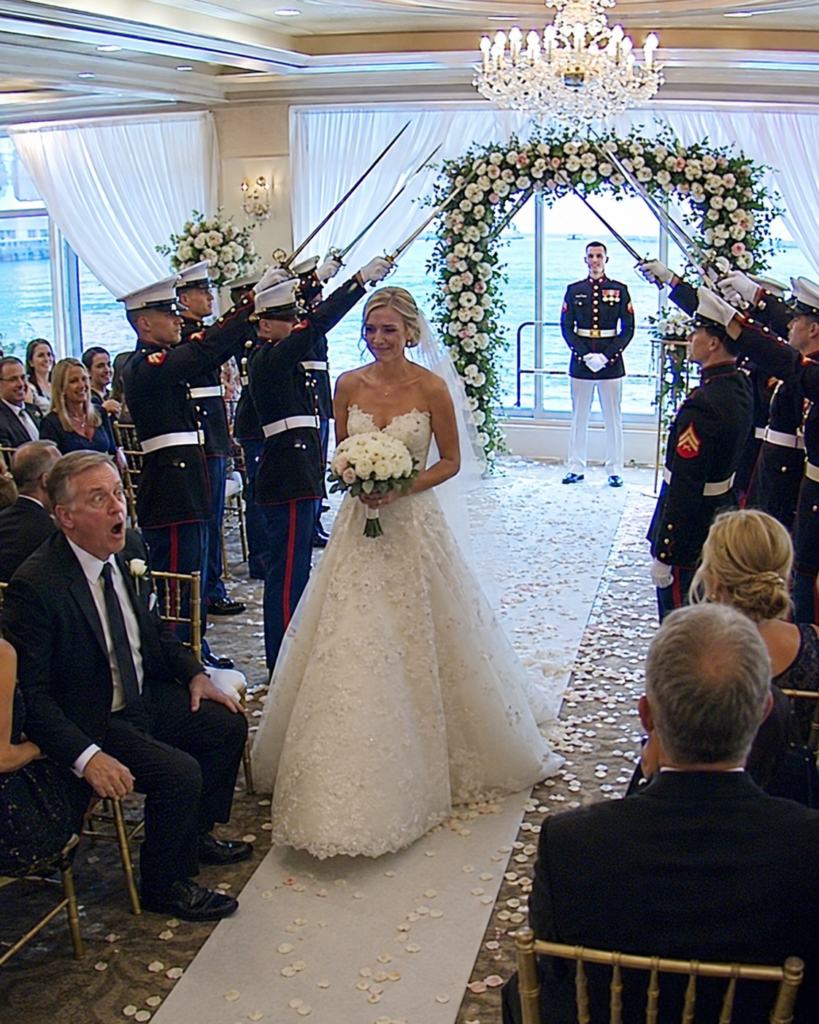
Fifty Marines in dress blues stepped into
the aisle in perfect unison, twenty-five to the left and twenty-five to the right.
The room gasped as Mameluke swords slid from their scabbards with a soft metallic whisper that seemed to cut straight through every cruel word my father had ever put into me.
“Company—swords! Arch!”
The blades lifted.
Sunlight from the tall ocean-facing windows hit the steel and scattered across the ballroom in shards of gold and silver.
Guests turned in astonishment.
Someone near the back audibly sobbed.
My bridesmaid Lena covered her mouth with both hands.
At the far end of that shining tunnel stood Marcus.
He was in his own dress blues, medals bright against his chest, shoulders square, gaze fixed on me with a steadiness so absolute that the room around him seemed to blur.
He was not watching to see if I would make it.
He already knew I would.
That changed everything.
I took my first step.
Then another.
And another.
I walked alone, yes.
But not abandoned.
Not exposed.
Not shamed.
I walked beneath fifty crossed swords raised in honor by men who owed me nothing except respect for the person their commander loved.
I walked past cousins who had told me I was being dramatic.
Past relatives who had called me difficult.
Past family friends who had smiled too carefully whenever my father’s name came up.
And I walked past my father.
His arms were no longer crossed.
His face had gone slack, as if his mind could not reorganize itself fast enough to absorb what was happening.
For the first time in my memory, he looked small.
I didn’t slow down.
At the final pair of swords, one young lieutenant dipped his blade just enough to touch my shoulder.
“Welcome to the Corps, ma’am,” he whispered.
Tears burned my eyes instantly.
Not because of the spectacle.
Because in that moment, after a lifetime of being measured and manipulated, I felt something I had never felt from my own father.
I felt protected.
Marcus took my hands when I reached him.
His thumbs brushed my knuckles once.
“You okay?” he asked quietly.
I nodded, though my chin was trembling.
“You?” I whispered back.
His eyes flicked briefly toward the front row, then back to me.
“Perfect.”
The ceremony itself became a blur of vows and breath and the salt-bright light off the water.
I remember the way Marcus’s voice steadied me when I spoke my vows.
I remember the warmth of his hands, the way our guests seemed wrapped not in shock anymore but in awe.
I remember looking out once and seeing my father sitting rigidly beside my mother, unable to reclaim the room he had planned to own.
When the officiant pronounced us husband and wife, the applause was thunderous.
But the real moment came later.
At the reception, as waiters moved between tables with champagne and the band eased into the first set, my father approached Marcus near the head table.
I saw him before either of them saw me.
He had arranged his face into that familiar salesman expression, the one he used when he wanted to pretend there had never been any offense at all.
He touched Marcus’s elbow.
Marcus turned.
My father smiled.
“Guess I underestimated you.”
Marcus did not smile back.
He did not
shake his hand.
He simply looked at him.
Then he said, calmly and clearly, “No, sir.
You underestimated her.”
The words landed harder than shouting would have.
My father gave a short laugh, already trying to recover.
“Families say things.
Wedding stress.
I’m sure Dorene gave you her version.”
“I know the full story,” Marcus said.
My father’s smile slipped.
“I know you demanded ten thousand dollars to walk your daughter down the aisle,” Marcus continued.
“I know you promised to sit front row and enjoy watching her suffer.
And I know that today, after all of that, you still came here expecting access to her.”
The conversations nearest them died immediately.
My mother turned pale.
One of my aunts looked at her plate with frantic concentration.
My cousin Heather, who had always defended my father, slowly lowered her champagne glass.
Marcus took one measured step closer.
“You will not speak to my wife again unless she asks you to.”
Wife.
That word changed the air.
Not because it made me belong to Marcus.
He would have hated that interpretation.
Because it marked a boundary my father had never believed I would hold.
My father turned to me then, maybe expecting me to soften things, maybe expecting me to repair the social damage for him the way I always had.
I didn’t.
I met his eyes and said nothing.
The silence told him more than any speech could have.
He had not lost a negotiation.
He had lost control.
He left the reception early.
No dramatic scene.
No shouted accusation.
Just a stiff nod to no one, a jaw clenched so tightly it looked painful, and a walk toward the ballroom doors that was somehow more humiliating than if he had exploded.
My mother slipped out after him.
A few relatives followed later with the cautious, guilty body language of people who were beginning to realize they had stood too close to cruelty for too long.
The rest of the reception turned into joy.
Real joy.
Not the brittle kind that depends on one person’s approval.
The Marines stayed longer than planned.
They laughed, danced badly, took photos with my college friends, and made my eighty-year-old grandmother blush by calling her “ma’am” with solemn courtesy.
One of them told me Marcus had started making calls three weeks earlier.
Another said, “Ma’am, there was no chance we were letting you walk into that alone.”
I cried then, finally and fully, standing near the cake table while my new husband held me and pretended not to notice his own eyes had gone red.
In the weeks after the wedding, my father sent three messages.
The first said he was embarrassed by how everything had been handled.
The second said I had made him look bad.
The third said family should forgive and move on.
None of them included an apology.
I did not respond.
Months later, I heard from a cousin that he still told people the Marines thing had been “showboating.” That it was all for attention.
That Marcus had overreacted.
Maybe he needed that story to survive his own reflection.
I no longer cared.
Because here is the truth that settled in me after that day:
Walking alone is not the same as walking unsupported.
My father thought he could
turn my wedding day into a lesson about what happens when I refuse to pay for love.
Instead, it became a lesson in what love looks like when it is real.
It looks like a man who gives you choices instead of threats.
It looks like people who stand up when someone tries to shame you.
It looks like respect with no invoice attached.
Sometimes I still think about my father sitting in that front row, waiting for a spectacle, only to watch an entire battalion rise for the daughter he had spent years trying to make feel small.
And I wonder which part hurt him more.
The fact that I didn’t crawl.
Or the fact that I never needed him to stand beside me in the first place.