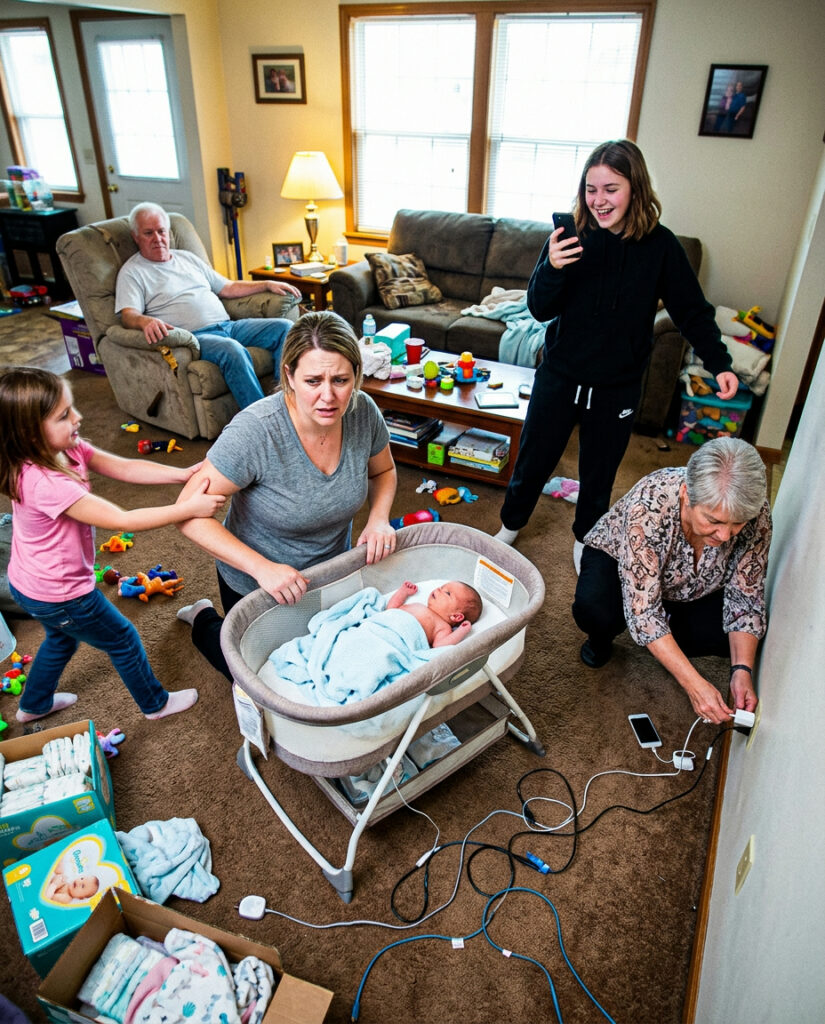
My parents unplugged my premature baby’s oxygen monitor to charge my niece’s phone.
That sentence still sounds impossible to me, even now.
It sounds like something exaggerated for shock, something a grieving mind might twist because the truth was too painful to hold correctly.
But I have the video.
I have the police report.
I have the hospital notes.
I have the memory of my daughter’s lips turning blue while my niece danced in front of a phone propped against a vase.
My name is Beatatrice, and my daughter Fern was born at thirty-two weeks.
Nothing about Fern’s beginning was easy.
One minute I was folding baby clothes and pretending I had plenty of time left.
The next, I was in a hospital bed with nurses moving around me too quickly, voices lowered, hands gentle but urgent.
Fern arrived tiny and silent enough to make my heart stop before the doctors made her cry.
When that small, angry sound finally broke through the room, I sobbed with relief so hard a nurse had to hold my shoulder.
The NICU became my world after that.
I learned the language of machines before I learned the rhythm of motherhood.
Oxygen saturation.
Apnea.
Bradycardia.
Feeding tubes.
Weight checks.
Alarms.
Numbers.
I knew which beeps meant a wire had slipped and which ones meant everybody needed to move.
Fern fought for every breath, and I fought beside her.
When she was finally discharged, she came home with instructions so detailed I kept them in a binder.
Her pulse oximeter and apnea monitor were not decorations.
They were not gadgets.
They were the warning system standing between my fragile baby and disaster.
My apartment was small and old, with unreliable wiring and narrow rooms.
My parents offered their house before I asked.
My mother, Doris, called me three times in one day insisting that Fern and I should stay with them until she was stronger.
“You can’t do this alone,” she said.
“You need family.”
I wanted to believe her.
My relationship with my family had always been complicated, but I told myself complicated was not dangerous.
My older sister Jessica had always been the favorite.
She was the one my parents bragged about, the one whose mistakes were explained away, the one whose daughter Chloe was treated like royalty from the moment she was born.
Chloe was thirteen, pretty, dramatic, and obsessed with filming herself.
She was not evil in the way adults can be evil.
She was spoiled, praised, and protected from consequences until she believed attention was the same as love.
If she interrupted dinner to record a dance, my mother smiled.
If she demanded quiet, my father turned off the television.
If she was rude to me, Jessica said she was just expressing herself.
Fern did not receive that softness.
From the first night in my parents’ house, the comments started.
“Does that machine have to beep so much?” my father asked, scowling from his recliner.
“It keeps her safe,” I said.
He waved a hand.
“You young mothers overcomplicate everything.”
My mother complained that the cords made the living room ugly.
Jessica joked that Fern had more equipment than a science lab.
Chloe wrinkled her nose and asked why the baby looked so small.
“She was premature,” I said, holding
Fern closer.
Chloe shrugged.
“She looks weird.”
Jessica laughed softly.
“Chloe, don’t be rude.”
But she said it the way people speak when they are amused, not when they are correcting a child.
I swallowed all of it.
I was exhausted.
Fern had appointments, medications, feeding schedules, and alarms that jolted me awake even when they were false.
I told myself I could endure a few cruel comments if it meant my daughter had a safe place to recover.
The cruel comments were warnings.
I did not understand that until Tuesday.
It was an October afternoon, bright and cold outside, warm inside because my mother always kept the heat too high.
Fern was asleep in her bassinet in the living room.
I had placed her where I could see the edge of the blanket from the kitchen doorway.
Her monitor was plugged into the wall beside the couch, the cord taped down so nobody would trip over it.
I was in the kitchen preparing her medication.
The bottle was on the counter.
The syringe was in my hand.
I remember checking the dosage three times because fear had made me precise.
Caring for a medically fragile baby turns ordinary tasks into sacred rituals.
You do not guess.
You do not rush.
You do not assume.
Then the alarm screamed.
My whole body reacted before my mind did.
The syringe slipped from my fingers and clattered across the tile.
I ran.
When I reached the living room, my mother was standing at the outlet with Fern’s monitor cord in her hand.
For a second, I could not process it.
My mind kept trying to make the image harmless.
Maybe the plug had fallen out.
Maybe she was moving it.
Maybe she did not understand.
Then I saw Chloe beside her, holding a phone charger.
Fern lay in the bassinet, her tiny fists curling and uncurling weakly.
Her mouth opened in a shallow, struggling movement.
Her lips were already tinged blue.
“Mom, what are you doing?” I screamed.
Doris barely looked at me.
“She needs to charge her phone.
She needs to post her T!k.Tok dance before her friends-this stupid beeping machine can wait.”
The words were so casual that they frightened me more than shouting would have.
I lunged for the outlet.
Jessica stepped between us and grabbed my wrist hard enough to hurt.
“Don’t you dare ruin her moment,” she hissed.
“That thing is staying unplugged until she’s done.”
I looked at my sister and saw no panic in her face.
No confusion.
No realization that she had crossed an unforgivable line.
Only annoyance, as if my daughter’s medical emergency was an interruption.
“Let go of me,” I said.
Chloe was behind her, propping her phone against a vase on the coffee table.
She adjusted her hair, checked the camera angle, and giggled when the alarm kept shrieking.
Then my father walked in.
Eugene took in the scene: me struggling, Jessica gripping my wrist, my mother by the outlet, Chloe’s charger plugged in, Fern gasping in the bassinet.
Any decent person would have moved first and asked questions later.
My father lowered himself into his recliner.
“Stop being such a paranoid drama queen,” he said.
“Babies survived for centuries without these ridiculous gadgets, and frankly, weak ones don’t deserve to
live anyway.”
I felt something inside me split.
There are moments when rage is too large to feel hot.
It becomes cold.
Clean.
Focused.
I wanted to claw my way past Jessica.
I wanted to scream until the walls shook.
But Fern needed action, not noise.
These people were not confused.
They were not going to be persuaded by fear or love.
They had chosen a phone battery over my daughter’s breathing.
So I used my free hand to pull out my phone.
I started recording.
First, I recorded the outlet.
Chloe’s charger was plugged in where Fern’s monitor should have been.
Then I recorded the monitor, powerless and useless.
I turned the camera toward Fern just long enough to capture her condition, then back to Jessica’s hand clamped around my wrist.
I caught my mother saying, “Stop making this dramatic.” I caught my father repeating that I was hysterical.
I caught Chloe restarting her dance because the first take had been ruined by my screaming.
Then I called 911 on speaker.
“My three-month-old premature baby’s oxygen and apnea monitor has been unplugged,” I said, forcing my voice to stay steady.
“Her oxygen is dropping.
My family unplugged it to charge a phone, and they are physically preventing me from reconnecting it.”
The room changed the instant they realized I was not only calling for help, but documenting them.
Jessica loosened her grip.
I twisted away and moved toward the outlet.
My mother snapped, “Don’t you dare lie to emergency services.”
“I’m recording everything,” I said.
My father stood up from the recliner.
Chloe froze mid-dance.
Jessica reached for my phone, but I backed away and kept speaking to the dispatcher.
“My baby’s lips are blue,” I said.
“I’m plugging the monitor back in now.”
I yanked Chloe’s charger from the wall and reconnected Fern’s monitor.
The machine screamed back to life.
The numbers were low enough to make my knees weaken.
The dispatcher’s voice came through sharp and controlled.
“Help is on the way.
Stay with your baby.
Is she breathing?”
“Yes,” I said, though the word barely came out.
“Barely.
She’s struggling.”
I touched Fern’s chest with two fingers, whispering her name over and over.
My family yelled behind me.
My mother said I was going to ruin Chloe’s childhood.
Jessica called me unstable.
My father said I had always needed attention.
Not one of them touched Fern.
The paramedics arrived in six minutes.
I know that because the report says six minutes.
In my memory, it was an entire lifetime.
They came through the front door with equipment and calm voices.
One moved straight to Fern.
Another asked what happened.
I told them, still shaking, still recording.
The paramedic looked at the charger on the floor, the monitor, the outlet, then at my family.
His face hardened.
Fern was given oxygen.
Her tiny body trembled under their hands.
Slowly, painfully, color returned to her face.
I sobbed when I saw her lips pink again, but the relief did not soften the horror.
It made it worse.
She had come that close while my family watched.
At the hospital, the doctors stabilized her.
They told me we were lucky I had responded quickly.
They told me interruption of monitoring in a baby with Fern’s history was dangerous.
They
told me to keep her away from anyone who did not respect her medical needs.
I sat beside her crib that night and stared at the blinking machines.
The same kind of machines my father had mocked.
The same kind my mother had unplugged.
The same kind my sister had blocked me from reconnecting.
Fern slept with her hands curled near her chest.
She looked impossibly small under the hospital lights.
I promised her, quietly, that I would never again confuse shared blood with safety.
The next morning, I went to the police.
The officer who took my report was polite at first in the neutral way officers can be when they do not yet know what they are about to see.
Then I played the videos.
His expression changed.
He watched my mother admit why she unplugged the monitor.
He watched Jessica hold my wrist.
He watched Chloe dance in front of the camera while the alarm screamed.
He watched my father say weak babies did not deserve to live.
When the clip ended, he sat back slowly.
“This is serious,” he said.
“At minimum, child endangerment.
Given that they prevented you from intervening, there may be additional charges.”
I also contacted child protective services.
I gave them names, dates, hospital paperwork, discharge instructions, and the videos.
I wrote everything down because I knew my family.
They survived by rewriting reality.
They would call it a misunderstanding.
They would say I exaggerated.
They would say I was overwhelmed, unstable, jealous, dramatic.
That afternoon, my phone started ringing.
My mother called first.
I let it go to voicemail.
“You need to stop this right now,” she said, her voice trembling with anger.
“You are destroying this family over nothing.
Fern is fine.”
Fern is fine.
As if survival erased the attempt.
My father left a message next.
“You edited that video to make us look bad.
You always were vindictive.”
Jessica sent texts so long they filled my screen.
She said Chloe was crying.
She said I had humiliated a child.
She said I needed to think about the damage I was doing.
I read those messages beside my daughter’s hospital crib and waited for one sentence that never came.
How is Fern?
It never arrived.
So I posted the clips online.
I did not post Fern’s face clearly.
I blurred what needed to be blurred.
But I posted the outlet.
The charger.
My mother’s voice.
Jessica’s hand on me.
My father’s words.
Chloe dancing while the alarm screamed.
The video spread faster than I expected.
Nurses recognized the sound of the alarm immediately.
NICU parents filled the comments with fury.
Strangers told me to get a restraining order, to never go back alone, to save every message.
By the next morning, my family’s version of events had collapsed.
My mother tried to claim she had only unplugged the monitor for a second.
The video proved otherwise.
Jessica said she had been holding my wrist to calm me down.
The video showed me trying to reach the outlet.
My father said his comment had been taken out of context.
There was no context that could rescue it.
Three days later, I returned to my parents’ house with a police escort to collect Fern’s belongings.
Walking through that front door felt
like stepping into a crime scene that had once pretended to be a home.
The living room looked almost the same.
The couch cushions were plumped.
The vase was back on the coffee table.
The bassinet stood near the wall, empty and small.
My mother stood in the hallway with her arms crossed.
“You’ve always been jealous of Jessica,” she said.
“That’s what this is really about.”
I did not answer.
Silence was the only dignity I could afford.
I packed Fern’s blankets, diapers, bottles, medication, and monitor supplies.
An officer stood near the doorway.
Another watched my mother, who kept muttering that I was tearing the family apart.
Then I bent to pick up a fallen pacifier near the couch and saw something glowing faintly underneath it.
A phone.
Not mine.
Not my mother’s.
Chloe’s old phone, the one she used when she wanted extra storage for videos.
The screen was still open to a draft.
I picked it up before I understood what I was seeing.
The thumbnail showed Chloe smiling in the living room.
Behind her, Fern’s bassinet was visible.
My mother stood near the outlet.
I pressed play.
The video had started before I entered the room.
Chloe was adjusting the camera, whispering, “Is this angle good?”
My mother’s voice answered, “Hurry up before Beatatrice hears that thing.”
Jessica laughed softly.
“Just keep her in the kitchen until Chloe gets the shot.”
My stomach turned.
This had not been a sudden careless choice.
It had been discussed.
Coordinated.
They knew the monitor mattered enough to worry I would hear it.
They knew I would stop them.
Then my father’s voice came from off camera.
“Maybe this will finally teach her not to bring fragile problems into my house.”
The officer took the phone from my hand and told me not to touch anything else.
My mother’s face went pale in a way I had never seen before.
Not guilty.
Not heartbroken.
Caught.
Jessica came down the stairs when she heard the commotion.
Chloe followed behind her, crying before anyone had even accused her.
When she saw the phone in the evidence bag, she started sobbing harder.
“It was supposed to be funny,” Chloe cried.
“Mom said nothing bad would happen.”
Jessica snapped, “Chloe, stop talking.”
But the damage was done.
The second video changed everything.
The charges escalated.
The investigation widened.
My mother, father, and sister could no longer claim confusion or panic.
The recording showed intent, planning, and deliberate interference with my child’s medical equipment.
I obtained a protective order.
I moved into a small rental with help from a hospital social worker, a local charity, and friends I had been too embarrassed to ask for help before.
It was not fancy.
The heat clicked strangely at night.
The kitchen cabinets stuck.
But every outlet in that apartment belonged to Fern’s safety, not Chloe’s attention.
The legal process took months.
My parents and Jessica tried every defense they could.
They said they did not understand the monitor.
They said I had exaggerated Fern’s condition.
They said Chloe’s video was childish stupidity, not evidence of danger.
But the doctors testified about Fern’s medical needs.
The paramedics described her condition when they arrived.
The officer testified about the second phone.
And the videos spoke louder than all
of them.
My parents pleaded guilty to child endangerment rather than risk trial on more serious charges.
Jessica accepted a plea as well because the footage of her physically preventing me from reconnecting the monitor was impossible to explain away.
They received probation, mandated counseling, community service, and no-contact orders involving Fern.
Some people online thought the punishment was too light.
Some relatives thought it was too harsh.
I stopped caring what relatives thought.
Chloe was ordered into counseling.
For a long time, I could not think about her without anger burning through me.
She had danced while my baby struggled to breathe.
She had laughed.
But she was also a child shaped by adults who taught her that attention mattered more than empathy.
I did not forgive her quickly.
I still have not fully.
But I understand that the adults in that room carried the deepest responsibility.
Fern is almost two now.
She is still small for her age, still watched carefully, still followed by specialists.
But she laughs with her whole body.
She throws peas off her high chair like it is a sport.
She pats my face when I cry, which is unfair because toddlers should not have to comfort their mothers.
Sometimes, when she sleeps, I stand in the doorway and listen to her breathing.
I know I should be past that by now.
Maybe one day I will be.
Maybe not.
My family still sends messages through distant relatives sometimes.
They say enough time has passed.
They say forgiveness would heal everyone.
They say my parents are getting older, Jessica misses me, Chloe made a mistake, and Fern deserves extended family.
But Fern already taught me what family is.
Family is not the person who shares your last name while unplugging your child’s lifeline.
Family is the paramedic kneeling on your living room floor.
The nurse who squeezes your shoulder without asking questions.
The friend who drops groceries at your door.
The stranger who says, “Save the evidence.” The social worker who finds you a safe place when you are too ashamed to admit you need one.
The last time my mother tried to contact me, she wrote one line that showed me she still did not understand.
“You ruined our lives over a machine.”
I looked at Fern sleeping beside me, her chest rising and falling in the soft rhythm I once feared I would lose, and I blocked the number.
Because it was never about a machine.
It was about the moment they decided my daughter’s breath was less important than a phone.
It was about the moment I saw exactly who they were.
And it was about the terrible truth that sometimes the biggest red flag is not how strangers treat you when you are vulnerable, but how calmly your own family does.