Connor’s words seemed to remain in the air long after he stopped speaking, as if the auditorium itself had become afraid to breathe too loudly.
I looked around and saw people lowering their phones, not because they had lost interest, but because recording suddenly felt too small for what was happening. A few minutes earlier, those same screens had been lifted to capture my son’s humiliation, yet now the room was forced to understand that he had walked in carrying thirty-seven ghosts.
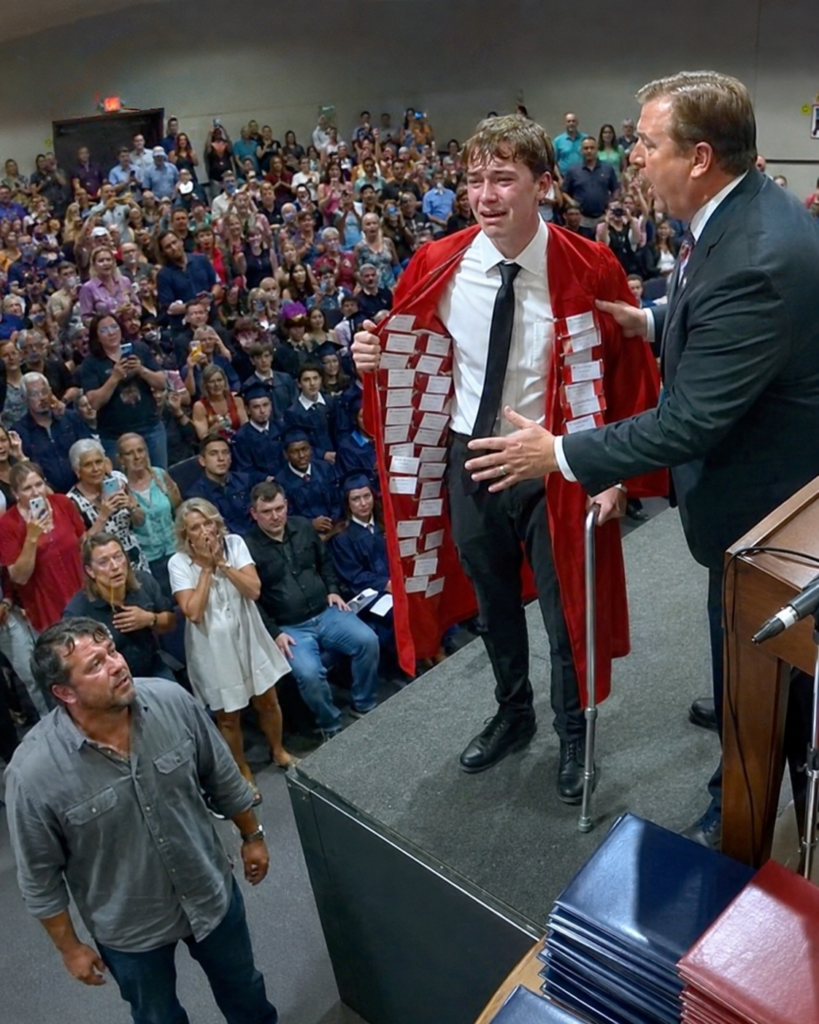
Principal Hayes stood close enough to take the microphone, but she did not reach for it again.
Her face had gone pale beneath the stage lights, and the official smile she had worn all morning was gone completely. For years, she had been the kind of administrator who believed discomfort was a problem to be managed, not a truth to be heard, and now my son had turned her polished ceremony into something no handbook could control.
Connor glanced toward her, then toward the first row where the school board members sat with their hands folded too tightly in their laps.
“I know this wasn’t the plan,” he said, his voice quieter now but somehow stronger. “But neither was spending half of seventh grade in a hospital bed.”
A painful stillness moved through the graduating class.
Several students who had once known Connor before the accident lowered their eyes, and I wondered how many of them remembered the boy he had been before metal rods, rehab appointments, and endless absences made him easier to forget. He had been fast then, always running, always laughing, always coming home with grass stains on his knees and dreams too big to fit inside our kitchen.
“I used to think the worst thing that happened to me was losing the way I walked,” Connor said.
He looked down at his cane, then back at the room. “But the worst thing was realizing how fast people get tired of your pain when it stops being new.”
My throat closed.
I remembered the first weeks after the crash, when our porch filled with casseroles and balloons, when classmates sent cards with messy signatures and promises to visit. Then came the second month, the third, the hard months when sympathy became awkward and everyone else’s lives returned to normal while Connor’s remained measured in stitches, medication schedules, and inches of movement gained through tears.
He never blamed them out loud.
That was the part that hurt me most, because he simply learned to expect less. He stopped asking why no one came over, stopped waiting by the window after school, stopped checking his phone when group photos appeared online from places he had not been invited.
Richard had called that maturity.
I had called it heartbreak.
Connor shifted his weight, and I saw pain pass across his face before he forced it away. “The families who sent me these names know that feeling too,” he said. “They know what it’s like when everyone is sad for a while, then the world moves on and expects you to move with it.”
A woman in the left section began to cry softly.
Connor looked toward the sound but did not stare. “I’m not here to ruin graduation,” he said. “I’m here because graduation means we made it to a day some people were robbed of.”
The words landed with terrible gentleness.
Then, from somewhere behind me, a chair scraped against the floor. An older man stood slowly, his gray hair combed neatly, one hand pressed to his chest as if he were holding himself together by force.
“My daughter’s name is on that gown,” he said.
The entire auditorium turned toward him.
Connor’s expression changed, not into surprise, but recognition. “Was she Sophie Whitman?” he asked.
The man nodded once, and the woman beside him covered her mouth with both hands.
Connor opened the left side of the gown wider and looked down until he found the name. His fingers touched the white stitching with a tenderness that made the scarlet fabric seem almost sacred.
“Sophie Whitman,” he said into the microphone. “She wanted to be a nurse.”
The man’s face broke.
His wife stood beside him, weeping openly now, and for a moment all the ceremony decorations around us felt painfully foolish. Balloons floated near the gym doors, flower arrangements framed the stage, and banners celebrated the future, while a dead girl’s parents stood among strangers listening to a boy say the name the world had tried to leave behind.
Connor bowed his head.
“I promised her parents I would say her name if I got the chance,” he said. “So I’m saying it now.”
Another chair scraped.
A woman near the aisle stood next, clutching a folded tissue in one hand. “My son is there too,” she said, and her voice shook so badly that a man beside her reached for her elbow.
Connor looked down at the gown again. “Jordan Brooks?” he asked.
She nodded through tears.
“Jordan Brooks,” Connor said. “He loved baseball and wanted to play for Oregon State.”
The woman let out a sound I would never forget.
It was not only grief. It was relief, the sound of a mother hearing her child returned to the room for one impossible second.
After that, the standing began one by one.
Not many at first, just a few scattered families who had come because Connor had written to them in secret, asking permission to carry names that were not his to carry without blessing. They stood in different sections of the auditorium, strangers to most of us, joined only by loss and by the scarlet gown my son had sewn at our dining room table while I thought he was finishing scholarship essays.
My hands began to tremble.
I remembered seeing scraps of red fabric hidden beneath his notebooks. I remembered him shutting his laptop too quickly whenever I entered the room and saying he was working on “something for graduation.” I had wanted to ask more, but some instinct told me he needed one piece of his pain that no adult could edit.
Now I understood.
He had not been preparing a protest.
He had been preparing a memorial.
Principal Hayes stepped back, and I saw shame move across her face as plainly as a shadow. Maybe she was remembering the email she had sent him, the one that said his request was “emotionally significant but not appropriate for the tone of commencement.”
I had read that email over his shoulder.
Connor had closed the laptop before I could say anything. “It’s fine,” he had said, but his voice had been too calm, and I should have known then that my son had learned to keep his real decisions quiet because adults were too good at saying no.
Richard leaned forward beside me, red-faced and rigid.
“This has gone far enough,” he muttered, but his voice no longer had the certainty it carried before. He sounded less angry now and more frightened, as if the room was slipping away from the version of Connor he preferred—the obedient survivor, the grateful patient, the son who made everyone comfortable by pretending comfort was possible.
I turned to him.
“Look at him,” I whispered.
Richard’s eyes flicked toward me. “I am looking.”
“No,” I said, my voice shaking. “You’re looking at what people might think of him. Look at him.”
For once, Richard had no quick answer.
Onstage, Connor drew a breath that seemed to cost him.
“I know some people laughed when I walked in,” he said.
A visible ripple of shame passed through the student section.
“It’s okay,” he continued. “I know what I looked like. I know the gown was bright, and I know it made me different.”
He paused, his hand tightening around the cane.
“But I hope before you leave today, you understand what I was carrying.”
No one spoke.
Connor looked toward the rows of graduates, his classmates sitting in navy gowns that now seemed almost too neat, too clean, too untouched by consequence. “This gown is not about being different,” he said. “It’s about remembering that every choice follows someone home.”
The silence that followed was enormous.
Then I heard one clap.
For a second, I did not realize it had come from me.
My hands had moved before my mind caught up, striking together through tears, weak at first and then harder. The mother beside me joined, then a teacher in the front row, then a student, then another, until the applause began to spread through the room like rain turning into thunder.
People rose to their feet.
Not everyone at once, but enough that the rest could no longer remain seated without making a choice. The families of the names stood first, then rows of parents, then teachers, then students who looked stunned by their own emotion.
Connor stood in the center of it all, not smiling, not bowing dramatically, not pretending the applause repaired anything.
He simply closed the scarlet gown slowly, as if tucking the names safely back inside.
That was when Richard stood.
For one foolish, aching moment, I thought he was finally going to clap for his son. Instead, he stepped into the aisle and walked toward the exit doors, leaving his program folded perfectly on the empty seat beside me.
I watched him go, and something inside me went quiet.
In all the years since the accident, I had chased after Richard emotionally, begging him to understand, begging him to soften, begging him to stop treating Connor’s pain like an embarrassment. But as the applause thundered around me and my son stood beneath the lights, I realized Richard leaving did not make the moment smaller.
It only revealed him more clearly.
The applause followed Connor all the way back to his seat.
He moved slowly, his cane tapping the floor once for every painful step, while seniors in navy gowns shifted aside to make room for him. A girl named Madison, who had once been on his middle school soccer team and had barely spoken to him since sophomore year, reached out and touched his shoulder.
“I’m sorry,” she whispered.
Connor looked at her for a moment, then nodded.
He did not give her the easy forgiveness people ask from the wounded so they can stop feeling guilty. He gave her acknowledgment, and somehow that felt more honest.
When he finally sat down, he looked exhausted.
I wanted to run to him, to wrap my arms around him, to tell him he did not have to be brave for one more second. But the ceremony moved forward because institutions always do, even when truth has cracked the floor beneath them.
Principal Hayes returned to the microphone.
Her hands were not steady.
“Before we continue,” she said, and her voice sounded different now, stripped of ceremony. “I would like to acknowledge Connor Mitchell’s courage and the families represented here today.”
She swallowed.
“The school should have listened more carefully.”
It was not enough.
It was not the full apology he deserved, not the admission that their fear of discomfort had become another kind of cruelty. But it was something, and in that room, after all that silence, something mattered.
The ceremony continued, though nothing about it felt normal anymore.
Every speech after Connor’s sounded smaller, as if the adults had suddenly realized their polished phrases could not compete with a boy who had opened his gown and let grief speak. When the valedictorian talked about the future, her voice trembled, and when the superintendent mentioned resilience, he glanced toward Connor with a humility I had not expected from him.
Then, at last, the names began.
Student after student crossed the stage while families cheered, and each time the applause rose, I felt Connor sitting somewhere beyond my sight, gathering strength for the walk he had dreamed of and dreaded. My heart counted the alphabet with cruel precision until finally Principal Hayes looked down at her list.
“Connor Mitchell.”
The room stood before he even reached the ramp.
Part 3
The sound of the whole auditorium rising for Connor did not feel like applause at first.
It felt like a storm breaking open above us, loud enough to shake the shame out of the walls, loud enough to chase every cruel laugh back into the mouths that had made it. Connor stood beside his chair for a moment, looking almost frightened by it, as if he trusted pain more easily than praise.
Then he turned toward the ramp.
He did not use the stairs because stairs had become one of the small humiliations life had left behind after the accident. Before the crash, Connor had taken steps two at a time, leaping down porches and bleachers as if gravity were only a suggestion, but now every incline demanded negotiation.
He moved slowly, cane first, left foot after, right foot steadying the rest of him.
No one rushed him. No one whispered. No one filled the silence with pity, and somehow that mattered more than the standing ovation itself, because for once, the room allowed my son to take the time his body needed without making him apologize for it.
I pressed my hands together beneath my chin and watched him climb the ramp beneath the bright stage lights.
His scarlet gown swayed around him, the hidden names brushing against his legs with every careful step. It was strange, but I could almost imagine those thirty-seven lives moving with him, not as ghosts dragging him backward, but as witnesses helping him cross.
Principal Hayes waited at center stage with his diploma folder in both hands.
Her eyes were red now, and when Connor reached her, she did not perform the quick handshake she had given every student before him. She took his hand in both of hers and held it for an extra second, long enough for the cameras to catch something no school newsletter could polish into a simple caption.
“Thank you,” she said softly.
The microphone did not catch it, but I saw the words on her lips. Connor looked at her, tired and pale, then answered with the calm sharpness that had always appeared in him when adults mistook silence for obedience.
“Next time, say yes before someone has to disobey.”
Principal Hayes flinched, not because he had been cruel, but because he had been fair. She nodded once, and that tiny motion seemed heavier than all her official speeches combined.
Connor took the diploma.
For a second, he looked down at it the way he used to look at medical bills, test results, and therapy schedules, as if paper had become something that usually carried bad news. Then his face changed, and I saw the boy who had survived suddenly understand that this paper belonged to him, that no drunk driver, no embarrassed father, no cautious principal had managed to take this day away.
He turned toward the audience.
The applause rose again, louder and deeper than before, and Connor gave a small breathless laugh that broke through his exhaustion. It was not a full laugh, not the carefree sound I remembered from before the accident, but it was real, and it moved through me like sunlight entering a room I had kept dark for years.
When he came down the ramp, students reached for him.
A hand touched his shoulder. Another brushed his sleeve. Someone whispered, “You did it,” and Connor nodded without stopping, because if he stopped too long, I knew his leg might lock and betray him in front of everyone.
By the time he returned to his seat, I was crying openly.
I did not care who saw. I had spent too many years swallowing fear in waiting rooms, hallways, parking lots, and empty bedrooms, and now my son had crossed a stage in scarlet while the world finally stood for him.
The rest of the ceremony passed as if everyone were walking through changed air.
Students still received diplomas, parents still cheered, and camera flashes still sparked across the auditorium, but something sacred had entered the room and refused to leave. Every time a graduate’s name was called, I saw someone glance toward Connor, as if remembering that a name was not just a sound but a life that could vanish in a second.
When the final cap flew, the room erupted.
Navy-blue squares spun beneath the ceiling lights, and families surged toward the graduates with flowers, balloons, and trembling arms. I stood too quickly, almost stumbling over Richard’s empty seat, and the sight of that vacant chair cut through my joy like a thin blade.
He had missed it.
Not the ceremony, because he had been physically present for most of that. He had missed the moment our son became larger than the accident, larger than shame, larger than the quiet disappointment Richard had mistaken for strength.
I pushed through the crowd until I found Connor near the side wall.
He was leaning slightly against the painted cinderblock, his cane tucked under one arm and the diploma held loosely in his hand. The scarlet gown was still closed, but I knew what rested inside it, and from the careful way people approached him, they knew too.
“Mom,” he said when he saw me.
That one word undid me.
I reached him and wrapped my arms around him carefully, mindful of the hip that still ached after long strain and the left leg that sometimes spasmed when he was overtired. He hugged me back with one arm, hard enough for me to know he had been holding himself together by will alone.
“You were incredible,” I whispered.
He lowered his forehead briefly to my shoulder. “I almost threw up before I started talking.”
I laughed through tears. “You looked braver than that.”
“I wasn’t,” he said. “I just decided fear could come with me if it wanted.”
Before I could answer, a gray-haired man approached with his wife beside him.
I recognized him immediately as Sophie Whitman’s father. Up close, his grief looked quiet and permanent, not fresh like a wound, but settled into him like weather that had changed the landscape of his face forever.
“Connor,” he said.
My son straightened as much as he could. “Mr. Whitman.”
The man’s mouth trembled. “You said her name exactly right.”
Connor’s eyes softened. “I practiced.”
Mrs. Whitman let out a broken little laugh, then reached forward and touched the scarlet fabric. “She would have liked this color,” she said. “She was dramatic in the best way.”
Connor opened the gown just enough to show Sophie’s stitched name.
The Whitmans stared at it as if looking through a window, and I understood then that grief does not ask for the impossible most days. Sometimes it only asks for proof that someone else remembers.
More families came after them.
Jordan Brooks’s mother pressed a baseball card in a plastic sleeve into Connor’s palm and told him Jordan had carried it in his wallet since seventh grade. Connor tried to refuse, but she closed his fingers around it and said, “You carried him today, so let him carry you a little too.”
My son’s face changed at that.
He looked down at the card, then nodded with a reverence that made him seem older than seventeen. “I’ll keep it safe,” he promised, and the woman touched his cheek once before stepping away.
All around us, the gymnasium buzzed with celebration, but near Connor there was a different kind of gathering.
People did not approach him like a celebrity. They approached him like someone standing beside a candle in the dark, each of them bringing a fragment of sorrow and leaving with it a little less alone.
Then the side door opened.
I saw Richard before Connor did.
He stepped into the gymnasium without his usual polished certainty, his tie loosened, his face gray and stripped of its anger. For years, I had watched him enter rooms like he had already decided what everyone owed him, but now he looked like a man arriving late to a truth that had stopped waiting for him.
Connor followed my gaze.
His body went still.
Richard crossed the floor slowly, and the families around us seemed to sense the shift because their conversations faded. He stopped a few feet from our son, looked at the scarlet gown, then at the cane, then finally at Connor’s face.
“I shouldn’t have left,” Richard said.
Connor did not answer.
The silence between them was not empty. It was full of hospital rooms Richard had avoided, therapy sessions he had dismissed, birthdays he had attended with gifts instead of tenderness, and every time he had called our son’s pain dramatic because he did not know how to face his own.
Richard swallowed hard.
“I need to talk to you,” he said.
Connor’s grip tightened around the baseball card in his hand. “Then talk.”

Part 4
Richard stood in front of Connor like a man who had spent years building walls and had only just realized he was trapped behind them.
For the first time since the accident, he did not look angry at Connor’s cane or embarrassed by the attention around us. He looked afraid of his son’s eyes, because Connor was no longer the broken boy Richard could lecture into silence.
“I thought if you kept talking about the accident, it meant you were stuck there,” Richard said, his voice low and rough. “I thought if I pushed you hard enough, you’d move past it.”
Connor watched him without blinking. “You didn’t push me past it, Dad. You pushed me away.”
The words hit Richard harder than any shouting could have.
His mouth opened, then closed again, and I could see the old instinct rising in him, the need to defend himself, explain himself, make himself less guilty. But something in Connor’s face stopped him before he could turn another apology into an argument.
Richard looked down at the floor. “I was ashamed,” he admitted.
Connor’s jaw tightened. “Of me?”
“No,” Richard said quickly, and his voice cracked on the word. “Never of you. I was ashamed because I didn’t know how to help you, and every time I looked at you struggling, I saw how useless I was.”
That confession settled between them with painful weight.
For years, I had wanted Richard to say something honest, something that did not sound like a command or a complaint. Now that he finally had, I realized honesty did not erase what had happened; it only opened the door to the harder work waiting behind it.
Connor looked exhausted, but he did not look cruel.
“That may explain it,” he said quietly. “It doesn’t erase it.”
Richard nodded, tears gathering in his eyes. “I know.”
For once, he did not ask Connor to comfort him.
That small restraint felt enormous. The old Richard would have wanted forgiveness immediately, would have wanted the moment repaired quickly so he would not have to sit inside the damage he had helped create.
Connor shifted the scarlet gown on his shoulders.
“I’m not ready for some big father-son moment,” he said. “I’m not ready to pretend everything is fine because you finally said one honest thing.”
Richard gave a painful half-smile. “That’s fair.”
“But you can start somewhere,” Connor said.
Richard looked up. “Anything.”
Connor opened the scarlet gown again, revealing the white-stitched names inside.
Around us, the families grew still, and the noise of the graduation celebration seemed to fade into the walls. Connor held the fabric open with both hands, even though I could see the strain in his arms and the tremor returning to his fingers.
“Read them,” Connor said.
Richard stared at the names. “Connor…”
“Out loud,” Connor said.
Richard swallowed hard.
He leaned closer to the scarlet fabric, and his voice came out stiff at first as he read the first name. “Sophie Whitman.”
Sophie’s parents stood nearby, holding each other.
“Jordan Brooks,” Richard continued.
Jordan’s mother pressed a hand to her mouth.
Name after name left Richard’s lips, and with each one, the polished father who had once told Connor to be normal seemed to disappear a little more. By the tenth name, his voice had begun to shake; by the twentieth, tears were sliding down his face without any attempt to hide them.
Connor did not interrupt him.
Neither did I.
For once, Richard had to carry something heavy without handing it back to someone else. He had to feel the weight of thirty-seven lives, thirty-seven families, and one son who had been begging to be understood beneath every quiet nod and every painful step.
When he reached the final name, his voice was almost gone.
He wiped his face with one hand and looked at Connor as if seeing the gown for the first time, not as defiance, not as drama, but as a burden his son had chosen to bear with dignity.
Connor closed the scarlet fabric slowly. “That,” he said, “is what I carried.”
Richard nodded. “I see that now.”
Connor’s expression softened, but only slightly. “Then don’t look away again.”
“I won’t,” Richard said.
The promise was simple, but none of us treated it like a miracle. Promises are easy when a room is watching; the truth would come later, in therapy appointments, hard conversations, missed chances repaired by showing up instead of explaining why he had not.
Still, for the first time in years, Richard did not run from the pain in front of him.
Principal Hayes approached us a few minutes later, holding her folded ceremony notes like they had become useless in her hands. She looked at Connor, then at the families standing near him, and the authority in her posture had been replaced by something much more human.
“Connor,” she said, “I owe you an apology.”
My son waited.
“I should have listened when you made your request,” she continued. “I was afraid the ceremony would become too heavy, and I forgot that some students walk into graduation already carrying things heavier than the rest of us can see.”
Connor studied her face. “Will you say that publicly?”
Principal Hayes inhaled.
The school board members had drifted closer, and I watched their expressions tighten. Connor was not asking for private regret; he was asking for accountability, and that was always harder for institutions than applause.
“Yes,” she said finally. “I will.”
“Then say the names next year,” Connor said. “Not mine. Theirs.”
Principal Hayes looked at the scarlet gown. “We can create a memorial scholarship or a safety awareness dedication.”
Connor shook his head gently. “Don’t make it clean so people can tolerate it. Just make it true.”
Her eyes filled. “I’ll try.”
Connor nodded. “That’s a start.”
Later, outside under the late afternoon sun, the air felt impossibly bright after the auditorium.
Families moved through the parking lot with flowers, balloons, and tired smiles, but people kept glancing toward Connor as if they knew they had witnessed something they would still be thinking about years later. The scarlet gown was folded over his arm now, the names hidden but not gone.
He leaned against my old silver Honda, drained to the bone.
For the first time all day, he looked seventeen again. Not a speaker, not a symbol, not a survivor carrying other people’s grief, just my son with soft brown curls crushed beneath a graduation cap and pain shadowed under his eyes.
“Was it too much?” he asked.
I stepped closer. “No.”
He looked down at the folded gown. “People laughed.”
“They stopped.”
A faint smile touched his mouth. “Yeah. They did.”
I reached up and adjusted the edge of his cap, even though it was already straight. Mothers do useless things when the useful things are too enormous, and Connor let me because he knew I needed that small, ordinary gesture more than he did.
“I’m proud of you,” I said.
“I know, Mom.”
“No,” I said, my voice breaking. “You know I love you. But today, I need you to hear that I am proud of the truth you told, proud of the way you stood there, proud of the boy who survived and the man who refused to let the world forget.”
His face crumpled.
Then he hugged me, and this time I did not worry about the cane, the gown, the diploma, or all the eyes still watching us from across the parking lot. I held my son the way I had wanted to hold him in the hospital, after every surgery, after every nightmare, after every lonely afternoon when he pretended being left behind did not hurt.
Richard stood a few feet away, silent.
Connor saw him over my shoulder, and after a long moment, he lifted one hand slightly. It was not forgiveness, not yet, but it was an invitation to begin earning the right to stay.
Richard nodded, tears still on his face.
That day, my son did not have the normal graduation I had once prayed for. He had something harder, louder, and far more unforgettable.
He walked into laughter wearing scarlet, opened his pain in front of strangers, and turned an auditorium into a place of remembrance. And as we drove away from North Valley High School, the folded gown resting safely across Connor’s lap, I understood that survival is not the end of pain.
Sometimes survival is the moment pain finally finds a voice.
THE END