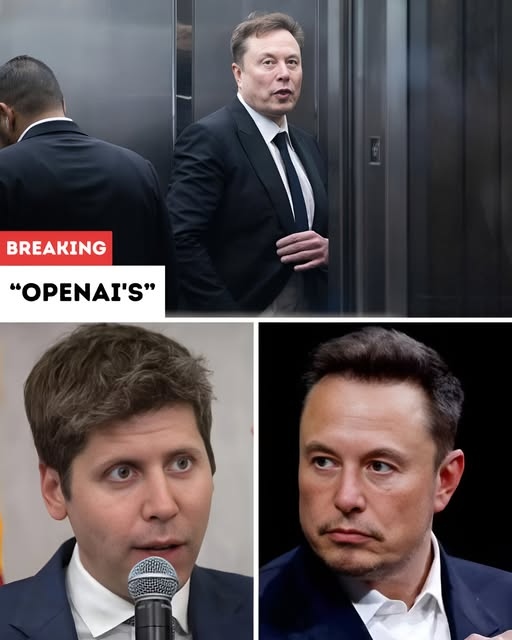
 Elon Musk found himself on Thursday April 30 forced to explain why his own commercialization of artificial intelligence wasn’t “stealing” from humanity and didn’t pose the same dangers as that of ChatGPT’s owners, accused of having abandoned their initial philanthropic mission. “Few answers are going to be complete, especially if you cut me off all the time,” the multibillionaire said as he resumed his duel with OpenAI’s lawyer on the fourth day of the trial he obtained before a federal court in Oakland, near San Francisco.
A judge forced to step in
Their fight, punctuated by attacks wrapped in bursts of politeness, had been interrupted halfway through the previous day. On several occasions, Judge Yvonne Gonzalez Rogers, tasked with deciding whether OpenAI did or did not betray its original nonprofit purpose, had to step in to compel the world’s richest man to answer directly.
Accused by the judge of playing the lawyer by complaining about the opposing side’s “leading” questions, the captain of industry eventually gave in. “I’m not a lawyer. But hey, I did take the introductory law class in college,” he replied with a smile that drew laughter from the courtroom.Elon Musk in court: OpenAI’s future hangs on a trial
From benefactor to accuser
A benefactor of OpenAI’s founders, to whom he gave $38 million during the company’s early days in 2015-2017, Elon Musk accuses CEO Sam Altman and his associate Greg Brockman of having betrayed the public-interest mission of the emerging company by turning it into a commercial entity.
Now valued at over $850 billion, OpenAI is considering a major stock market listing. That listing would be blocked if the SpaceX boss gets what he is asking for: OpenAI’s return to the status of a nonprofit foundation. Such an outcome would reshuffle the cards in the global AI competition, where OpenAI is competing with Anthropic, Google and the Chinese sector champions.
The defense presses Musk’s contradictions
OpenAI’s lawyer, Bill Savitt, tried to show that Elon Musk closely resembled what he denounces: all his companies, Tesla, Neuralink, X and xAI, his own AI company recently absorbed into SpaceX, are for-profit, and the entrepreneur himself presents them as beneficial to humanity. “There’s nothing wrong with having a for-profit organization,” the businessman said, suggesting that OpenAI should have taken that path from the start and could not change its purpose along the way. “You just can’t steal a charity,” he repeated, hammering the word “charity” rather than “non-profit.”
The $97 billion buyout episode
To counter this argument, dubbed a maneuver to slow down a competitor, OpenAI’s lawyer led Elon Musk to comment on his February 2025 initiative, when he assembled a consortium of investors to buy ChatGPT’s creators’ assets for $97 billion. “They were stealing a charity and we had to stop them,” Musk defended himself, admitting that he had not planned to return these assets to a nonprofit structure or to turn ChatGPT into open-source software.
The Terminator scenario rejected by the judge
On Tuesday, his lawyer had led him to portray himself as a selfless benefactor, driven by the protection of humanity in the face of a perilous technological revolution that should not be left in the hands of Google or other profit-hungry competitors. “In the worst case, AI would kill us all, I imagine,” Musk said with a smirk, seizing on a cue from his lawyer to invoke the Terminator film scenario.
The judge, however, prohibited derailing the proceedings with the invocation of AI’s existential threats. “It’s ironic your client, despite these risks, is creating a company that is in the exact space,” she told Steven Molo, Musk’s lawyer.
Altman and Nadella expected on the stand
Elon Musk’s long opening testimony concluded Thursday morning, but he could be recalled to the stand before the end of the proceedings in mid-May. Sam Altman, his former protégé turned enemy, did not miss any of these exchanges on Thursday and left the courtroom right after.
His hearing is expected the week of May 11, according to those close to him at AFP. Greg Brockman is expected as early as Monday on the witness stand, where Satya Nadella, Microsoft’s CEO and the first tech giant to have backed OpenAI’s commercial pivot, must also take a seat.