We were seated beneath string lights in my parents’ backyard in Naperville, at the kind of engagement dinner my mother planned like a magazine spread. White flowers ran down the center of the table.
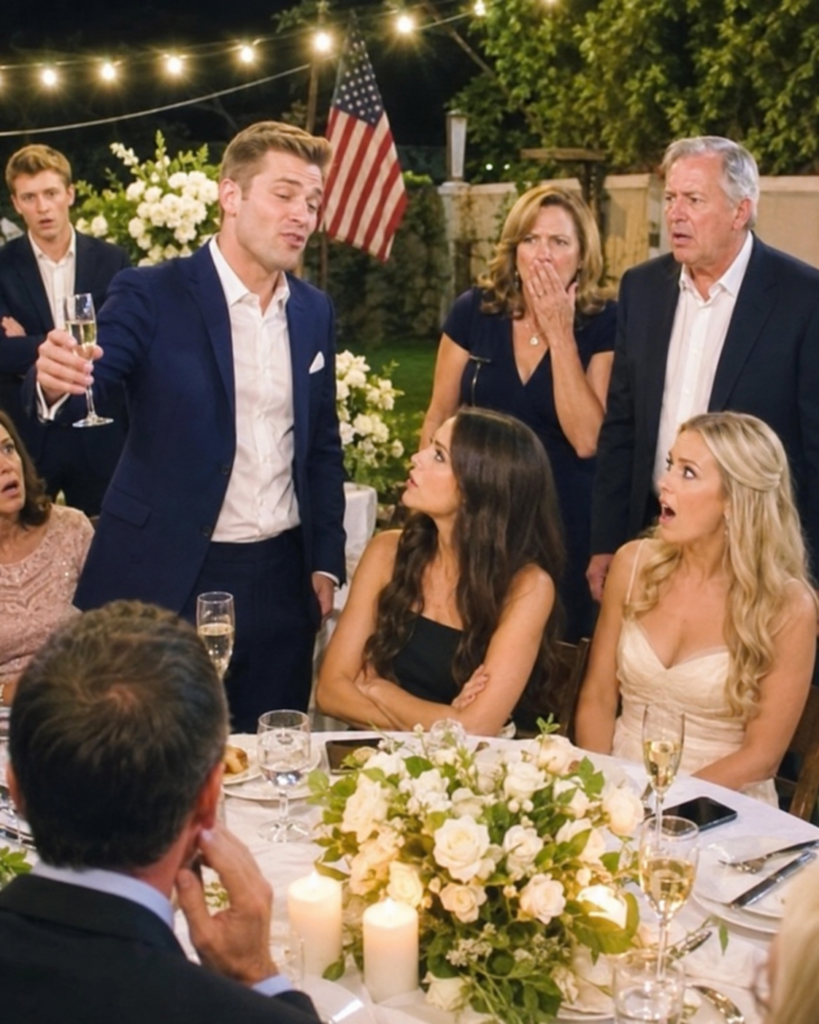
Gold flatware flashed beside untouched dessert plates. A small American flag stirred near the porch, clipped to the railing because my father liked the house to look proper.
Marcus leaned back in his chair, smiling like he had just delivered the toast of the year.
“Some people are built for impact,” he said, lifting his glass toward the investors, cousins, neighbors, and friends around us. “And some people are just there.”
A few guests chuckled because they thought this was harmless sibling teasing.
It was not harmless.
His eyes slid toward me.
“Elena has always been the background person,” he continued. “Sweet. Quiet. Good at following directions. Useless in a real crisis, but dependable if you need paperwork organized.”
My mother looked down at her plate.
My father pretended to adjust his napkin.
No one corrected him.
That was the part that always made the room colder than the words themselves.
Marcus could aim a joke at my ribs, and my family would study the tablecloth like it had become urgent.
They had done it at birthdays, graduations, cookouts, and now at his engagement dinner, in front of the woman he planned to marry.
Sophia sat beside him in an ivory dress, one hand near her untouched wine.
She had been quiet all evening, but not absent.
She watched who interrupted whom.
She watched who laughed too late.
She watched Marcus answer questions meant for me.
Earlier, when someone asked where I worked, Marcus had cut in before I could open my mouth.
“Hospital operations,” he said smoothly. “She understands the admin bottlenecks.”
I let it pass.
When his friend Eric asked if I had seen medical software fail in real settings, Marcus laughed and said, “She sees spreadsheets, not emergencies.”
I let that pass too.
Not because I was weak.
Because I had learned that some families do not want the truth; they want the role they assigned you to stay convenient.
In our family, Marcus was the brilliant one, the loud one, the son with vision.
I was the careful one.
The quiet one.
The one who made things easier in the background.
He could turn a three-month sneaker hustle into a legacy speech.
I could win a statewide science competition and get a kiss on the forehead before my mother offered Marcus another burger.
So when he called me useless, nobody gasped.
They only shifted.
A chair creaked.
A fork touched porcelain.
Someone near the end of the table gave a small uncomfortable laugh and then stopped when nobody joined.
Marcus noticed the silence and tried to save himself by making it bigger.
“I’m kidding,” he said, though his smile had sharpened. “Come on. Elena knows I love her. She just avoids pressure. Always has.”
That was when Sophia turned fully toward me.
Not toward Marcus.
Toward me.
“No,” she said.
One word.
Quiet, but hard enough to cut the table in half.
Marcus blinked.
“Babe.”
Sophia did not look at him.
She was studying my face now with a focus that made something in my chest tighten.
Her eyes moved from my expression to my hands, then back again.
Something had caught in her memory.
I could see it happening, piece by piece, like a lock beginning to turn.
“Have we met somewhere before?” she asked.
The backyard sound changed.
The patio music seemed softer.
The clink of glasses stopped.
My mother’s hand froze around her water glass.
My father finally looked up.
Marcus laughed too quickly.
“She meets a lot of people,” he said. “Probably at one of those hospital events. Elena is around that stuff.”
Sophia’s brow tightened.
“Around that stuff?” she repeated.
He reached for her hand.
She pulled it back just enough that only I noticed.
I should have looked away.
I should have given my usual vague answer, the one I used at family gatherings to keep the peace:
I work at Northwestern.
I coordinate complicated cases.
I’m part of the surgical department.
Small words.
Soft words.
Words my brother could rearrange into something beneath him.
But Sophia kept looking at me like the room had disappeared and only the truth mattered.
“What do you actually do?” she asked.
Marcus cut in before my breath had even settled.
“Nothing impressive,” he said. “Trust me.”
This time, the cruelty did not land as a joke.
It landed as evidence.
Sophia’s face changed, not dramatically, but enough.
Her eyes cooled.
Her posture straightened.
The woman sitting beside my brother was suddenly no longer playing fiancée at a family dinner.
She looked like someone catching the first lie.
“I asked her,” she said.
Marcus’s smile held, but only at the surface.
The table went very still.
Across from me, my cousin Isabelle lowered her fork.
Eric glanced between Marcus and me, his investor smile fading.
My mother whispered my name like she wanted to stop something but did not know which person to stop.
Sophia leaned in slightly.
“Please,” she said, softer now. “What do you do?”
Every face turned toward me.
For years, my brother had lived safely inside the assumption that I would protect the peace before I protected myself.
He had used my silence like furniture, like something sturdy and familiar that would always support his performance.
But that night, beneath the string lights, with his insult still hanging in the air, I saw his confidence flicker.
Just once.
A small pulse of fear at the edge of his mouth.
I set my fork down carefully beside my plate.
The sound was tiny.
Everyone heard it.
I looked at Sophia first, then at Marcus.
And before I said the one word that would change the room, my brother’s champagne smile finally disappeared.
Part 2
Marcus had always believed silence meant surrender.
He had never considered that sometimes silence was simply discipline.
I folded my hands together and looked directly at Sophia.
“Trauma.”
Just one word.
Nothing more.
The backyard seemed to lose all sound.
Marcus frowned.
“…Trauma?”
I nodded.
“I’m a trauma surgeon.”
No one moved.
Not immediately.
The breeze continued stirring the flowers, but around the table every face had become perfectly still.
Marcus laughed.
It came too quickly.
“No, you’re not.”
His voice cracked slightly on the last word.
I didn’t answer.
Sophia did.
“Oh my God…”
She stared at me as though a photograph had suddenly come into focus.
“I know you.”
Marcus rolled his eyes.
“Babe—”
“No.”
She didn’t even glance at him.
“I know exactly who she is.”
Her breathing became uneven.
“It was last November.”
She looked back at me.
“Mass casualty.”
My stomach tightened.
There had been several.
“Which one?” I asked quietly.
“The commuter train derailment.”
The memory returned instantly.
Thirty-eight critical patients.
Two operating rooms converted into emergency bays.
Residents crying in hallways.
Families lining corridors waiting for names.
I remembered.
Sophia swallowed.
“My father.”
Everything around the table disappeared.
“My father was trapped in the third passenger car.”
I remembered him now.
Multiple crushed ribs.
Collapsed lung.
Liver laceration.
Cardiac arrest before surgery.
I had operated for nearly seven hours.
“You…”
Her eyes filled.
“You were the surgeon.”
I nodded once.
“I’m sorry we never met properly afterward.”
“You saved his life.”
Her voice shook.
“You wouldn’t leave the operating room.”
Marcus looked between us, confused.
“What are you talking about?”
Sophia ignored him.
“My dad still talks about you.”
She laughed through tears.
“He says the woman with the calm voice kept telling everyone exactly what to do.”
She turned toward everyone else.
“They called her in from home because the hospital was overwhelmed.”
One of Marcus’s investors slowly lowered his wine glass.
Sophia continued.
“She coordinated five operating rooms.”
I corrected her gently.
“Six.”
She smiled.
“Six.”
Then she looked directly at Marcus.
“And you just called her useless.”
No one laughed.
No one even breathed loudly.
Marcus forced another smile.
“So she’s a surgeon.”
He shrugged.
“Good for her.”
I recognized the performance.
When he couldn’t win, he minimized.
“I’ve built companies.”
He spread his hands.
“We’re talking different worlds.”
Eric finally spoke.
“Wait.”
He stared at me.
“Northwestern?”
“Yes.”
“As in…the Level One Trauma Center?”
“Yes.”
“You lead surgery there?”
“I direct the adult trauma service.”
Another silence.
Eric looked at Marcus.
“You said she handled paperwork.”
Marcus opened his mouth.
Nothing came out.
Sophia slowly turned toward her fiancé.
“Why would you say that?”
He laughed again.
“Oh, come on.”
“I simplified.”
“You lied.”
“It wasn’t important.”
She looked genuinely confused now.
“Not important?”
Her voice remained calm.
“My father is alive because of her.”
Marcus shifted in his chair.
“You’re making this bigger than it is.”
Sophia blinked.
“Bigger?”
She reached into her purse.
“I think I still have it.”
Everyone watched.
She removed a worn leather wallet.
Inside was a folded newspaper clipping.
Carefully unfolding it, she placed it on the table.
The headline read:
LOCAL TRAUMA TEAM SAVES 27 CRITICAL PATIENTS AFTER DERAILMENT
There was a photograph.
I hated that photograph.
My surgical cap hung crooked.
Blood stained one shoulder of my scrubs.
Dark circles surrounded exhausted eyes.
Someone had taken the picture as I left the ICU thirty-two hours after the accident.
Sophia touched the photograph.
“My father carries this article.”
She looked at Marcus.
“He told me that if I ever had children, he hoped they’d grow up with this woman’s courage.”
Marcus stared.
His face slowly drained of color.
“I…I didn’t know.”
“No,” I answered quietly.
“You never asked.”
Those six words landed harder than anything else I’d said.
Because they were true.
Marcus had never once asked what I actually did.
Not once.
For years.
It had always been easier to decide who I was than to discover it.
Across the table, my mother began crying silently.
My father removed his glasses.
Neither of them interrupted.
Perhaps for the first time in decades, they realized how much of my life they had missed.
Eric cleared his throat.
“I’ve read about you.”
I looked toward him.
“You published that hemorrhage protocol.”
I nodded.
“The military adopted part of it.”
Another investor leaned forward.
“You’re Dr. Elena Brooks?”
“Yes.”
“The one who testified before Congress?”
Marcus’s head snapped toward me.
“…Congress?”
I hadn’t wanted this.
I had wanted dinner.
Instead, the truth kept unfolding on its own.
“I testified about emergency preparedness.”
“When?”
“Last spring.”
Marcus whispered,
“You never told us.”
I looked at him.
“You never asked.”
Again.
The same answer.
This time it hit even harder.
Because everyone realized it wasn’t simply about medicine.
It was about years.
Years of assumptions.
Years of never seeing the person sitting beside them.
Sophia slowly reached across the table.
She took my hand.
“Thank you.”
I squeezed hers gently.
“For your father?”
“For reminding me that heroes don’t always announce themselves.”
She looked back at Marcus.
“But liars usually do.”
Marcus stood abruptly.
“This is ridiculous.”
“No,” Sophia replied.
“It’s finally honest.”
Part 3 – Ending
Marcus walked away from the table.
He only made it as far as the edge of the patio before realizing no one had followed him.
Not our parents.
Not his friends.
Not his investors.
Not even Sophia.
For perhaps the first time in his life, the audience had stayed behind.
He slowly turned back.
“I made a joke.”
His voice sounded smaller now.
“That’s all.”
Eric stood.
“No.”
“It wasn’t.”
He folded his napkin.
“It was character.”
Marcus frowned.
“What does that mean?”
“It means people joke about what they already believe.”
No one argued.
Marcus looked toward our father.
“Dad?”
My father didn’t answer immediately.
Instead he stared at his hands.
They looked older than I remembered.
“When Elena was sixteen,” he finally said quietly, “she stayed awake three nights with your grandmother in hospice.”
Marcus looked confused.
“When you were twenty-two,” Dad continued, “she postponed medical school interviews to help Mom after her surgery.”
He looked at me.
“I don’t think I ever thanked you.”
I smiled faintly.
“You were busy.”
The words weren’t bitter.
That somehow made them worse.
Mom began crying harder.
“I thought you didn’t mind.”
“I know.”
“I thought you preferred staying in the background.”
“I learned to.”
She covered her mouth.
“I’m so sorry.”
Across the yard, guests pretended not to watch.
No one succeeded.
Marcus looked around desperately.
“This is insane.”
“I’ve supported this family.”
“You’ve built businesses.”
“You’ve done well.”
I nodded.
“I’m proud of that.”
He blinked.
“You are?”
“Of course.”
“I’ve never wanted your life to become smaller.”
“I only wanted room for mine.”
That sentence seemed to break something inside him.
Because he suddenly understood.
This had never been competition.
Only recognition.
Sophia stood.
She slowly removed the engagement ring.
Marcus stared.
“…Soph?”
She placed the ring carefully beside his champagne glass.
“I’ve spent eighteen months wondering why every story you told made you the smartest person in the room.”
She looked at him sadly.
“Tonight I found out why.”
He stepped toward her.
“Don’t do this.”
“I have to.”
“You embarrassed your own sister because you assumed she’d stay quiet.”
She glanced toward me.
“The woman who saved my father’s life.”
Then she looked back at Marcus.
“If you can diminish someone like her…”
She shook her head.
“…one day you’ll diminish me too.”
Marcus reached for her hand.
She stepped away.
The movement was small.
Final.
She walked around the table until she stood beside me.
Instead of speaking, she hugged me.
Very gently.
“Thank you,” she whispered.
“For what?”
“For telling the truth.”
She left a few minutes later.
Alone.
The engagement dinner ended before dessert was served.
Guests drifted away in uncomfortable silence.
No one mentioned champagne.
No one touched the cake.
As the rental company packed away tables beneath the string lights, Marcus remained sitting by himself.
The newspaper clipping still rested beside his untouched glass.
He stared at the photograph for a very long time.
I almost felt sorry for him.
Almost.
As I gathered my coat, my father approached.
“I’ve been thinking.”
I waited.
“I know every detail of Marcus’s first business.”
He smiled sadly.
“I don’t even know what floor your office is on.”
“Tenth.”
He laughed once.
A tired laugh.
“I should have known that.”
“You still can.”
He nodded.
“I’d like to.”
It wasn’t an apology that erased thirty years.
Nothing could.
But it was the first honest sentence between us in a long time.
Outside the gate, the evening air carried the scent of fresh-cut grass and summer rain.
I started walking toward my car.
Behind me, I heard footsteps.
Marcus.
“I was jealous.”
I stopped but didn’t turn.
He continued quietly.
“You always made difficult things look easy.”
“I thought if people noticed you…”
He swallowed.
“…they’d stop noticing me.”
I faced him.
“Marcus.”
He couldn’t meet my eyes.
“I don’t expect forgiveness.”
“I know.”
“I just wanted you to know the truth.”
For a long moment, neither of us spoke.
Finally I said,
“The opposite of being seen isn’t being ignored.”
He looked up.
“It’s being misunderstood.”
His eyes filled.
“I misunderstood you for years.”
“Yes.”
“You did.”
I opened my car door.
Before getting inside, I looked back one last time.
“My patients teach me something every day.”
He waited.
“The strongest hearts aren’t the ones that never break.”
“They’re the ones willing to heal.”
Then I drove away.
Months later, I received a handwritten letter.
Marcus had begun volunteering with a nonprofit that helped families of trauma victims navigate hospital systems.
The letter wasn’t dramatic.
There were no excuses.
Only accountability.
At the bottom, he had written one sentence.
“For the first time in my life, I’m trying to become the kind of person I spent years pretending to be.”
I folded the letter and placed it in my desk.
Not because everything had been fixed.
Some wounds leave scars.
They should.
Scars remind us that healing happened.
And sometimes the quietest person at the table isn’t silent because they have nothing worth saying.
Sometimes they’re simply waiting until the truth no longer needs to raise its voice.