PART 2
The photograph on my phone was not blurry.
That was the first thing I noticed.
Not the signature. Not the date. Not the legal header printed across the top.
The clarity.
Whoever had taken that picture had made sure every letter was sharp enough to cut me.
My signature sat at the bottom of the page in dark blue ink.
Daniel R. Whitman.
The slant was mine. The pressure was mine. Even the slight break in the “W,” where my hand always lifted for half a second, was mine.
But I had never signed that document.
I stood in the empty nursery with broken glass still stuck in the soles of my shoes, staring at the image until the screen dimmed.
Then another text came through.
Your office. 9:00 a.m. Don’t be late.
No name.
No explanation.
Just command.
I called the number.
Disconnected.
Of course.
I laughed once, a dry, ugly sound that didn’t belong in a room where my son had once slept.
“Noah,” I whispered.
His name turned my bones soft.
For the first time that night, the affair stopped mattering. The house stopped mattering. My suits, watches, wine, cars, ego, all of it fell away.
My baby was gone.
I tried Hannah again.
Straight to voicemail.
“Hannah, call me,” I said, and hated how small my voice sounded. “Please. I don’t know what you think you’re doing, but you can’t take Noah. You can’t just disappear with my son. Call me.”
I ended the message before I said anything else. Before I begged.
Then I called my attorney.
It rang eight times.
“Daniel?” Marcus Vale answered, his voice thick with sleep and irritation. “Do you know what time it is?”
“My wife sold my house.”
A pause.
“What?”
“She sold my house, emptied it, took my son, locked me out, and apparently filed for divorce.”
Marcus was awake now. I could hear sheets shifting, the click of a bedside lamp.
“Start again.”
I didn’t start again. I was too busy pacing through the nursery, stepping around the manila envelope like it was a body.
“She sent me a photo of my signature on something I never signed.”
“What document?”
“I don’t know. I’m going to the office at nine.”
“You’re going nowhere alone,” Marcus said sharply. “Send me the photo.”
I did.
He opened it while I waited, breathing through my mouth.
Thirty seconds.
A minute.
Then he said, very quietly, “Daniel.”
I didn’t like the way he said my name.
“What?”
“Where did she get this?”
“I told you. I don’t know.”
“This is not a divorce filing.”
My throat tightened. “Then what is it?”
“It appears to be an acknowledgment of voluntary transfer of marital property and waiver of immediate contest.”
“That’s impossible.”
“Not impossible,” Marcus said. “Just catastrophic.”
I stared at the bare wall where Noah’s mobile used to hang. “Explain.”
“If that signature is treated as authentic, it means you consented to the sale or transfer of assets under certain conditions. I need the full document, not a photograph, but Daniel…” He exhaled. “If Hannah has this, and if she has evidence of infidelity, financial misconduct, hidden accounts, corporate expense misuse—”
“What financial misconduct?”
Silence.
Too much of it.
“Marcus.”
“You tell me.”
My stomach turned.
I thought of Olivia’s hotel suite in Boston. The room service. The bracelet. The private driver. The dinners billed under “investor entertainment.” The flights that had not always been business. The consultant invoices Olivia’s boutique agency had submitted to Whitman Capital.
The invoices I had approved.
The invoices I had stopped reading months ago.
Marcus didn’t need me to confess. He heard it in my silence.
“Do not speak to anyone,” he said. “Not your wife. Not Olivia. Not your partners. Not your assistant. Nobody. Go to a hotel. I’ll meet you at your office before nine.”
“The house—”
“Forget the house.”
“My son is gone.”
“I understand that.”
“No, you don’t.” My voice broke hard. “You don’t understand anything.”
Marcus was quiet.
Then he said, “Daniel, listen carefully. Your wife did not vanish in a panic. She planned this. People who plan this well do not leave only emotional damage behind. They leave traps. Do not step into another one.”
After he hung up, I stood in the nursery until dawn began diluting the dark at the windows.
My perfect life had not collapsed.
That was too gentle.
It had been dismantled.
Piece by piece.
While I was gone.
At 7:12 a.m., a police cruiser pulled into the driveway.
For one delirious second, I thought Hannah had called them on herself. Then I remembered the shattered kitchen door.
A neighbor must have heard.
Two officers came through the back, hands resting near their belts, voices careful.
“Sir, is this your residence?”
“Yes,” I said automatically.
One of them glanced at the empty rooms. “Can you prove that?”
That was the second time my world shifted.
I opened my mouth.
Nothing came out.
My wallet had my driver’s license. This address. My name.
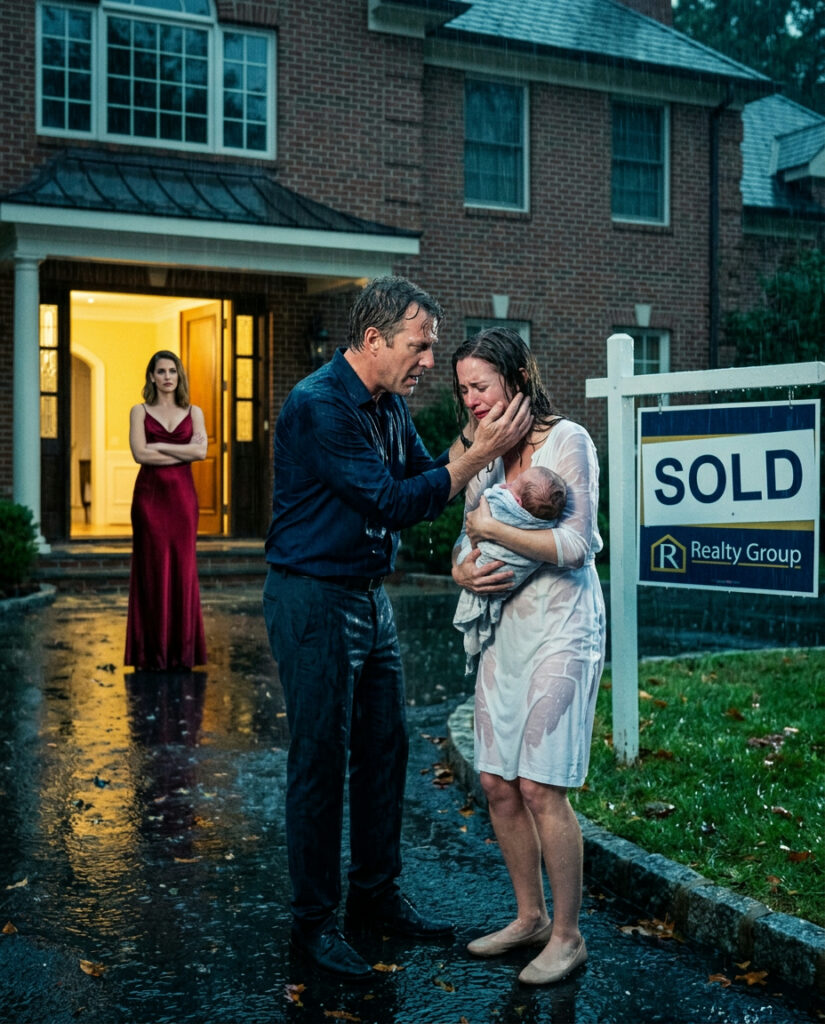
But the SOLD sign outside had more authority than I did.
The older officer, Martinez, looked at the broken glass and then back at me.
“Did you break the door?”
“I live here.”
“That’s not what I asked.”
I felt anger return, hot and familiar. “My wife locked me out of my own house.”
“Your wife’s name?”
“Hannah Whitman.”
The younger officer checked something on his tablet.
His expression changed.
Not much.
Enough.
“Sir,” he said, “according to county records, this property transferred yesterday afternoon.”
“That’s impossible.”
“I’m telling you what I’m seeing.”
“My wife can’t sell my house without me.”
Martinez studied my face. “Apparently, she had authorization.”
My phone felt heavy in my pocket.
Authorization.
My signature.
The fake signature that looked real.
I wanted to shout. I wanted to explain Olivia, Hannah, Noah, the nursery, the note, the unknown number, the whole impossible machinery of my life being taken apart while I slept in another woman’s bed.
Instead, I said, “I’m leaving.”
“Good idea,” Martinez said.
The way he said it made clear it wasn’t a suggestion.
They didn’t arrest me. That was the mercy of the morning.
They only escorted me out of the house I used to own.
On the lawn, beneath that brutal sign, a black SUV idled at the curb.
For a moment, I thought it was Marcus.
Then the rear window lowered.
A woman sat inside.
Silver hair. Sharp cheekbones. Black sunglasses though the sun had barely risen.
Eleanor Bennett.
Olivia’s mother.
I had met her once at a charity auction in Greenwich, where she donated three hundred thousand dollars to children she never intended to meet and looked bored doing it.
She smiled at me now as if we had arranged breakfast.
“Daniel,” she said. “You look terrible.”
“What are you doing here?”
“Watching consequences arrive.”
I stepped closer to the SUV. “Where’s Hannah?”
Her smile thinned. “You really have no idea who your wife is, do you?”
Something cold pressed behind my ribs.
“Tell Olivia to stay away from me,” I said.
Eleanor laughed softly. “My daughter is many things. Patient is not one of them. She’s already called you seven times this morning.”
I checked my phone.
Seven missed calls.
Three voicemails.
I hadn’t felt it vibrate.
Eleanor’s sunglasses reflected my own ruined face back at me.
“You should answer her,” she said. “She’s frightened.”
“Of what?”
“Of having chosen the wrong man.”
The SUV window began to rise.
I slapped my hand against the glass before it sealed. “What does that mean?”
Eleanor lowered it one inch.
“It means your wife was not the only woman collecting evidence.”
Then she drove away.
At 8:43, I reached Whitman Capital.
The building stood in downtown Stamford, twelve floors of tinted glass with my name on the lobby wall. At least, it had been my name.
When I walked through the revolving door, the security guard flinched.
Flinched.
“Morning, Mr. Whitman,” he said.
But his hand moved under the desk.
I saw it.
A button.
A call.
An alarm.
“Don’t,” I said.
He froze.
Everyone in the lobby seemed to know something I didn’t.
The receptionist looked down when I passed. Two analysts stopped talking. One of the junior partners turned and walked in the opposite direction.
My office was on the top floor, corner suite, harbor view, imported walnut desk, ego in architectural form.
The elevator climbed too slowly.
When the doors opened, my assistant’s desk was empty.
Not unattended.
Cleared.
No framed photo of her dog. No lavender hand cream. No stack of colored files. No half-finished coffee.
Just a sealed envelope.
Daniel Whitman.
Same handwriting.
Hannah’s.
I didn’t touch it yet.
Marcus stood outside my office, suit wrinkled, eyes grim.
Beside him were two people I did not recognize.
A woman in a navy suit.
A man with a leather briefcase.
Behind the glass wall of the conference room, my partners sat in silence.
All six of them.
Nobody looked pleased.
Nobody looked surprised.
Marcus came toward me.
“Daniel, we need to talk before you go in.”
“Where are the divorce papers?”
“In the conference room.”
“And them?” I nodded toward the strangers.
“Corporate counsel,” Marcus said. “And a forensic accountant.”
The floor felt unstable beneath my shoes.
“Why is there a forensic accountant in my office?”
The woman in navy answered before Marcus could.
“Because Mrs. Whitman delivered forty-three boxes of documents to our firm at 6:00 a.m., along with three encrypted drives.”
Her voice was calm.
Professional.
Deadly.
“I’m sorry,” I said. “Who are you?”
“Rebecca Shaw. Interim special counsel for Whitman Capital’s board.”
I turned to Marcus. “Interim what?”
He lowered his voice. “The board convened an emergency meeting.”
“I am the board.”
“Not anymore.”
The sentence landed harder than the SOLD sign.
I looked through the glass wall again. My partners sat around the conference table where I had closed million-dollar deals, destroyed competitors, and once made a grown man cry over a debt restructuring.
Now they waited like jurors.
“What did Hannah give them?” I asked.
Rebecca Shaw opened her leather folder.
“Evidence suggesting misuse of company funds, undisclosed related-party transactions, falsified client entertainment records, payments to Olivia Bennett Consulting for services that may not have been rendered, personal expenditures classified as business development, and possible investor disclosure violations.”
I stared at her.
“That’s absurd.”
“Is it?”
I hated her for asking so quietly.
Marcus touched my arm. “Daniel. Think very carefully before answering anything today.”
I shook him off and pushed into the conference room.
Conversation died.
My lead partner, Grant Ellison, sat at the head of the table.
My chair.
He had the nerve to sit in my chair.
“Get out of my seat,” I said.
Grant’s face did not move. “Sit down, Daniel.”
The others avoided my eyes.
Except one.
Caleb Frost.
Youngest partner. My protégé. The man I had dragged from a third-tier firm and made rich.
He looked almost sad.
That frightened me more than anger would have.
On the table lay a thick stack of documents.
Divorce petition.
Custody motion.
Temporary restraining order.
Asset preservation request.
Corporate audit demand.
I saw Hannah’s name.
Hannah Elise Whitman.
Petitioner.
I saw mine.
Respondent.
Then I saw another document at the center of the table.
A resignation letter.
Already drafted.
My name typed at the bottom.
“What the hell is this?”
Grant folded his hands. “You need to step down as managing partner while the investigation proceeds.”
I laughed. “No.”
“Daniel,” Caleb said quietly, “this is bigger than the affair.”
I turned on him. “Don’t say that word in this room.”
“The room already knows,” Grant said.
A screen at the far wall lit up.
My stomach dropped.
There were photographs.
Me and Olivia outside the Boston hotel.
Me kissing her in a restaurant hallway.
Me entering her apartment building in Tribeca.
Receipts.
Messages.
Then invoices.
Olivia Bennett Consulting.
$48,000.
$72,000.
$116,000.
Market positioning strategy.
Investor communications.
Brand advisory.
I had approved them all.
Some were real.
Some maybe weren’t.
I couldn’t remember anymore.
That was the worst part.
Rebecca Shaw spoke from the doorway.
“Mrs. Whitman’s counsel alleges that corporate funds were used to maintain an extramarital relationship and conceal marital assets.”
“My wife is a photographer,” I snapped. “She doesn’t know corporate law.”
Grant looked at me with something like pity.
“No,” he said. “But her father did.”
The room went quiet.
My pulse struck once, hard.
Hannah’s father.
Thomas Archer.
A name she rarely spoke.
A man I knew only in fragments.
Dead before I met her. Former prosecutor. Financial crimes division. Brilliant. Difficult. Unforgiving.
Hannah had inherited his eyes.
I had never wondered what else she inherited.
Rebecca placed a small black drive on the table.
“She also delivered archived materials from Mr. Archer’s personal files. Apparently, he investigated Whitman Capital years ago.”
My mouth opened.
Closed.
“That’s impossible,” I said.
Grant leaned back. “He investigated your father.”
The room seemed to narrow.
My father had built the original fund. I had inherited it, expanded it, polished it until old money trusted us and new money feared us.
“My father was never charged with anything.”
“No,” Grant said. “He wasn’t.”
He looked down at the drive.
“According to what we’ve seen, that may have been because someone made sure Thomas Archer stopped looking.”
Marcus stood very still beside me.
I heard the HVAC humming overhead.
A phone buzzed.
Nobody moved to answer.
“What are you implying?” I asked.
Grant did not answer.
Caleb did.
“We don’t know yet.”
But his face said he knew enough.
I looked around the table and understood, too late, that I had walked into the building as Daniel Whitman, billionaire, founder, husband, father, untouchable.
And everyone in that room had already begun speaking to me as a liability.
The meeting lasted nineteen minutes.
It felt like an execution performed with stationery.
I refused to resign.
They suspended my authority pending review.
I demanded access to company records.
They revoked it.
I threatened lawsuits.
Rebecca Shaw reminded me that litigation would trigger discovery.
That word shut my mouth.
Discovery.
A polite legal term for ripping open every locked drawer in a man’s life.
When I finally left the conference room, the sealed envelope from Hannah still sat on my assistant’s empty desk.
I picked it up.
Inside was one photograph.
Not of me and Olivia.
Not of Noah.
Not of Hannah.
It was a picture of my father.
He stood outside a courthouse in 1998, younger than I remembered, wearing a charcoal coat and an expression I had later mistaken for strength.
Beside him was Thomas Archer.
Hannah’s father.
They were shaking hands.
On the back, Hannah had written:
Ask your mother what he bought.
I drove to my mother’s estate in Darien like a man being hunted by his own shadow.
Victoria Whitman lived behind iron gates and old hedges, in a house that smelled of lilies, lemon polish, and control. She had survived my father, two scandals, one congressional inquiry, and breast cancer without losing a single inch of posture.
She was having tea when I arrived.
Of course she was.
Her silver hair was arranged perfectly. Her pearls rested against her throat. She wore cream silk at ten in the morning, as if ruin were something that happened to other families.
“Daniel,” she said when the maid showed me in. “You look like your father did during the Aubrey matter.”
“What did Dad buy from Thomas Archer?”
The teacup paused halfway to her mouth.
There it was.
Not shock.
Recognition.
I threw the photograph onto the table.
It slid across the polished surface and stopped beside the sugar bowl.
Mother looked at it for a long moment.
Then she said, “Where did you get this?”
“Hannah left it for me.”
Her mouth tightened at my wife’s name.
“She always watched too much.”
“What does that mean?”
“It means quiet women are never as harmless as men hope they are.”
I gripped the back of a chair. “Answer me.”
Mother looked toward the maid.
“Leave us.”
When the door closed, she set down her cup.
“Your father did what he needed to do.”
I almost laughed. “That’s your answer?”
“That is the only answer that matters.”
“What did he buy?”
Her eyes sharpened. “Silence.”
The word hung between us.
I felt twelve years old again, standing outside my father’s study, listening to voices stop the moment I entered.
“How?”
Mother sighed, as if I had asked an indelicate question at dinner.
“Thomas Archer had evidence. Not enough to convict, perhaps, but enough to destroy confidence. Your father was overleveraged. One whisper of fraud and the fund would have collapsed. Families would have lost fortunes. Employees would have been ruined.”
“So he paid him off.”
Mother’s face hardened.
“Do not make it sound common.”
“What would you call it?”
“Containment.”
I sank into the chair opposite her.
“Hannah knows.”
“Clearly.”
“She gave the files to the board.”
Mother blinked once.
That was her version of panic.
“All of them?”
“I don’t know.”
“You stupid boy.”
I stared at her.
She had not called me boy since my father’s funeral.
“This is because of Olivia Bennett?” she asked.
I didn’t answer.
Her smile was cruel and brief.
“Men in this family have always mistaken appetite for power.”
“Where is Hannah?”
Mother looked away.
“You know?”
“No.”
But again, the pause was wrong.
I stood. “Mother.”
“She came to see me three weeks ago.”
The room tilted.
“What?”
“She brought Noah. He was wearing that little blue sweater.”
“Sage,” I said without thinking. “Hannah hated blue.”
Mother’s eyes flickered. For half a second, grief touched her face.
Then it vanished.
“She asked me about your father,” she continued. “About Thomas. About the settlement.”
“And you told her?”
“I told her to protect her child.”
My laugh was hollow. “From me?”
“From the name.”
That hurt more than I expected.
Mother reached into the drawer of the tea table and withdrew a slim envelope.
“I knew this might happen.”
“What is that?”
“Something your father should have burned.”
I took it.
Inside was a copy of a wire transfer confirmation from 1999.
Ten million dollars.
Paid from a shell company linked to Whitman Holdings.
Recipient: Archer Family Trust.
I stared at it.
“Hannah’s family took the money?”
“Yes.”
“Then why would she expose us?”
Mother’s gaze was steady.
“Because Thomas Archer died eleven days later.”
My hand tightened around the paper.
“How?”
“Car accident.”
“But you don’t believe that.”
“I believe your father was capable of many things,” she said. “And I believe Thomas Archer was frightened before he died.”
Outside, a gardener’s blower started up, droning beneath the window like distant machinery.
“My wife has been sitting on this?”
“No,” Mother said. “I think your wife only recently learned enough to understand what she had.”
“And you never told me?”
“You were like him,” she said. “Ambitious. Charming. Addicted to winning. I thought not knowing might give you a chance to become something better.”
I wanted to hate her.
It would have been easier.
Instead, I thought of Hannah in our kitchen three weeks ago, Noah on her hip, watching me lie about Chicago while she already knew the shape of the grave beneath my family.
My phone rang.
Olivia.
I declined.
It rang again.
I declined again.
Then a text arrived.
Daniel, answer me. My mother says Hannah is going to destroy us both.
Mother saw the name on my screen.
“Olivia Bennett was never your escape,” she said. “She was a mirror.”
I left without replying.
By noon, the story had leaked.
Not all of it.
Enough.
Financial sites reported that Whitman Capital’s managing partner had taken temporary leave amid an internal audit. Anonymous sources mentioned improper payments, conflicts of interest, and a personal matter involving a consultant.
By one, Olivia Bennett Consulting had disabled its website.
By two, investors began calling.
By three, my personal banker informed me that several accounts had been restricted pending review of marital claims and corporate inquiries.
By four, the hotel where I had checked in politely informed me that my card had been declined.
I sat in the lobby with one overnight bag I had bought from a shop downstairs because my own clothes were gone.
Gone.
Everything gone.
At 4:17 p.m., exactly twelve hours after I found the SOLD sign, Olivia walked into the lobby.
She looked nothing like she had the night before.
No silk dress. No perfume-cloud confidence. No laughter curling around expensive lies.
She wore black leggings, a camel coat, sunglasses too large for her face, and fear she could not style away.
“You ruined me,” she said.
I stared at her. “Hello to you too.”
“Don’t be cute.”
“I’m homeless, suspended, and being hunted by lawyers. Cute is all I have left.”
She sat across from me and leaned in.
“Did you know?”
“Know what?”
“That Hannah was Archer’s daughter.”
I went still.
“You knew?”
Olivia removed her sunglasses.
Her eyes were red.
“My mother knew. She said the name meant something, but she wouldn’t tell me why. Not until this morning.”
I studied her face, searching for performance.
Olivia had always been good at becoming what the room desired. Brilliant consultant. Wounded daughter. Temptation. Confidante. Co-conspirator.
Maybe I had never known her at all.
“Your firm billed mine for fake work,” I said.
She flinched. “Some of it was real.”
“That is not the defense you think it is.”
“You approved everything.”
“Yes,” I said. “I did.”
For a moment neither of us spoke.
The lobby fountain trickled beside us, serene and offensive.
Then Olivia whispered, “She sent me something.”
My spine tightened.
“What?”
Olivia opened her phone and turned it toward me.
A video.
Paused.
The frame showed me asleep.
Not in Olivia’s bed.
In my office.
My head rested on folded arms on my desk. A glass of scotch sat near my hand. The date stamp read six months earlier.
“What is this?”
“I don’t know,” she said. “It came from an unknown number.”
She pressed play.
The video showed my office from the angle of the bookshelf.
Hidden camera.
Someone entered the frame.
A woman.
Not Hannah.
My assistant, Claire.
She moved quietly to my desk, lifted my hand, and pressed a pen between my fingers.
My sleeping fingers curled around it.
Then a man stepped into view.
Caleb Frost.
My protégé.
He placed documents beneath my hand one by one.
Claire guided my wrist.
My signature appeared.
Again.
Again.
Again.
The video ended.
I could not breathe.
Olivia’s voice shook.
“Daniel, what did you sign?”
I took the phone from her and replayed it.
Once.
Twice.
The signature in the photograph.
The waiver.
Maybe more.
God knew how much more.
“Send this to me,” I said.
“I tried. It won’t forward.”
“Screen record it.”
“It disappears when I do.”
I looked up at her.
“Who sent it?”
“No number. Just a file.”
“What did the message say?”
Olivia swallowed.
“It said, ‘He was never the only liar.’”
The lobby sounds faded.
Claire.
Caleb.
My office.
My hand.
My signature.
Hannah had not forged it.
Someone else had manufactured my consent months ago.
And Hannah had used it.
Or discovered it.
Or both.
I stood so fast the chair scraped behind me.
“Where are you going?” Olivia asked.
“To find Caleb.”
She grabbed my wrist. “Daniel, think. Why would someone send me that video? Why not send it to you?”
Because whoever held the knife wanted to watch us turn on each other.
Because the game was still being played.
Because Hannah wasn’t the only person who had packed a life in secret.
My phone buzzed.
Unknown number.
A new text.
Your wife found the first door. You are standing in front of the second.
Then an address appeared.
Not in Connecticut.
Not in New York.
A storage facility in White Plains.
Unit 119.
Gate code included.
Olivia read it over my shoulder.
“You can’t go there alone.”
I looked at her hand still wrapped around my wrist.
Last night that hand had felt like escape.
Now it felt like evidence.
“I can’t go with you,” I said.
Her face changed.
For once, she understood before I explained.
“You think I’m part of this.”
“I don’t know what you are.”
“That’s rich.”
“Yes,” I said. “It was.”
Then I left her in the lobby.
The storage facility sat behind a strip mall with a nail salon, a liquor store, and a tax office that promised refunds in twenty-four hours. The sky had gone the color of wet concrete by the time I arrived.
The gate opened with the code.
No attendant.
No cameras I could see.
Unit 119 was at the far end, under a flickering light.
The padlock was already open.
I stood there for a long moment, listening.
Traffic hissed beyond the fence.
Somewhere nearby, metal clanged.
I lifted the door.
Inside were boxes.
Not moving boxes.
Archive boxes.
Dozens of them.
Each labeled in black marker.
WHITMAN HOLDINGS — 1998.
ARCHER.
BENNETT.
CALEB FROST.
OLIVIA.
DANIEL.
HANNAH.
NOAH.
My son’s name stopped me.
I went to that box first.
My hands were shaking so badly I tore the lid.
Inside was a small stack of photographs.
Noah in his stroller outside the pediatrician’s office.
Hannah carrying him into a grocery store.
Me holding him in the hospital, staring down at his red, furious face as if he had personally offended me by making me love him.
Under the photos was a medical report.
Paternity test.
My vision blurred.
I saw my name.
Daniel Whitman.
Probability of paternity: 0.00%.
The paper slipped from my hand.
For several seconds, there was no sound in the world.
Then my own breath came back wrong, ragged and animal.
“No.”
I dropped to my knees and grabbed the report.
Read it again.
And again.
The letters did not rearrange themselves.
Noah was not my biological son.
A laugh burst out of me, then died.
Hannah had taken my son.
But he was not my son.
Except he was.
He was.
I had fed him bottles at 2:00 a.m. while answering emails with one thumb. I had placed my finger in his palm and felt his grip tighten. I had watched him fall asleep on my chest and discovered, inconveniently, that there were forms of wealth no investor could recognize.
Blood did not get to cancel that.
It did not get to win.
At the bottom of the box was another envelope.
This one was not in Hannah’s handwriting.
It was my father’s.
I knew it from old birthday cards, from margin notes on contracts, from the cruel, elegant strokes of a man who believed paper existed to obey him.
Daniel,
If you are reading this, then the wrong person has opened the wrong door.
Thomas Archer had a daughter. I had a son. That should have been the end of it.
It was not.
There are debts money cannot settle, and blood has a memory longer than law.
Do not trust Victoria.
Do not trust Bennett.
Do not trust the boy you raised under your roof unless you are certain who placed him there.
Forgive me for making you heir to a war you did not know had begun.
—R.W.
I read the letter until the words blurred.
The boy you raised under your roof.
Noah.
Who placed him there?
A sound came from outside.
Footsteps.
I shoved the letter into my jacket and turned.
Caleb Frost stood in the doorway of Unit 119.
He wore a dark coat, no tie, rain dotting his hair. In one hand, he held a gun pointed loosely at the floor.
He looked exhausted.
Not guilty.
Not afraid.
Exhausted.
“Daniel,” he said. “You weren’t supposed to come here first.”
My body went cold.
“First?”
Caleb stepped inside and pulled the storage door halfway down behind him.
The flickering light painted his face in pieces.
“Where is Hannah?” I asked.
“She’s alive.”
That was not the same as an answer.
I moved toward him.
He raised the gun.
“Don’t.”
I stopped.
“Did you drug me?” I asked.
“Yes.”
The simplicity of it was obscene.
“Did you forge my signature?”
“No. You signed.”
“You moved my hand while I was unconscious.”
“That distinction matters to lawyers. Not to machines. Not to banks. Not to trustees.”
“Why?”
Caleb looked toward the boxes.
“Because your father taught everyone in his orbit that morality was a luxury for people without leverage.”
“You were a kid when my father died.”
“I wasn’t talking about him.”
Something passed across his face.
Old hatred.
Fresh grief.
“My mother worked for your family,” he said. “Not in the house. In the files. She was the one who moved money through shell accounts when Robert Whitman paid Thomas Archer. She knew everything. She kept copies.”
I remembered Caleb’s mother vaguely. A pale woman at firm holiday parties. Quiet. Efficient. Dead from cancer before Caleb joined us.
“You came to work for me because of her?”
“I came to learn what your family buried.”
“And Hannah?”
He looked at me.
“Hannah came for the same reason.”
The room seemed to shrink.
“No.”
“You think you met her by accident?”
I shook my head.
“No.”
The word was useless. Childish.
Caleb’s expression softened, which made it worse.
“She chose the gallery where you liked to buy art. She knew your schedule. She knew what wine you ordered. She knew you would mistake silence for innocence.”
The memory rose in me with cruel brightness.
Hannah standing beside a photograph of winter trees, wearing a gray sweater, her hair pinned badly, pretending not to notice me noticing her.
I had thought I pursued her.
I had thought I won her.
God help me, I had thought Hannah Whitman was the first thing in my life I had earned honestly.
“She married me for revenge,” I said.
Caleb said nothing.
That was answer enough.
The gun in his hand lowered slightly.
“She didn’t plan on Noah,” he said.
I stared at him.
The paternity test lay between us on the concrete.
Caleb saw it.
His face changed.
“You opened that box.”
“Who is his father?”
He looked away.
“Who is Noah’s father?”
The silence answered before he did.
My knees weakened.
“No,” I whispered.
Caleb’s mouth tightened.
“It wasn’t like that.”
I lunged.
He raised the gun again.
“It wasn’t like that!” he shouted.
My hands curled into fists.
“You slept with my wife.”
“She was never yours in the way you thought.”
That sentence hit me harder than the gun would have.
For one second, I wanted him to fire.
For one second, I wanted the story to end cleanly, violently, without more rooms to open.
But Caleb lowered the weapon.
“Hannah was supposed to expose the company, recover her father’s files, and leave before anyone knew what happened. Then she got pregnant. Then Noah was born. Then…” His voice thinned. “Then everything changed.”
“For her?”
“For all of us.”
I laughed, but there was no humor in it.
“So what was I? The mark? The wallet? The family name you needed access to?”
Caleb’s eyes flashed.
“Yes.”
The honesty was brutal.
Then he added, quieter, “At first.”
The storage unit light flickered again.
Rain tapped the metal roof.
I thought of Hannah’s note.
You were so busy hiding your life from me that you never noticed I was packing mine.
She hadn’t only packed her life.
She had built it inside my blind spots.
“Where is she now?” I asked.
Caleb didn’t answer.
I took one step toward him.
“Where is my son?”
His face hardened.
“He is not your son.”
The words left him with the force of a blade.
Something inside me went still.
I looked at him, and for the first time all day, the rage cleared enough for me to see what stood in front of me.
Not a mastermind.
Not a traitor with clean hands.
A man afraid of losing what he believed belonged to him.
Just like me.
“Noah knows my voice,” I said. “He turns his head when I walk into the room. He falls asleep when I hum that stupid song Hannah hates. He has my name on his birth certificate. So say whatever you want, Caleb. Biology gets a vote. It does not get the verdict.”
Caleb’s jaw worked.
For a moment, the gun shook.
Then my phone rang.
Unknown number.
Both of us froze.
I answered and put it on speaker.
For three seconds there was only static.
Then Hannah’s voice filled the storage unit.
“Daniel.”
My eyes closed.
Just my name.
One word, and it reopened every room in me.
“Hannah,” I said. “Where are you?”
“I told you not to look.”
“You left me a trail.”
“No,” she said. “Someone else did.”
I looked at Caleb.
He looked genuinely confused.
“Hannah,” Caleb said, stepping closer. “Where are you?”
She heard him.
The silence changed.
“Caleb,” she said. “You shouldn’t be there.”
His face went pale.
“What does that mean?”
“It means you were followed.”
A sound cracked outside.
Not thunder.
A shot.
Caleb jerked backward before I understood what had happened.
The gun flew from his hand and skittered across the concrete.
Blood bloomed dark across his shoulder.
I dropped as a second shot punched through the storage door, tearing metal inches above my head.
“Hannah!” I shouted.
“Daniel, listen to me,” she said, voice suddenly sharp, urgent. “There’s a black case behind the Bennett box. Take it and run.”
Another shot.
Caleb groaned on the floor, clutching his shoulder.
“Who is shooting at us?”
“The person who killed my father.”
The words turned the air to ice.
“That’s impossible,” I said.
“No,” Hannah whispered. “It’s not.”
Outside, footsteps splashed through rain.
Slow.
Certain.
I crawled toward the Bennett box, shoved it aside, and found a black hard case tucked against the back wall.
Locked.
“Hannah, what’s in it?”
“The reason I disappeared.”
The storage door began to rise.
Inch by inch.
A pair of polished shoes appeared beneath it.
Then dark trousers.
Then the barrel of a gun.
Caleb, bleeding, reached for his weapon with his good hand.
Too far.
I grabbed the black case and swung it with everything I had.
It slammed into the intruder’s wrist.
The gun fired wild.
The storage unit exploded with sound.
The man staggered back, and I saw his face.
For one impossible second, I thought I was looking at my father.
Same jaw.
Same gray eyes.
Same cold, disappointed mouth.
But Robert Whitman had been dead for seventeen years.
This man was older than me, younger than my father would have been, with a scar cutting through one eyebrow.
He smiled when he saw my face.
“There you are,” he said.
Like he had been waiting my whole life to meet me.
Hannah’s voice screamed from the phone.
“Daniel, run!”
I kicked Caleb’s gun toward him, grabbed the case, and bolted through the side gap between stacked boxes as another shot shattered the wall behind me.
I didn’t look back until I reached my car.
Caleb stumbled out after me, soaked in rain, face gray with pain, firing twice into the darkness.
The man vanished between units.
Not fleeing.
Repositioning.
My phone lay somewhere inside Unit 119, Hannah’s voice lost beneath rain and gunfire.
Caleb collapsed against my passenger door.
“Drive,” he gasped.
I wanted to leave him.
I wanted to watch him bleed under the flickering storage light.
Instead, I shoved him into the car.
Because he knew where Hannah was.
Because he might know where Noah was.
Because hatred could wait.
I sped through the open gate and onto the road, tires screaming against wet pavement.
Only when the storage facility vanished behind us did Caleb speak.
“There’s a burner in my coat pocket.”
I kept one hand on the wheel and dug it out.
The screen showed one new message.
From Hannah.
Three words.
Bring him home.
Below it was a location pin.
And beneath that, a photo.
Noah asleep in a crib I did not recognize.
Beside him, on the blanket, lay a silver baby bracelet engraved with his initials.
N.A.W.
Noah Archer Whitman.
But the bracelet wasn’t what made my blood freeze.
In the corner of the photo, half reflected in the nursery window, stood a woman watching over him.
My mother.
PART 3 — THE WOMAN IN THE WINDOW
The first thing Caleb said after seeing my mother in Noah’s photograph was not a confession.
It was worse.
“Turn around.”
Rain hammered the windshield so hard the road ahead looked like a black river. Caleb sat slumped in the passenger seat, one hand pressed to his bleeding shoulder, his face pale beneath the dashboard glow.
I gripped the wheel. “What?”
“Turn the car around, Daniel.”
I laughed once, sharp and cracked. “You were just shot. I’m not driving back to the man who did it.”
Caleb’s eyes stayed fixed on the burner phone in my hand. On the photo of Noah sleeping. On the reflected shape of Victoria Whitman standing over my child like a ghost invited into the room.
“That location pin,” Caleb said. “It isn’t where Hannah is.”
“How do you know?”
“Because I helped build the escape route.”
The words punched through the car.
“You what?”
Caleb swallowed, grimacing as pain cut across his face. “There were three safe locations. Hannah knew two. I knew one. That pin is none of them.”
The rain blurred the headlights of oncoming cars into long white scars.
“You expect me to believe you now?”
“No.” Caleb’s voice was low. “But I expect you to believe this: if Victoria is with Noah, then Hannah has already lost control.”
My foot eased off the gas.
For most of my life, my mother had been a marble statue in pearls, impossible to move and impossible to read. I had seen her destroy reputations with one lifted eyebrow. I had seen executives apologize to her for things they hadn’t done. I had watched servants, bankers, politicians, and even my father orbit her like she was the silent center of the family’s gravity.
But I had never thought of her as dangerous.
Not truly.
Not until that photograph.
“Where is Hannah?” I asked.
Caleb leaned his head back against the seat. “There’s an old Whitman property near Cold Spring. River house. It’s not in the family name anymore. Hannah thought nobody knew about it.”
“And you?”
“I knew because my mother hid copies of everything Robert Whitman touched.”
I looked at him. “Why should I drive there instead of to the pin?”
“Because the pin is bait.”
“From Hannah?”
“No.” Caleb looked at me then. “From Victoria.”
My phone rang.
Not the burner.
My real phone, lying in the cupholder, its screen cracked from the chaos at the storage unit.
MOTHER.
I stared at it.
Caleb whispered, “Don’t answer.”
So of course, I did.
“Daniel,” my mother said.