I knew something was wrong before the gate agent said it out loud.
It was in the way her smile changed.
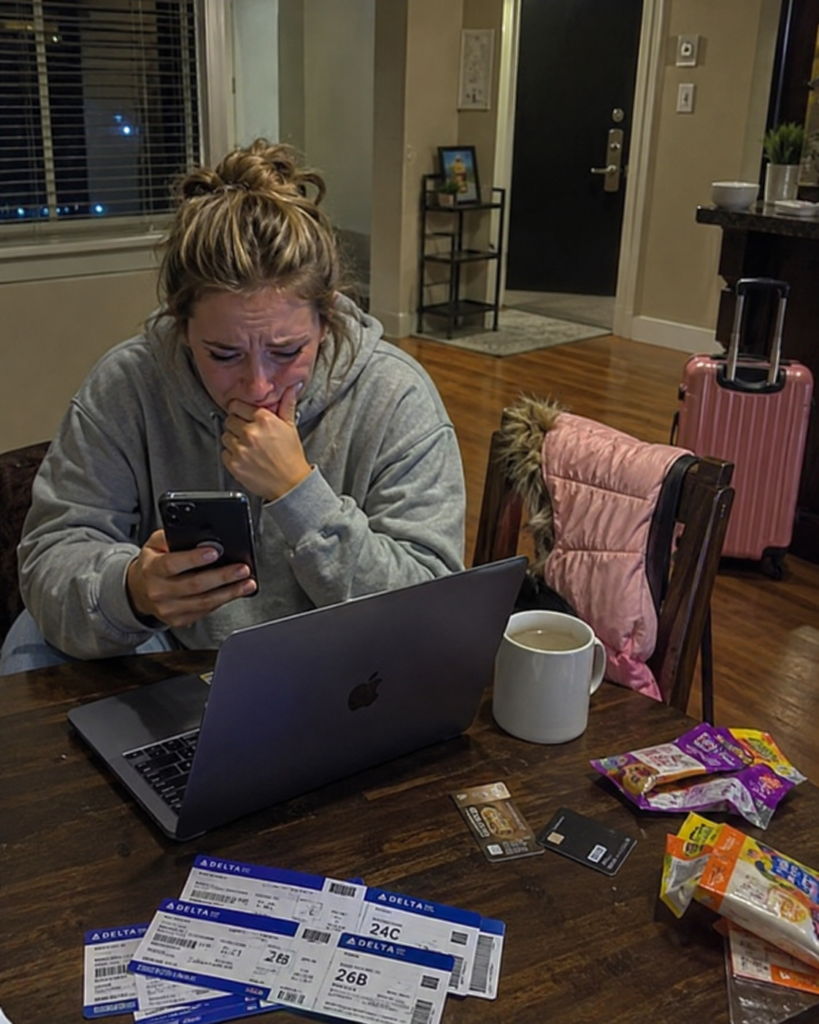
One second, she was doing the polite airport smile everyone uses when they have already said the same sentence six hundred times that day.
The next, her eyes lowered to the screen and stayed there.
The scanner blinked red.
Behind us, suitcase wheels clicked over tile.
A boarding announcement crackled through the speakers, half-swallowed by the noise of tired travelers and rolling bags.
Cold air pushed out from the jet bridge every time the door opened, sharp enough to cut through my coat and make my daughter lean against my side.
Lily was seven years old.
She wore a pink winter coat, purple mittens, and a snow hat with white pom-poms that bounced every time she moved.
She had packed her own backpack that morning with a coloring book, fruit snacks, and the stuffed rabbit she still pretended she was too big to need.
Her mittened hand was tucked in mine.
She still believed adults were supposed to do what they promised.
That was the part that hurt before anything had officially gone wrong.
Ahead of us, my family was already halfway through the boarding line.
My mother wore the cream scarf she only wore when she wanted photos.
My father kept checking his watch, his jaw tight, as if patience was something the rest of the world owed him.
My brother Tyler and my cousin Chris were laughing under their breath near the stanchions.
My sister Marissa stood beside her husband with her phone held high, angling it so the airport windows and the line of planes behind her looked expensive.
Lily raised her hand and waved.
Nobody waved back.
I told myself they had not seen her.
That was what I did with my family.
I took their small cruelties and sanded them down until they looked like mistakes.
If my mother forgot to invite me to lunch, she was busy.
If my father called only when the power bill was due, he was embarrassed.
If Marissa made every plan without asking me what worked for Lily, she was just organized.
If everyone laughed when I showed up late after working a double shift, I told myself they were teasing.
It is amazing how long you can survive on explanations nobody earned.
The gate agent looked at my ID again.
Then she looked at Lily.
Then she looked at me with that careful expression people use when they have bad news but no power to fix it.
“Ma’am,” she said softly, “your reservation has been canceled.”
For a second, the whole airport seemed to move without me.
People stepped around us.
A man behind me sighed and shifted his laptop bag to his other shoulder.
A toddler cried somewhere near the windows.
I stared at the agent like the sentence might change if I waited long enough.
“That can’t be right,” I said. “I paid for this ticket. My family is on this flight.”
She typed again.
Her mouth tightened.
“I’m sorry. The reservation attached to your name and your child’s name was canceled prior to check-in.”
Lily looked up at me.
Her eyes were too open.
“What does canceled mean?” she whispered.
I squeezed her hand.
“It means there’s a mistake.”
I said it for her.
I wanted it to be true for me.
Another employee came over, a man with a lanyard and the tired calm of someone who had already been yelled at twice before dinner.
I explained that my sister Marissa had handled the booking.
Marissa always handled the booking.
She handled the receipts, the room assignments, the grocery lists, the cabin deposit, and the rental car seating like it was a small government and she had been elected by God.
For this trip, she had created a shared folder called “Colorado New Year.”
It had a budget sheet, confirmation screenshots, a packing checklist, a rental agreement PDF, and a page titled “Who Owes What.”
My line said $1,300.
I paid it the same afternoon she asked.
I still had the bank transfer confirmation.
At 4:38 PM, while the employees typed and spoke to each other quietly, I texted the family group chat.
“Something is wrong with my ticket. They’re saying Lily and I were canceled.”
No one answered.
I looked up.
My family was moving down the jet bridge.
My mother did not turn.
My father did not turn.
Tyler did not turn.
Chris did not turn.
Marissa walked in last, her expensive coat swinging at her knees, her phone still in her hand.
That morning, she had posted a mirror selfie in that coat with the caption, “New year, new peace.”
She did not look back either.
Lily tugged my sleeve.
“Mom, are we still going?”
I tried to answer, but the words stuck behind my ribs.
Then the jet bridge door closed.
“No, baby,” I said. “We aren’t.”
She looked at the door for a long time.
Longer than a child should have to.
The employees were kind in the way strangers can be kind when they do not know enough to make it personal.
They offered to check later flights.
They explained fees.
They asked if I wanted a supervisor.
I could feel everyone in line behind us wanting us to move.
So I moved.
I took Lily’s backpack, our carry-on, and the small hope I had carried into that airport, and I walked away from the gate.
The Uber ride home was almost silent.
The heater blew weak air against the fogged windows.
Lily kept her snow hat on the entire ride.
She did not color.
She did not ask for snacks.
She just stared out the window at the gray road and the winter sky.
I kept checking my phone.
Every few minutes, I told myself somebody would answer.
My mother would say there had been confusion.
My father would ask if we were safe.
Marissa would send some fake apology wrapped in excuses and control.
Nothing came.
Back at our apartment, everything looked exactly how we had left it that morning.
Two suitcases stood by the door.
Lily’s boots were lined neatly on the mat.
A paper grocery bag sat on the counter with snacks for the plane still inside.
Cheese crackers.
Gum.
Apple slices.
A little pack of chocolate-covered pretzels Lily had picked because she wanted to share them with her uncle on the plane.
I made her grilled cheese because I did not know what else to do with my hands.
“We can still have a good New Year,” I said.
She nodded.
Her eyes stayed on the suitcase.
“We can go sledding close by.”
Another nod.
Then, in the smallest voice, she asked, “Did Aunt Marissa forget us?”
I turned toward the stove so she would not see my face.
“I don’t know yet,” I said.
But I did know.
Not fully.
Not with proof.
But a part of me had known since the scanner blinked red and my sister walked away without turning around.
After Lily fell asleep, I sat at the kitchen table under the weak yellow light.
The apartment was quiet except for the refrigerator humming and the occasional car moving through the parking lot outside.
I opened the family group chat.
There were no missed apologies.
No explanations.
No panic.
Just the message I had sent at the airport sitting there like something everyone had stepped over.
At 10:07 PM, Marissa finally answered.
“You should already be used to being left out by now.”
That was it.
One sentence.
No excuse.
No apology.
Not even a lie pretty enough to insult me with.
I stared at the screen until the words blurred.
Then I looked down the hall toward Lily’s room.
Her door was cracked open.
Her snow hat sat beside her pillow.
The pom-poms looked almost childish in the dark, and somehow that made me angrier than the text itself.
They had not just humiliated me.
They had taught my daughter, for one full afternoon, that love could leave her standing at a gate and keep walking.
For years, I had thought being useful meant being loved.
I paid my parents’ utility bills when my father said things were tight.
I covered Tyler’s “temporary” loans when his temporary problems lasted three years.
I renewed the family streaming subscriptions because everyone used them and nobody else ever remembered the passwords.
I kept the emergency fund spreadsheet because Marissa said I was “better with money.”
I stored receipts.
I tracked deposits.
I set reminders for autopay dates.
I kept copies of my parents’ utility logins and the shared savings ledger in a finance folder attached to my email.
I did not do it because I was stupid.
I did it because I wanted to believe there was a difference between being needed and being used.
There is a difference.
People who need you worry when you disappear.
People who use you get angry when the service stops.
At 10:19 PM, I opened my laptop.
My hands were shaking, but not from fear.
The first thing I did was search my email for “Colorado New Year.”
I found the payment thread.
Marissa had sent one group email with the cabin link, then moved the actual confirmations into a folder only she and I could access because she said the others would “make a mess of it.”
There it was.
My $1,300 transfer.
My name on the shared sheet.
My debit card listed as a backup payment method for the cabin deposit.
My email attached as the financial contact because, three weeks earlier, Marissa had said, “Just put yours down for now. You’re the responsible one.”
At the time, it had sounded like trust.
Now it looked like a trap.
By 11:14 PM, I changed every password on every shared finance document connected to my email.
By 12:26 AM, I removed my debit card from my parents’ utility accounts.
By 1:03 AM, I canceled Netflix, Spotify, and every shared subscription tied to me.
By 2:41 AM, I transferred the emergency fund back into the account it had originally come from.
Mine.
Every deposit was traceable.
Every statement had my name on it.
Every dollar I moved was legally mine.
I did not empty anyone else’s account.
I did not steal.
I did not destroy.
I simply stopped holding up a table where everyone else had decided I was not worth saving a seat.
At 3:00 AM, I closed the laptop.
Outside, the apartment parking lot was still.
A small American flag sticker on our neighbor’s mailbox fluttered each time the wind pushed down the hallway.
The ordinary little sound of it scraping against metal felt louder than it should have.
They were somewhere in the air by then.
Probably reclined in their seats.
Probably ordering drinks.
Probably telling themselves I was home crying because that was the role they had given me.
The quiet one.
The useful one.
The one who came back even after being slapped by silence.
They forgot who held the keys.
The next morning, they landed in Colorado and started posting like nothing had happened.
Luxury cabin.
Stone fireplace.
Snow on pine trees.
Matching mugs.
Marissa uploaded a group photo from the porch and cropped the left side so neatly you would never know Lily and I had ever been part of the plan.
My mother commented three snowflake emojis under it.
My father wrote, “Finally some peace.”
I stood in my kitchen with coffee gone cold beside me and looked at that word.
Peace.
Some families call it peace when the person they hurt stops asking to be treated like a person.
I let them have one full day.
On Day 2, Chris texted me first.
“Why did the document password change?”
Marissa followed six minutes later.
“Seriously?”
Then Tyler.
“Did you change the Netflix?”
I ignored all of them.
That night, my mother left a voicemail.
Her voice sounded too bright at first, then cracked at the edges.
“Emily, honey, call me when you get this. Your father’s card is acting weird. It declined twice at dinner, and we need to know if you did something to the accounts.”
Not “Are you okay?”
Not “How is Lily?”
Not “I am sorry we left your child at an airport gate.”
Just panic because the floor had moved under them.
On Day 3, Marissa stopped posting.
On Day 4, Tyler announced in the family chat that he was leaving early because of a work emergency.
Tyler had not had a work emergency in his life that did not involve a maxed-out card or a woman named Ashley changing the locks.
I kept Lily busy.
We made pancakes.
We went sledding at the little hill behind the apartment complex.
We built a crooked snowman with bottle caps for eyes and a baby carrot for a nose.
She laughed for the first time all week when the snowman’s head slid sideways and landed on my boot.
I took a picture of her next to it.
Her cheeks were red from the cold.
Her smile was real.
That picture mattered more than every perfect cabin photo Marissa had staged.
By Day 5, bank alerts flooded my phone.
Failed autopay.
Failed subscription renewal.
Failed card verification.
I had not realized how many things they had quietly balanced on me until I stopped being the ground.
At 6:00 PM on the sixth evening, the family group chat erupted.
My mother said the mortgage payment had bounced.
Marissa said she could not log into the savings account.
My father demanded everyone stop “acting childish.”
Chris accused Marissa of messing up the reservation money.
Marissa accused me without using my name.
“She knows exactly what she did,” she wrote.
I was sitting at the kitchen table with Lily’s math worksheet on one side and my laptop on the other.
Lily was in the living room coloring a snowman purple because she said real snowmen deserved choices.
My phone buzzed again.
This time, it was not a text.
It was an urgent email from the luxury cabin’s property manager.
The subject line made me sit back slowly.
“Final Payment Failure / Immediate Response Required.”
I opened it.
The first line said the final payment had failed at exactly 6:03 PM.
The second said the backup card on file had been declined.
The third said the registered payer needed to provide a valid payment method by morning or the reservation would be locked and the remaining nights released.
Registered payer.
I scrolled down.
My name was on the payment authorization.
My email was on the rental file.
My debit card was listed as backup because Marissa had said it was easier if one responsible person kept the paperwork clean.
Under the email was an attachment.
“Guest Responsibility Addendum.”
I opened it.
Marissa’s initials appeared in three places.
My name was typed under financial contact.
There was a damage deposit amount I had never approved.
Then my phone rang.
Marissa.
I let it ring.
She called again.
I let it ring again.
My mother called from my father’s phone.
I answered that one.
“Emily,” she said, and her voice was trembling now. “Honey, please. Whatever you’re doing, this is embarrassing.”
Not cruel.
Not dishonest.
Not unfair.
Embarrassing.
Behind her, I heard Marissa snap, “Ask her if she froze the cabin card.”
My father’s voice came next, low and hard.
“Emily, enough.”
I looked at Lily’s unopened suitcase by the door.
Then I looked at the grocery bag with the plane snacks still folded on top of the fridge.
Then I looked at the email waiting for my reply.
“Enough?” I said.
For once, nobody talked over me.
I told them I had removed my card from every account I did not personally owe.
I told them I had reclaimed the emergency fund that had been built from my deposits.
I told them I had saved copies of the transfer records, utility statements, subscription receipts, and the cabin payment thread.
Marissa laughed once, but it came out wrong.
“You’re punishing us because you missed a flight?”
“No,” I said. “I’m refusing to pay for the trip you removed my daughter from.”
Silence moved through that cabin so cleanly I could hear it through the phone.
Then my mother whispered, “We didn’t know she would be that upset.”
That sentence told me everything.
They had known.
Maybe not the mechanics.
Maybe not every detail.
But they knew Lily and I were not getting on that plane, and they walked anyway.
I opened the property manager’s email and typed one sentence.
“I do not authorize my card or name to be used for this reservation.”
Before I hit send, Marissa said, “Emily, don’t you dare.”
For once, her voice had no polish left.
I hit send.
The confirmation reply came back two minutes later.
My card was removed.
My name was removed as financial contact.

The reservation would require Marissa to provide a new valid card immediately.
I forwarded the email to the family chat.
Then I attached the bank transfer showing my $1,300 payment.
Then the screenshot of the canceled airline reservation tied to my name and Lily’s.
Then Marissa’s text.
“You should already be used to being left out by now.”
Nobody typed for almost a full minute.
Three dots appeared.
Disappeared.
Appeared again.
Chris finally wrote, “Marissa, what did you do?”
Marissa answered, “This is being twisted.”
Tyler wrote, “Did you cancel their tickets?”
My mother called me again.
I did not answer.
Instead, I sat on the floor with Lily and helped her tape her purple snowman drawing to the fridge.
She asked if we would ever go to Colorado.
I told her yes, someday, but not with people who made her feel unwanted.
She thought about that.
Then she said, “Can we go somewhere where people wave back?”
I had to turn my face away for a second.
“Yes,” I said. “We can.”
By the next morning, Marissa had paid the cabin balance with her own card.
I knew because she sent a message at 7:42 AM that said, “Hope you’re happy.”
I was not happy.
That was the thing none of them understood.
Peace did not feel like winning.
It felt like putting down something heavy and realizing your hands were bruised from carrying it too long.
Over the next week, the calls kept coming.
My father wanted the utility logins restored.
My mother wanted to know how she was supposed to handle the mortgage draft.
Tyler wanted his streaming profile back because he had “stuff saved.”
Chris wanted to stay neutral, which apparently meant asking me to forgive everyone without anyone admitting what they had done.
Marissa sent one long message about family loyalty.
I read the first line and deleted it.
Then I did something I should have done years earlier.
I made a new folder.
Not for them.
For me.
Inside it, I saved every statement, every receipt, every transfer, every account removal confirmation, and every screenshot from the night they left us at the airport.
I named the folder “Start Here.”
Because that was what it was.
Not revenge.
A beginning.
A week later, my mother showed up at my apartment.
She stood in the hallway near the mailbox with the little American flag sticker and looked smaller than I remembered.
She had no scarf.
No camera smile.
Just tired eyes and a purse clutched too tight against her side.
“I didn’t think Marissa would actually cancel yours,” she said.
I looked at her for a long moment.
That was the closest thing to an admission I was ever going to get.
“Did you think we were just supposed to disappear quietly?” I asked.
She looked past me into the apartment.
Lily’s boots were by the door.
Her drawing was on the fridge.
Her suitcase was finally unpacked.
My mother’s mouth opened, then closed.
“I don’t know what I thought,” she said.
That was honest enough to hurt.
I did not invite her in.
I told her I loved her, but I would not be paying her bills anymore.
I told her I would not manage family money anymore.
I told her Lily and I would not attend trips, dinners, holidays, or gatherings where respect was treated like an optional upgrade.
She cried then.
Quietly.
Not because she had lost me completely.
Because she finally understood access was no longer automatic.
Months later, Lily and I took our own trip.
Not Colorado.
Not a luxury cabin.
Just a small rented place near a frozen lake with a porch, a mailbox at the end of the drive, and enough snow for a child to fall into it laughing.
We made cocoa in chipped mugs.
We bought sleds from a small hardware store.
We took pictures where nobody was cropped out.
On New Year’s Eve, Lily stood on the porch in her pink coat and waved at an older couple walking their dog.
They waved back.
She turned to me with the biggest smile.
“See?” she said.
I smiled too.
“Yes,” I told her. “I see.”
For years, I thought being useful meant being loved.
Now I know better.
Love does not leave a child at a gate.
Love does not use your card, your work, your silence, and then call you dramatic when you finally close the account.
Love waves back.
And when it does not, you are allowed to stop standing there with your hand in the air.