The first Christmas after Cancun did not begin with forgiveness. It began with a voicemail.
Mark played it in the kitchen while the children sorted through the shells they had brought home in a zippered pouch. Linda’s voice filled the room, polished and wounded, telling him that the family had been humiliated, that people had noticed the empty chairs, that Rachel had spent half the dinner answering questions.
She never said, “I hurt the kids.”
Image
She said, “Your wife made me look cruel.”
That was the sentence that told me we were not dealing with regret. We were dealing with a woman who had lost control of the stage and wanted the spotlight back.
Mark set the phone on the table. He looked at the children, then at me. For years, I had watched him fold himself smaller around his mother. Linda did not need to yell to rule a room. She only needed to sound disappointed, and everyone started rearranging themselves.
“You could have warned me,” he said.
“I did,” I told him. “Every year.”
He looked away. That was not victory. It was the sound of something finally cracking.
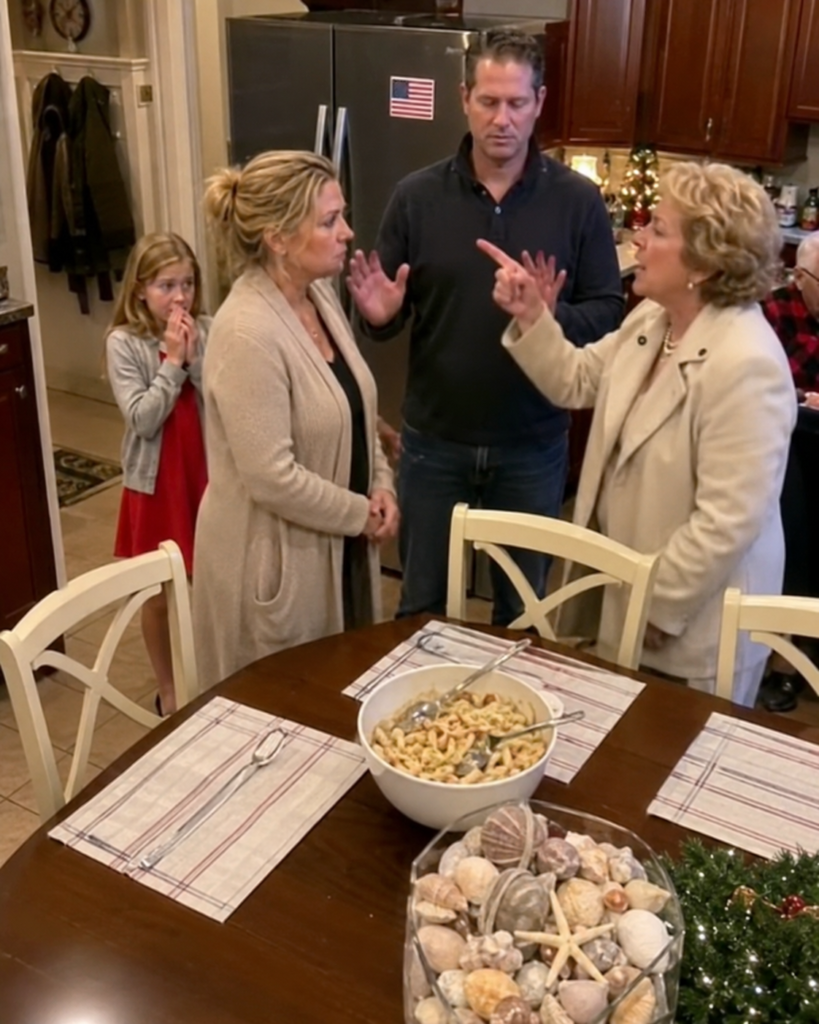
The knock came that evening. Three sharp hits, the kind that did not ask permission. When I opened the door, Linda stepped inside before I invited her. Her coat was still buttoned. Her lipstick was perfect. Her eyes went straight to the children, as if she was counting what she had lost.
“I hope you’re proud of yourself,” she said.
No hello. No Merry Christmas. No “I missed you.”
“I am proud,” I said. “They had a beautiful Christmas.”
Linda’s mouth tightened. “You embarrassed this family.”
“No,” I said. “You did that when you decided three children belonged in a basement because they weren’t polished enough for your table.”
Mark whispered my name, not as a warning this time, more like a man trying to steady the room. Ava stood in the hallway with Noah and Sophie behind her. Her face had gone careful. I knew that look. It was the look a child wears when adults are deciding whether she matters.
Linda followed my gaze and smiled at Ava. “Sweetheart, Grandma always has a place for you.”
The words sounded kind. The tone did not.
Mark moved before I did. One step. Not aggressive, not dramatic, but enough to put his body between his mother and our daughter.
Linda saw it. So did I.
“Mom,” he said, “don’t.”
It was one word, but in that house it landed like a chair scraping across a silent room.
Linda turned on him. “So she wins? That’s what this is? You choose her over your mother?”
His face changed. I had seen him tired, guilty, frustrated. I had never seen him look awake to his own life.
“I’m choosing my family,” he said.
Linda left without hugging the children. She did not slam the door, which somehow felt worse. She closed it softly, like she wanted us to hear the dignity she believed she still had.
That night, after the kids went to bed, Mark sat on the couch with his phone face down on his knee. He told me something I had never heard before.
“She grew up like this,” he said. “My grandmother compared her to her cousins all the time. Clothes, grades, manners, who sat where. She used to tell me she promised herself her house would never feel out of control.”
I thought about Linda’s perfect table. The matching napkins. The seating chart that always placed Rachel’s children in the light and mine below the floorboards.
Pain does not become wisdom just because it gets old.
Sometimes it becomes a rulebook.
“Then it stops with us,” I said.
Mark nodded. For the first time, I believed he meant it.
January was quiet in the way a house feels after a storm passes but the trees are still bent. Linda stopped calling me. She sent Mark short messages with periods at the end of every sentence.
The children must miss their cousins.
I hope you are happy now.
Your mother would never have done this.
Then Rachel began. She texted Mark about how sad their mother was, how nobody understood why I had made Christmas “so hostile,” how the kids needed family. His aunt called to “check in” and spent twelve minutes explaining that older women have traditions and younger women should be patient.
That was how Linda worked. If she could not reach us directly, she turned the family into weather.
For a while, Mark tried to stand in the middle of it. He said his mother was hurt. I said hurt people still have choices. He said she missed the kids. I said missing them was not the same as respecting them. He did not argue.
In March, the Easter invitation arrived through Mark, not me. Linda wanted to host everyone. She said she wanted to make peace.
I asked Ava if she wanted to go.
She looked down at her cereal bowl and asked, “Do we have to?”
There it was again. Not anger. Not rebellion. Fear dressed up as politeness.
I crouched beside her chair. “No. We don’t have to go anywhere that makes you feel small.”
She looked at me like I had opened a window in a room she thought had no doors.
Mark called Linda that evening. He did not put it on speaker, but I could hear enough from his side.
“No, Mom. Not until you can treat Sarah and the kids with respect.”
A pause.
“Because they are my family.”
Another pause, longer this time.
“No. This is not her making me say anything.”
When he came back into the kitchen, he looked pale.
“She said you turned me against her,” he said.
“No,” I answered. “She just noticed you turned toward us.”
The rumors came next. They always do when a family loses its favorite version of a story. At the grocery store, Mark’s aunt told me Linda was heartbroken. Rachel posted a photo of her children at Linda’s house with the caption, “Grandma’s favorite little helpers. We missed our other three today.”
I stared at that picture for longer than I should have. Two smiling cousins holding gifts. Linda’s living room glowing behind them. It was not an invitation. It was a reminder.
I still decide who belongs.
That night, Ava asked why Grandma only posted pictures with Emily and Liam.
I wanted to throw the phone across the room. Instead, I held my daughter and said, “Sometimes grown-ups make mistakes. That is not your fault.”
She asked, “Then why do I feel like it is?”
There are no clean answers to a question like that. There is only the choice you make afterward.
The next morning, Mark told me Linda had called the school office. She said she wanted our updated address to send Easter baskets. The office did not give it to her, but the request chilled me anyway. It was not about chocolate or pastel ribbons. It was about going around the boundary.
That afternoon, Mark called her again. This time he put it on speaker.
“Mom,” he said, “you can see the kids only if you respect my wife and our rules. If you keep using other people, the school, or the children to get around us, you won’t be part of our lives.”
Linda’s voice came through tight and small. “So she wins.”
“No,” he said. “The kids do.”
She hung up.
Weeks passed. No calls. No messages. No family invitations that arrived like summons. Our house became lighter by inches. We started Friday movie nights. We ate pancakes for dinner once because Sophie asked and nobody had to justify it. On the first warm Saturday, Mark grilled burgers in the backyard while the kids made a blanket fort between two lawn chairs.
It was not dramatic. That was the gift.
Then the white envelope arrived.
No return address. Our names written in Linda’s perfect cursive. Inside was an old photo from one of our first Christmases as a married couple. Ava was three in the picture, sitting near the edge of the table with Linda’s hand resting on the back of her chair. On the back, in that same careful handwriting, Linda had written:
You’ll come back eventually. They always do.
Mark read it once and closed his eyes.
“I don’t know what to do with that,” he said.
“Nothing,” I told him. “We don’t have to answer every hook she throws.”
But I kept the photo. I do not know why. Maybe because proof matters. Maybe because part of me wanted to remember exactly what control looked like when it dressed itself up as family.

In June, the children had a school talent show. Ava sang in a small group. Noah performed a magic trick with a paper cup that he had practiced until the cup was bent. Sophie waved from the front row like she was part of every act.
We were sitting near the middle when the whispers began behind us. Mark came back with bottled water, saw my face, and turned.
Linda stood near the rear doors in her cream coat.
For a second, my whole body went hot. The school had not told her. We had not told her. Someone in the family had.
Mark started to move, but I caught his sleeve. “Not now. This is theirs.”
So we watched our children. Ava found us in the audience and smiled. Her voice shook in the first line, then steadied. I glanced back once and saw Linda watching her. Not with the old assessment, not the measuring gaze she used at Christmas. She looked almost afraid.
After the show, the kids ran to us with ribbons. Linda approached slowly, stopping a few feet away.
“I just wanted to see them,” she said. “I didn’t want trouble.”
“You should have asked,” Mark said.
She nodded. That startled me more than any argument could have.
“I know,” she said. “I thought you would say no.”
“We might have,” I said. “Trust works like that.”
She looked at me then. Really looked. No table between us. No relatives waiting for her performance. No basement below our feet.
“I have been angry at the wrong people,” she said.
I did not rush to comfort her. That was new for me too.
She took a small silver box from her purse and asked if she could give it to the kids. I looked at Mark. He looked at the children. Ava stood close to my side, curious but cautious.
“You can hand it to them,” I said.
Inside were three small shell necklaces, each with a tiny label in Linda’s handwriting. Ava. Noah. Sophie. The shells were old, not store-bought shiny, but smooth and pale, like someone had kept them in a drawer for years.
Linda’s voice broke a little. “I found those on a trip long ago. I kept meaning to give them something special. I didn’t know how to do it without making it… about me.”
That was the first honest thing I had ever heard her say.
Ava thanked her politely. Noah asked if his was real. Sophie put hers on immediately and announced that it matched her shoes, which it absolutely did not.
Linda laughed. It sounded rusty.
Before she left, she turned to me. “You do not have to forgive me today.”
“Good,” I said, not cruelly. “Because I can’t do that today.”
She nodded. “Then maybe I can start with not making it worse.”
For three months, that was all she did. She did not push. She texted Mark to ask what the children liked, and she accepted short answers. She sent birthday cards to all three kids, not just one, and the cards said normal things. No guilt. No grand statements. No “Grandma misses you so much it hurts.” Just love, Grandma Linda.
In early November, she called. Mark answered on speaker, and I felt my shoulders tense before she finished saying hello.
“I wanted to ask before the holidays,” Linda said. “Would you consider Christmas Eve here? No big dinner. No Rachel. No cousins. Just you, Sarah, and the children. One table.”
One table.
The phrase sat in the room.
I told her we would think about it. She said that was fair. Then she hung up before she could ruin the moment by begging.
We talked about it for days. Mark was hopeful in a guarded way. I was cautious in a tired way. The kids were honest. Ava said she would go only if she could sit beside me. Noah wanted to know if there would be pie. Sophie asked if Grandma still had the “fancy bathroom soap.”
On Christmas Eve, we went.
I expected the old house to feel like a museum. Instead, the candles did not match. The napkins were different shades of red. The plates were not the good ones. In the dining room stood one long table with seven chairs.
No basement table.
No folding chairs by the laundry room.
No place for my children to be less.
Linda greeted them awkwardly, but she let them come to her instead of pulling them in. Then she turned to me and said, “I made your favorite pie. I remembered you liked it.”
It was such a small thing that it almost hurt.
Dinner was careful at first. People passed salt like they were negotiating a treaty. Mark watched his mother the way a person watches a glass near the edge of a counter. But slowly, the children filled the room. Noah told the same joke three times. Sophie got whipped cream on her sleeve. Ava laughed without checking my face first.
Halfway through dessert, Linda set down her fork.
“I know I can’t undo what I did,” she said. “But I am trying to learn a different way to love them.”
Nobody moved.
Then Ava, brave in the quiet way children sometimes are, asked, “Does that mean we can always sit upstairs?”
Linda’s eyes filled.
“It means there is no downstairs table anymore,” she said.
That was the only apology my children needed to understand.
When we got home, Ava hugged me in the hallway. “Grandma was nice today,” she whispered.
“She was,” I said.
“Do you think she’ll stay nice?”
I looked at Mark. He was hanging up coats, listening.
“I think she’s learning how,” I said.
Later that night, my phone buzzed. A message from Linda.
Thank you for giving me another chance.
I typed back:
We are all learning.
I did not feel the old need to make it bigger than it was. I did not feel the need to declare the family healed or the past erased. Some wounds do not disappear just because someone sets a better table.
But my children had eaten Christmas dinner upstairs. They had laughed with full plates in front of them. They had left without asking why they mattered less.
That was enough for one night.
Forgiveness, I learned, is not a door you fling open. Sometimes it is a chair you pull out slowly, while keeping your hand on the back of it, making sure the person across from you understands they are not entitled to sit there forever.
Linda may change. She may not. Mark and I may still have to say no a hundred more times. But our children know something now that I wish I had known sooner.
Peace is not keeping everyone happy.
Peace is knowing your children are safe at the table.