Jesse borrowed a stock trailer from a man at the feed mill and hauled the bull north before the sun started dropping behind the pale hills. The road out of Valentine stretched long and empty, cutting through country that looked almost unfinished to people who did not understand it. Sandhills rose and fell under a washed-out sky. Fence lines ran for miles. Cattle stood in bunches against the wind. The bull rode quietly behind him, never slamming the trailer, never bawling, never acting like the rejected animal everyone had decided he was.
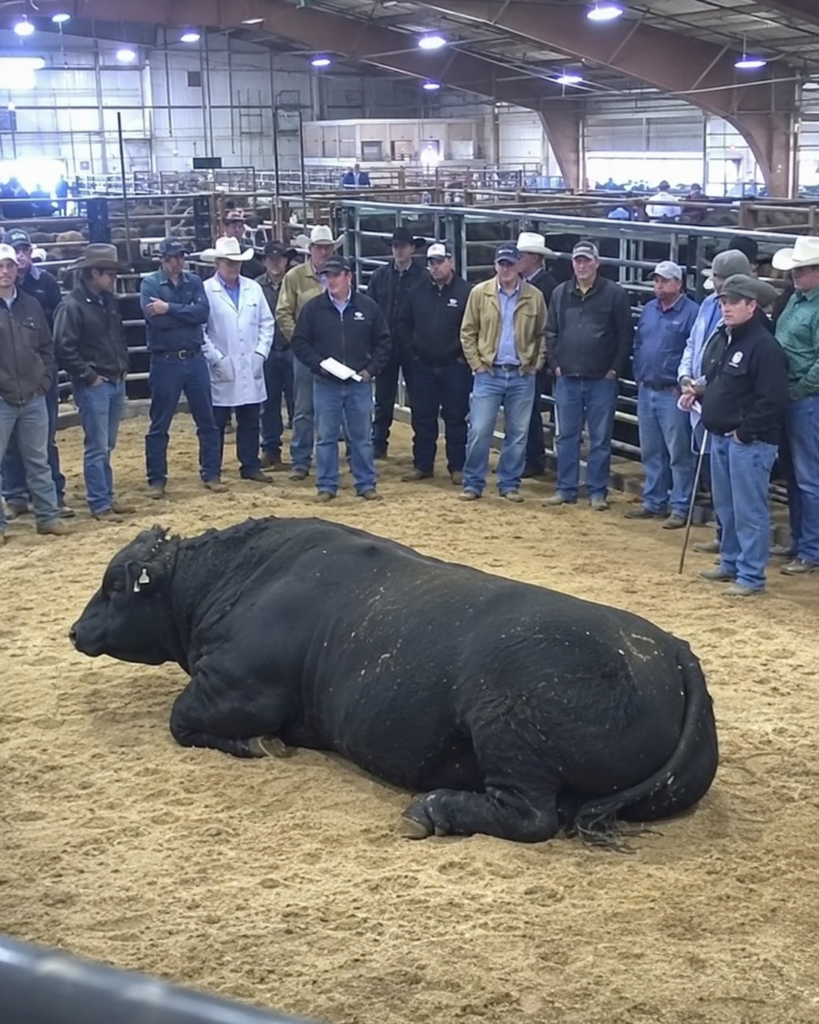
At a gas station outside town, Jesse bought coffee he could barely afford and stood beside the trailer for a long moment, looking through the slats. The bull turned his head and regarded him with one calm, dark eye.
“I hope you know something they don’t,” Jesse muttered.
The bull only chewed.
By the time Jesse reached the leased ground near Ainsworth, the evening had cooled into blue shadow. Walt Dooley was waiting by the gate in his old pickup, the one with cracked vinyl seats and a dashboard faded nearly white by decades of sun. Walt climbed out slowly, one hand braced on the door frame, and watched Jesse back the trailer toward the small corral.
“That him?” Walt asked.
“That’s him.”
“What’d he cost?”
Jesse hesitated. “Nineteen hundred.”
Walt’s eyebrows lifted, but he did not laugh. He never laughed at a man’s risk unless the man had asked for it. He leaned on the fence and watched the bull step out into the pen.
“Looks plain,” Walt said.
“Plain isn’t always bad.”
“No,” Walt said. “Sometimes plain stays alive.”
Jesse smiled a little at that. He had named the bull before he ever reached the pasture. Cedar. Not because the bull was grand or powerful or beautiful in the show-ring way, but because he reminded Jesse of the cedar posts that held up old fences across the Sandhills. Nothing flashy. Nothing that drew attention. But they stood in the ground for decades without rotting, taking wind, snow, heat, and neglect without asking for praise.
That night, after checking the water tank and feeding the cows, Jesse drove back to the small rental house he could barely afford and called his mother in Kearney. Mary Pruitt answered on the second ring, her voice tired from a full day of teaching high school math but warm the moment she realized it was him.
“How was the sale?” she asked.
Jesse sat at his kitchen table, boots still on, sale papers spread in front of him. “Good.”
“Did you buy anything?”
“I bought a bull.”
There was a small pause. “How much?”
“Nineteen hundred.”
The silence that followed was longer than the one at the auction. Jesse could picture her standing in her kitchen, one hand on the counter, doing the math faster than he wanted her to. She knew what that money meant. She knew he did not have another cushion waiting somewhere. His father had not left land or life insurance or a line of equipment. Dale Pruitt had left memories, calloused gloves, a saddle Jesse could not bring himself to sell, and advice that came back at inconvenient times.
“Jesse,” his mother said carefully, “wasn’t that your whole cattle account?”
“Pretty much.”
“Oh, honey.”
“I know.”
“What if he doesn’t work out?”
Jesse looked at the papers again. Thirty-four centimeters. Bottom third weaning weight. Sire with alleged calving problems. He knew every reason he should be afraid. He had been carrying those reasons from Valentine all the way home.
“Then I’m in trouble,” he admitted.
His mother did not answer.
“But Mom,” he said, and something in his own voice surprised him. “His feet are perfect.”
Mary Pruitt knew math, teenagers, grief, and how to stretch a paycheck. She did not know cattle feet. She did not understand how a young man could gamble his savings on hooves when trained breeders had refused the same animal. But she heard something beneath his words that she had not heard in a long time. Since Dale’s death, since graduation, since the loan statements began arriving and the feed mill shifts swallowed his days, Jesse had spoken mostly in maybes. Maybe next year. Maybe if prices hold. Maybe if Walt renews the lease. Maybe if nothing breaks.
Now he sounded certain.
That frightened her and comforted her at the same time.
“Be careful,” she said softly.
It was what mothers said when they wanted to say don’t but knew their sons were already too far down the road.
In June, Jesse turned Cedar out with his twelve cows. The grass had come on green and soft across the hills, and meadowlarks flashed yellow against the fence posts. Jesse stood by the gate as the bull stepped into the pasture. The cows lifted their heads, curious but not alarmed. Cedar did not charge into them or toss his head or announce himself like some young bulls did. He simply walked forward as if he had always belonged there.
For the first three weeks, nothing happened that would make a story worth telling. Cedar bred cows quietly. He did not break fences. He did not fight shadows. He did not chase them ragged. He moved through the herd with steady patience, doing his work without drama. Jesse watched too much. He knew he watched too much. Every evening after his shift, he drove to the pasture and studied the cattle through binoculars until the light faded.
“Trying to stare them pregnant?” Walt asked one evening, pulling up beside him.
“Trying to make sure I didn’t ruin myself.”
Walt spat into the grass. “Those are usually the same thing.”
By fall, ten of the twelve cows had settled. Eighty-three percent. Decent for a young bull in his first season. Not spectacular. Not embarrassing. Just enough to keep Jesse alive and worried. He sold hay to cover winter feed costs, patched fences instead of replacing them, and tried not to think too hard about March. Ten calves had to hit the ground alive. Ten calves had to grow. Ten calves had to prove that the hand he raised in Valentine had been wisdom instead of desperation.
Winter came hard. The wind found every crack in Jesse’s rental house. Ice formed on water tanks. His truck protested every cold morning before finally turning over. At the feed mill, men talked about bred heifers, hay shortages, and diesel prices. Sometimes one of them asked Jesse about the cheap bull from Valentine with a grin that was not exactly cruel but not exactly kind either.
“Still walking?” one man asked.
“Still walking,” Jesse said.
“That’s a start.”
Jesse smiled because it was easier than defending something that had not yet proven itself. But each night, when he checked Cedar standing black and quiet against the pale snow, he felt the same stubborn certainty he had heard in his own voice when he spoke to his mother. The bull was not impressive. He was not fashionable. He did not look like a future. But he stood square on those perfect feet, and Jesse kept believing there was more to him than the sale barn had seen.
Part 3
The first calf came on a Tuesday morning in March, in that gray hour when the sky was light enough to make shapes but not bright enough to give comfort. Jesse had set his alarm for every three hours, because calving season made sleep feel like a luxury reserved for people with less at stake. He drove to the pasture with a flashlight, a thermos of bitter coffee, and a calving kit rattling in the passenger seat.
He expected trouble. He had been expecting trouble for weeks. The stories about Cedar’s sire had crawled into the back of his mind no matter how much he tried to dismiss them. Every time a cow’s belly dropped, he imagined a backwards calf, a hip lock, a vet bill he could not pay, a dead calf on cold ground. Rumors had a way of surviving even in the minds of people who claimed not to believe them.
He found the first cow near a low rise, standing calmly with steam rising off her back in the cold air. At her feet was a small black calf, wet, blinking, and already trying to stand.
Jesse stopped the truck.
For a few seconds, he did not move. The calf pushed itself up on shaking legs, collapsed once, tried again, then found its balance. The cow turned and began licking it with slow, rough strokes. Jesse stepped out carefully, half afraid to disturb whatever miracle had taken place without him.
By the time he reached them, the calf was nursing.
No chains. No puller. No call to Nina Volk, his veterinarian. No frantic struggle in the dark. Jesse crouched in the damp grass and looked at the calf’s narrow head, smooth shoulders, and lively eyes.
“Fifty-nine pounds,” he recorded later, after weighing it.
That number worried him. Light calves were easier to deliver, but too light could mean weakness. He told himself one calf meant nothing.
The second calf arrived that afternoon. Sixty-one pounds. Born clean. Standing fast. Nursing strong.
The third came before dawn two days later.
Then the fourth.
Then the fifth.
Each time, Jesse drove out with his calving kit. Each time, the kit stayed closed.
By the end of calving season, ten calves stood beside ten cows, alive and healthy. Ten births. Ten unassisted deliveries. Average birth weight sixty-one pounds. Jesse wrote the numbers in a spiral notebook and stared at them until they blurred. He had braced himself for disaster and received ease instead.
When he called his mother, she cried before he even finished telling her.
“That’s good, right?” she asked, laughing through the tears.
“That’s very good,” Jesse said, though even then he was cautious. Birth was only the first test. Growth came next.
The worry about small calves lasted exactly thirty days.
At one month old, the calves looked wrong. Not sick wrong. Not weak wrong. The opposite. Their ribs had disappeared beneath muscle. Their hips had rounded. They moved with a kind of spring that made Jesse pause when he saw them. Calves born that light were not supposed to thicken so quickly on grass and milk alone.
Jesse borrowed a scale and weighed them. The numbers made no sense. He checked the scale. He reset it. He weighed one calf twice, then a third time, because he was certain some mechanical mistake had slipped into the process.
The scale was fine.
The calves were gaining an average of three point four pounds per day.
Jesse drove straight to Ainsworth and found Dr. Nina Volk at the veterinary clinic, washing her hands after stitching a horse’s shoulder. Nina was in her late forties, sharp-eyed, blunt, and kind in the way people are kind when they have seen too much death to waste words.
“Nina,” Jesse said, standing in the doorway, “something’s wrong with my calves.”
She looked up. “Wrong how?”
“They’re too heavy.”
She dried her hands slowly. “That’s not usually how people describe a problem.”
“I’m serious.”
“I can see that.”
The next morning, Nina drove out to the pasture expecting a hidden issue, maybe bloating, maybe inaccurate records, maybe a young rancher seeing what he hoped to see. What she found were ten calves with bright eyes, clean noses, tight hides, and muscle they had not paid enough feed to earn.
She watched them move. She checked the cows. She reviewed Jesse’s notebook. Birth weights. Dates. Pasture conditions. No creep feed. No supplements. No special treatment. Just grass, milk, and Cedar.
After an hour, she sat on the tailgate of Jesse’s pickup and tapped the notebook with one finger.
“Nothing’s wrong with them,” she said. “Something’s right.”
Jesse leaned against the fender, afraid to breathe too loudly.
“Your bull is transmitting efficiency,” Nina continued. “Those calves are converting forage into gain at a rate I don’t see often. Maybe almost never in a small herd like this.”
“But his weaning weight was low,” Jesse said. “Bottom third. That’s why people passed on him.”
Nina nodded. “They read the number. They didn’t know what the number meant.”
“What does that mean?”
“It may mean his own environment suppressed his growth. Or that the trait expresses differently in his offspring. Or that the contemporary group made him look worse than he was. Data is only as useful as the person interpreting it.” She looked toward Cedar, who stood near the fence as if none of this concerned him. “The best traits don’t always advertise themselves on the animal carrying them. Sometimes they only show up in what he produces.”
Jesse thought about the auction barn. Gavin Mercer’s closed folder. Deb Atchison’s doubtful face. Marshall Klein walking away from the sire line.
“What about the calving problems?” he asked. “His sire’s reputation?”
Nina’s mouth tightened. “I looked into that after you bought him.”
“You did?”
“You were too worried not to make me curious.” She flipped another page in her notes. “Two C-sections out of forty-three births in that herd near Kearney. That’s about four point six percent. Depending on the group, that’s not high. In fact, it’s lower than what a lot of herds see.”
Jesse stared at her. “So the rumor was wrong?”
“The rumor was louder than the record. That happens all the time.”
The pasture seemed suddenly wider, the morning brighter, the air sharper in Jesse’s lungs. Three professionals had walked away from Cedar because of a measurement two centimeters short, a growth figure they took at face value, and a calving rumor that had grown teeth as it traveled. Three respected cattle people had reached conclusions that sounded safe. Jesse, with twelve cows and no cushion, had trusted the one thing his eyes told him was true.
Cedar’s feet were still perfect.
By October, the calves looked like they belonged to a richer man. Jesse hauled all ten to the Ainsworth sale barn with his stomach tied in knots. He told himself not to expect too much. Markets were markets. Buyers were buyers. A good calf did not erase debt in one afternoon.
But when the calves crossed the scale, the average weight came back at six hundred twelve pounds. Fifty to ninety pounds heavier than calves raised on similar grass by men with more land, better equipment, and better reputations.
The bidding moved faster than Jesse expected. He stood near the rail, trying to keep his face still while each calf brought more than he had dared hope. When it was over, he folded the sale receipt and put it in his shirt pocket with hands that did not feel quite steady.
In the parking lot, as he was checking the trailer latch, a man in a clean coat and expensive boots walked toward him. Jesse recognized him as one of the feedlot buyers from Grand Island, the kind of man who sat quietly during a sale and missed nothing.
“Those were your calves?” the man asked.
“Yes, sir.”
“Lots fourteen through twenty-three?”
“Yes, sir.”
“What’s the sire?”
Jesse hesitated, then said, “Registered Angus bull I bought in Valentine. Paid nineteen hundred for him.”
The buyer studied him for a long moment. It was a different kind of look than the ones Jesse was used to. Not pity. Not amusement. Calculation.
“I’ll give you two hundred above market per head next year,” the buyer said. “Standing offer. Same sire. Same management. I’ll take every calf you produce.”
Jesse nodded because speaking too quickly might reveal what that offer meant to him.
On the drive home, he did the math three times. Ten calves had brought enough to keep him moving. Next year, the premium alone could add two thousand dollars. On twelve cows. With a bull the room had rejected.
For the first time in years, the future did not look like a wall.
Part 4
Walt Dooley had watched the whole thing without saying much. That was Walt’s way. He did not interfere, did not hover, and did not hand out praise like candy. From the kitchen window of his old ranch house, he had watched Jesse’s truck come and go before dawn. He had watched the thin young man check fences in freezing wind, fight water tanks in winter, and walk pastures in summer when most people would have waited until evening. Walt knew more than he let on. Retired ranchers often did.
The Saturday after the calves sold, Walt drove over with a thermos of coffee and parked near the fence where Cedar was grazing. The bull lifted his head once, decided the old man posed no threat, and went back to eating.
Walt got out slowly and leaned both arms on the top rail.
“Your calves weighed heavier than anything I ever raised on that ground,” he said. “And I had thirty years to try.”
Jesse stood beside him, unsure whether to apologize or grin. “It’s the bull.”
Walt looked at Cedar for a long time. “That plain black thing?”
“That plain black thing.”
“He doesn’t look like much.”
“No, sir.”
Walt nodded, as if that confirmed something important. “Good ones usually don’t need to.”
The wind moved through the grass. In the distance, the calves’ mothers grazed in a loose line, their coats dark against the tan hills.
“I’ve got twenty cows I haven’t wanted to sell,” Walt said. “Too good to quit on, too many for my knees. Run them with him next season. Fifty-fifty split on the calves.”
Jesse turned to him. “You serious?”
“I’m too old to joke about cattle.”
Jesse looked back at Cedar. One season ago, he had been terrified over twelve cows. Now twenty more were being offered because one old man trusted results more than reputation.
“Deal,” Jesse said.
Year two became the year Cedar stopped being a gamble and became a pattern. Thirty-two cows went to pasture. Twenty-seven settled. The calves came in March with the same narrow heads, smooth shoulders, and stubborn will to live. Birth weights averaged sixty-three pounds. Jesse still checked every three hours, still carried the kit, still worried because worry had become part of the job. But again, he never opened the kit.
By summer, even men who had smiled at him in the feed mill stopped smiling. They asked questions instead. What mineral was he using? What grass rotation? What vaccination program? What creep feed? Jesse told them the truth, and some of them believed him less than they would have believed a lie.
The calves did not need tricks. They needed their mothers, Sandhills grass, and Cedar’s blood.
Nina Volk arranged residual feed intake testing on five of Cedar’s calves through contacts at the university. Jesse did not pretend to understand every scientific detail, but he understood enough. The test measured how efficiently an animal turned feed into weight. Two calves could gain the same amount, but one might require far less feed to get there. In a business where every pound of feed had a cost, efficiency was not a small advantage. It was survival hiding inside arithmetic.
When the results came back, Nina drove to Jesse’s place herself. She found him repairing a gate hinge and waved the envelope like evidence.
“Top ten percent,” she said.
Jesse wiped grease off his hands. “Top ten in what?”
“Conversion efficiency in the state database for the group they were tested against.”
He stared at her.
Nina smiled. “Your bull is not lucky, Jesse. He’s not a fluke. He’s transmitting one of the most economically valuable traits in beef cattle.”
The words landed harder than praise. Jesse had spent so long hoping not to fail that success felt almost suspicious.
Nina crouched near the gate and drew in the dust with a stick. “Think about a calf that costs three dollars a day to feed versus one that costs two-twenty for the same gain. Across a feeding period, across hundreds or thousands of animals, that difference is enormous. Feedlots care about that more than shine, more than sale-ring noise, more than most of the things people brag about. Cedar’s calves make money after they leave your pasture. That’s why buyers are calling.”
And they were calling.
The Grand Island buyer kept his promise. Then another feedlot in central Nebraska called. Then a third. By the end of the second weaning season, Jesse had standing interest before the calves ever left grass. He did not have enough cattle to satisfy the demand, which was a problem so new to him that he almost did not trust it.
The premium held. Two hundred dollars above market per head. Consistent. Clean. Written into conversations with men who cared about performance, not pedigree gossip.
Jesse paid down his truck. He paid extra on his student loans. He repaired the old working pens instead of patching them with hope and baling wire. He bought better mineral. He replaced two gates. None of it made him rich, but each improvement felt like another board laid across a river he had been trying to cross for years.
Then the call came in November.
Jesse was sitting in his truck after dark, eating a gas-station sandwich and looking over bills, when his phone rang. The number was unfamiliar, but the voice was not. He had heard it in sale barns, on videos, at field days.
“Mr. Pruitt? This is Gavin Mercer from North Platte.”
Jesse sat straighter.
“Yes, sir.”
“I’ve been hearing about your calves.”
Jesse looked out through the windshield. Cedar was a black shape near the hay ring, visible only when he moved against the snow.
“Have you?”
“I have. Good reports. Very good reports, actually. I’d like to discuss a semen collection arrangement on your bull.”
For a moment, Jesse said nothing. His mind carried him back to Valentine. Gavin Mercer in the pens. Gavin Mercer measuring Cedar. Gavin Mercer closing the folder because thirty-four centimeters was not thirty-six. Gavin Mercer walking away before the bull ever entered the ring.
Now that same man wanted access to the genetics he had dismissed.
“What kind of arrangement?” Jesse asked.
Gavin named a number. It was not small. A year earlier, Jesse might have swallowed his tongue hearing it. Even now, the amount could have changed things. Equipment. Debt. Security. Breathing room.
But money was no longer the only thing Jesse was measuring.
He thought about the Grand Island buyer who had noticed before the big breeders did. He thought about Walt offering twenty cows when no one else was interested. He thought about his calves already spoken for because he had built trust one load at a time. He thought about sitting in the back row at Valentine with every dollar he had and raising his hand while the room ignored him.
“I appreciate the interest, Mr. Mercer,” Jesse said. “But Cedar’s not available.”
The silence on the line was sharp.
“You understand what I’m offering?”
“I do.”
“You’re leaving money on the table, son.”
Jesse’s jaw tightened. He had been called son by too many men who used the word as a way to make him smaller.
“I’ve been on the table, Mr. Mercer,” he said. “It’s not a good place to be.”
For a while, neither man spoke.
Then Gavin Mercer surprised him.
“Your father would have liked that answer.”
Jesse’s fingers tightened around the phone. The truck suddenly felt too small.
“You knew my dad?”
“Dale Pruitt? Worked with him one summer back in the eighties. Best hand I ever had. Quiet. Tough. Could fix fence in weather that sent other men home. I offered him full-time work once.”
Jesse swallowed. “He never told me that.”
“He turned me down because the job would have kept him too far from Kearney. Said he had a boy he wasn’t interested in missing.”
Jesse looked down at the old scar across his knuckle, earned years ago helping his father mend a gate. Dale Pruitt had died at fifty-one, heart giving out while he was fixing fence on land that belonged to someone else. Jesse had been seventeen. His father had never owned much, never left much, never been invited to sit with the men who wrote catalogs and set trends. But he had shown up. Day after day. Weather after weather. Job after job.
“He was a good man,” Gavin said, softer now.
“Yes,” Jesse said. “He was.”
After the call ended, Jesse stayed in the truck for a long time with the engine off and the cold pressing in. He thought about his father. He thought about Cedar. He thought about the strange justice of a rejected bull carrying a rejected man’s son toward a life neither of them had been promised.

Part 5
By the time Cedar turned six, nobody laughed when Jesse Pruitt’s calves came through a sale barn. Nobody called his herd a starter set unless they meant it with respect. Cedar covered fifty cows between Jesse’s growing herd and Walt’s remaining cows, moving through the pasture with the same calm purpose he had shown from the beginning. He never became flashy. He never filled out into the kind of bull that made strangers stop their trucks on county roads. He stayed moderate, quiet, and plain, with a deep middle, a calm eye, and feet that still landed cleanly beneath him.
But his calves sold before they were weaned.
Three feedlots had standing orders. The premium settled at two hundred dollars above market and stayed there, year after year, because the numbers kept holding. Birth weights stayed moderate. Calving problems stayed almost nonexistent. Weaning weights stayed strong. Feed efficiency stayed better than men expected and better than many wanted to admit. Cedar had become a reputation of his own, not built by catalogs or show banners, but by cattle that gained on grass and kept gaining in the feed bunk.
Walt Dooley watched it all with satisfaction he tried to hide and failed. He had grown older, his steps slower, but his mind remained sharp. One spring morning, he called Jesse to his kitchen table and slid a bank folder across the worn wood.
“What’s this?” Jesse asked.
“Eighty acres came up next to your lease.”
“I heard.”
“You should buy it.”
Jesse laughed once, because the idea still sounded too large. “With what money?”
“With a loan.”
“The bank won’t look at me.”
“They will if I co-sign.”
Jesse stared at him.
Walt sipped coffee as if he had suggested nothing more dramatic than changing mineral brands. “I don’t have grandchildren who want this country. You do. That matters.”
“Walt, I can’t ask you to do that.”
“You didn’t.”
The old man looked out the window toward the grass that rolled beyond the house. “I watched your father once, you know.”
Jesse went still. “You knew him?”
“Not well. Everybody knew everybody a little. He day-worked for my neighbor one summer. Quiet man. Worked like he had something to prove and nothing to complain about.” Walt turned back to Jesse. “You’ve got that same sickness.”
Jesse looked down and smiled, but his eyes burned.
The loan went through. Eighty acres were added to the operation, and Jesse walked the boundary fence the evening after signing the papers. The land was not grand by the standards of big ranch families. It would not make him wealthy overnight. But it was his first owned ground, and as he stood there with the sunset spreading copper across the hills, he felt something shift deep inside him.
For most of his life, land had belonged to other people. His father had fixed fences for other people. Jesse had leased grass from other people, borrowed trailers from other people, waited for permission from other people. Now he stood on a piece of Nebraska that carried his name on the note, and even with the debt attached, it felt like freedom.
He knelt and pressed his hand into the grass.
“Dad,” he whispered, “we got some.”
The wind moved over the hills as if answering.
That fall, Mary Pruitt drove up from Kearney to see the place. She arrived in a practical sedan with a bag of groceries on the passenger seat, because mothers brought food even when their sons were grown. Jesse met her by the gate, suddenly nervous in a way he had not been before cattle buyers or bankers. He wanted her to see it. More than anyone, he wanted her to understand that the worry had not been wasted, that the sacrifice had not disappeared into a foolish dream.
He drove her through the pasture slowly. The cows grazed in the late light, their calves thick and strong beside them. Cedar stood near the fence line where the Middle Loup River cut through the country, black against the amber grass, plain as ever. Mary got out of the truck and stood for a long time without speaking.
Jesse waited. He had inherited patience from cattle, not from youth.
Finally, she turned to him with tears in her eyes. “Your dad would have cried if he saw this.”
Jesse looked away quickly, but not before his own eyes filled.
“Yeah,” he said. “He would’ve tried not to.”
Mary laughed softly through her tears. “And failed.”
They walked to the fence together. Cedar lifted his head and watched them approach. He did not come charging. He did not pose. He simply stood there, steady and unconcerned, while the calves behind him grazed on land Jesse now partly owned.
“He’s the one?” Mary asked.
“That’s him.”
“He looks so ordinary.”
Jesse smiled. “That’s what everybody said.”
Mary studied the bull for a while. “And you saw something different.”
“I saw his feet.”
She shook her head in wonder. “I still don’t know what that means.”
“It means he could keep going.”
His mother looked at him then, and Jesse realized she was no longer only talking about the bull.
For years, people had measured Jesse the way they measured Cedar. Not enough land. Not enough cows. Not enough money. Too young. Too broke. Too late to start in a business where most people were born into what he was trying to build from scratch. They had seen the student loans, the part-time job, the borrowed trailer, the mismatched cows, and they had drawn conclusions that sounded reasonable.
Maybe they were reading the data correctly.
Maybe they were drawing the wrong conclusion.
Cedar did not look like an animal that changed a life. He looked like a fence post with legs, as Jesse sometimes joked. Moderate frame. Black hide. Calm eye. No sale-ring glamour. No dramatic presence. But he had given Jesse more than calves. He had given him proof that value could hide beneath plainness, that rumors could be weaker than records, that one good decision made with clear eyes could alter the shape of a future.
The breeders had said no because they trusted what was easy to measure. They measured centimeters. They measured a weaning weight printed on a page. They measured a story that had traveled too far from its source. Jesse had measured soundness. He had measured longevity. He had measured the way a bull placed his feet beneath himself when no one else cared to look.
Everything after that traced back to a cold Saturday in April.
The auctioneer’s fading voice. The quiet room. Men looking at their boots, waiting for Lot 61 to pass through unnoticed. A young man in the back row with nineteen hundred dollars and no room for error. A hand raised almost before courage could talk him out of it.
Jesse often thought about what would have happened if he had hesitated. If he had listened to the silence. If he had let the judgment of older, richer, more established men become his own. Cedar might have gone to slaughter. Jesse might have bought a cheaper, worse bull later, or no bull at all. The calves would never have come. The feedlot buyer would never have stopped him in the parking lot. Walt would never have offered twenty cows. The bank would never have opened its door. His mother would never have stood in that pasture, crying over the life her husband had dreamed of but never lived to see.
One hand had changed all of it.
Years later, when younger ranchers asked Jesse how he had found Cedar, he never told the story like a miracle. He told it like a lesson.
“Don’t ignore numbers,” he would say. “But don’t worship them either. Numbers tell you where to look. They don’t always tell you what to see.”
Then he would point toward the pasture, where Cedar moved slowly among the cows, older now but still sound, still steady, still standing on the feet everyone else had overlooked.
The bull no one wanted had not become great because the crowd changed its mind. He had been great before anyone recognized it. That was the part Jesse never forgot. Worth did not begin the moment powerful people noticed. Worth had been there in the sale ring, under the lights, in the silence, waiting for one person desperate enough, careful enough, or brave enough to see it.
And on that cold Saturday in Valentine, when the room went quiet for all the wrong reasons, Jesse Pruitt raised his hand.
The quiet changed.
So did everything else.
THE END