My parents did not invite me to Thanksgiving.
That sentence sounds small when I say it now, almost childish, like a family squabble over hurt feelings and holiday seating.
But it was not small.
It was a clean, elegant cut delivered with a smile.
The kind of wound only family knows how to make.
My mother called ten days before Thanksgiving at 7:14 p.m.
I remember the exact time because I was at my kitchen counter grading third-grade math quizzes and wondering whether I had enough energy left to make real dinner or if peanut butter toast counted as self-care.
My apartment was quiet except for the low hum of the refrigerator and the occasional buzz of my old laptop.
Beside me sat a chipped Roosevelt Elementary mug full of coffee that had already gone cold.
When my mother said, “Isabelle, honey, we need to talk,” I felt the warning before the words arrived.
There are voices people reserve for funerals, breakups, and family disappointments.
My mother had perfected one that blended all three.
I leaned back in my chair.
“Okay.”
“Vanessa is bringing someone important home for Thanksgiving,” she said.
“His name is Jonathan Pierce.”
I knew the name immediately, though I did not say that.
Jonathan Pierce was an executive director with the Metro Education Alliance, one of the largest education nonprofits in the region.
I knew his grant history, his board affiliations, his published interviews, and his fundraising strengths.
He had spent the last five years trying to arrange a meeting with the chair of the Wright Education Foundation.
Me.
But in my family’s world, Jonathan Pierce was only my younger sister’s polished, successful boyfriend.
“Oh?” I said.
My mother took that as permission to continue.
“He’s very accomplished.
Very refined.
He’s used to a certain environment.”
The knife came next, gentle and precise.
“Vanessa thinks it would be better if you skipped Thanksgiving this year.”
I did not speak.
So she rushed to explain, the way people do when they know they are being cruel and want the cruelty to sound practical.
“Your teaching job is sweet, Isabelle.
Noble, of course.
But Jonathan moves in very different circles.
There will be donors there, business people, old family friends.
Vanessa doesn’t want anything awkward.”
“Awkward?” I repeated.
My mother exhaled softly, like I was making her say something unpleasant.
“You make forty-two thousand a year, darling.
Vanessa makes nearly six figures.
Jonathan attends galas and board dinners.
We don’t want you feeling out of place.”
Then she asked the question that made the humiliation official.
“You understand, don’t you?”
I looked down at the quiz on top of the stack.
Bryson Miller.
Eighteen out of twenty.
Three months earlier, Bryson had cried over a fractions worksheet because he had decided he was stupid.
He told me someone at home laughed when he got homework wrong.
So I stayed after school with him again and again, drawing pizzas and candy bars and football fields until one afternoon he stared at the page and whispered, astonished, “Wait.
I get it.”
That was my work.
That was the life my family found unimpressive.
“I understand,” I said.
My mother’s relief came so quickly it made my throat burn.
“Thank you, honey.
I knew you’d be mature about it.”
After we hung up, I sat in silence for a long time.
My apartment was still the same small apartment: one bedroom, cheap shelves, secondhand couch, children’s artwork clipped to the side of my refrigerator, half-finished lesson plans on the table.
The kind of place my family liked to glance around and mentally file under proof that Isabelle had never quite become somebody.
Then I opened the email account they did not know existed.
The subject line waiting for me read: Metro Education Alliance Partnership — Final Approval Needed.
I clicked it.
Inside were final legal documents approving an $8.3 million commitment over three years.
My foundation.
My money.
My signature.
I stared at the screen until the words blurred.
There are moments when two lives collide so sharply you can almost hear the impact.
The small apartment.
The school papers.
The old Honda outside.
And behind all that, a fortune my family had never suspected, directed through trusts, holdings, and a foundation built on one woman’s quiet convictions.
My grandmother Helen died when I was eighteen.
She had been a public school English teacher for thirty-seven years, the kind students came back to visit decades later.
She wore sensible shoes, owned beautiful books, made perfect tea, and refused to believe that teaching was anything less than sacred work.
My father had spent most of his adult life dismissing her.
“She’s intelligent enough to have made real money,” he used to say.
“Instead, she spent her whole life in classrooms.”
Grandma Helen would smile in that calm way that made weak men feel louder than they were.
What my father never respected was that she was also brilliant with money.
Over decades, she bought rental properties in neighborhoods no one else believed in yet.
She invested conservatively and consistently.
She reinvested income.
She lived below her means so long it looked like modesty to people who only understood status through display.
By the time she died, her estate was worth $64.8 million.
Most of it came to me.
Not because I was her favorite.
Because I was the only one who listened.
A year before she died, she sat across from me at her kitchen table and said, “Your father will always think teaching is a waste.
He confuses public praise with actual worth.
Do not make that mistake.
If you ever have enough, invest in children and teachers.
Quietly.
Let the work speak.”
I promised I would.
And I did.
With Mitchell Carver, the attorney she trusted, I built structures my family never bothered to notice.
Wright Holdings LLC.
The Wright Family Trust.
The Wright Education Foundation, named for Grandma Helen’s maiden name.
At Roosevelt Elementary, where I taught under the name Isabelle Pearson, I lived the life I loved.
At the foundation, under my legal name Isabelle M.
Wright, I funded the kind of help schools beg for and rarely receive.
Scholarships.
Arts programs.
Teacher grants.
Counseling expansions.
Technology labs.
Emergency family assistance.
In 2017, the foundation donated twelve million dollars to build a new STEM and arts wing at Roosevelt.
My family attended the dedication.
They stood in front of the building and admired the anonymous donor.
I stood thirty feet away in sunglasses and a cap, and they never noticed.
The irony went deeper than that.
Five years
before that Thanksgiving, my parents had nearly lost their house on Maple Ridge Drive.
My father’s finances were collapsing.
They did not know because he had built most of his personality around pretending to be more secure than he was.
When the mortgage default became unavoidable, I stepped in through Wright Holdings and bought the house outright for $520,000 cash, then structured it so they would never know the buyer was me.
The monthly support they received afterward came through the Wright Family Trust—$3,200 that kept them stable.
My father assumed it was some delayed remainder from my grandmother’s estate.
My mother never asked questions she might not like the answers to.
They accepted the house.
Accepted the money.
Accepted the comfort.
But not me at their table.
Thanksgiving morning came cold and bright.
The family group chat filled early with photos of polished silverware, cream plates, gold napkins, and the dramatic centerpiece my mother only used when she was entertaining people she wanted to impress.
Vanessa posted a smiling picture from the dining room.
Can’t wait to show Jonathan where I grew up.
I stared at the message, then put my phone face down.
Because where she grew up had been saved by me.
By noon I was at Roosevelt Elementary, helping with the annual community meal we hosted for families who were struggling.
The cafeteria smelled like turkey, gravy, instant stuffing, and industrial coffee.
It was loud and warm and imperfect.
Volunteers moved between folding tables carrying trays and paper cups.
Children darted around chair legs in holiday clothes that did not quite fit.
Tired parents sat long enough to unclench.
Bryson spotted me near the serving line.
“Miss Pearson!” he yelled, launching himself toward me.
I laughed and hugged him.
“Hey, trouble.”
His mother, Kesha, came over carrying two plates.
She looked exhausted, grateful, and embarrassed to be grateful all at once.
“You’re here on Thanksgiving?” she asked.
“Of course,” I said.
She shook her head.
“You should be with your family.”
I looked around the cafeteria—the kids, the teachers, the volunteers, the mothers with second jobs, the fathers trying not to look ashamed for needing help.
“I am,” I said.
Her eyes filled instantly.
She blinked hard and smiled at me like she understood more than I had said.
At 6:48 p.m., while I was scraping mashed potatoes from a catering pan, Vanessa posted another picture.
Fourteen people around my parents’ dining table.
My father with a wineglass.
My mother glowing.
Vanessa tucked against Jonathan Pierce in a silk dress that probably cost half my monthly rent.
Best Thanksgiving ever.
So grateful for family.
I looked at the word family until it stopped meaning anything.
Then I locked my phone and finished cleaning up.
I thought that would be the end of it.
I was wrong.
At 10:17 that night, a text from an unknown number appeared on my screen.
Ms. Wright, this is Jonathan Pierce.
I need to speak with you urgently tomorrow morning if possible.
There has been a serious misunderstanding regarding my dinner tonight at the Pearson residence.
My body went completely still.
Ms. Wright.
Not Isabelle, Vanessa’s sister.
Not Miss Pearson, Roosevelt teacher.
Ms. Wright.
There were only two ways he could know that name.
Someone had told him, or he had found something.
The truth, I learned the next morning, was more satisfying than either possibility by itself.
After dinner, my father had led Jonathan into his study for bourbon and self-invention.
He loved performing success in front of successful men.
He told old stories about deals that no longer mattered.
He spoke about investments as if they still existed.
He referenced connections who had long since stopped taking his calls.
Jonathan listened politely until he noticed paperwork on the desk.
A partnership agreement.
Wright Education Foundation.
$8.3 million.
My father had no business touching that file, but he loved anything that made him feel adjacent to importance.
It had likely been forwarded to the house through one of the estate mailing addresses he never fully understood.
Jonathan picked it up casually while my father was talking.
Then he saw the signature page.
Isabelle M. Wright.
Foundation Chair.
He looked up.
“Daniel,” he said carefully, “is your family connected to the Wright Foundation?”
My father laughed.
“Wright? No, no.
Just paperwork.
My daughter Isabelle uses her grandmother’s name on some legal things.
She’s not involved in anything meaningful.
She’s just a school teacher.”
Jonathan did not smile.
Instead, he excused himself, went into the guest bathroom, and locked the door.
He searched the name.
Then the foundation.
Then Roosevelt Elementary.
Then pictures.
Same face.
Same woman.
Same person they had deliberately excluded because she might embarrass them.
When he returned to the study, the performance was over.
He held the contract in one hand and asked only one question.
“Where is Isabelle tonight?”
My father, apparently annoyed, said something like, “She had other plans.”
Vanessa, who had followed them into the room by then, tried to laugh it off.
“She’s not really Jonathan’s type of company.”
That, according to Jonathan, was the moment he nearly walked out without another word.
Instead, he finished the evening, went home, and sent me the message.
The next day, I agreed to meet him at a quiet downtown café at nine in the morning.
He arrived early.
So did I.
He stood when I approached the table.
For a second, he looked like a man about to walk into a board meeting and a confession at the same time.
“Ms. Wright,” he said.
I set my bag down.
“Miss Pearson is fine before school hours.”
To his credit, he laughed once, softly.
Relief flickered across his face and vanished.
“I owe you an apology,” he said.
“For attending that dinner under false assumptions.
And for not recognizing you sooner.”
“You weren’t the one who excluded me,” I said.
“No,” he said.
“But I was sitting at the table when they justified it.”
I held his gaze.
“And what did you think?”
He was quiet long enough that I respected the answer when it came.
“I thought your sister was shallow,” he said.
“I thought your parents were worse.
And I thought any organization led by someone who chose to stay in a classroom while giving away that kind of money was probably being run by the most interesting person I’ve never met.”
That made me smile despite myself.
Then his expression sharpened.
“There’s something else you should know.
The partnership approval is not final yet.
It still requires my recommendation to the board.
Last night made me question whether your family has been misrepresenting any connection to you or the foundation.”
“They have no role in my work,” I said immediately.
“No influence.
No access.
None.”
He nodded.
“I believed that was likely true.”
I folded my hands around my coffee cup.
“Why are you really here, Mr.
Pierce?”
He did not flinch.
“Because I want the partnership.
Because I respect the work.
And because I need to know whether your family intends to exploit your name.”
I thought about my father’s vanity, my mother’s social hunger, Vanessa’s desperation to look elevated through proximity.
“Yes,” I said.
“They do.
Whether they realize it yet or not.”
He exhaled slowly.
“Then I think you should be prepared.”
I was.
What I was not prepared for was the speed.
Within forty-eight hours, Vanessa had apparently turned the discovery into a grievance.
In her version, I had humiliated the family by hiding my identity.
My mother agreed.
My father, insulted that Jonathan now wanted to speak to me instead of him, escalated the entire thing into betrayal.
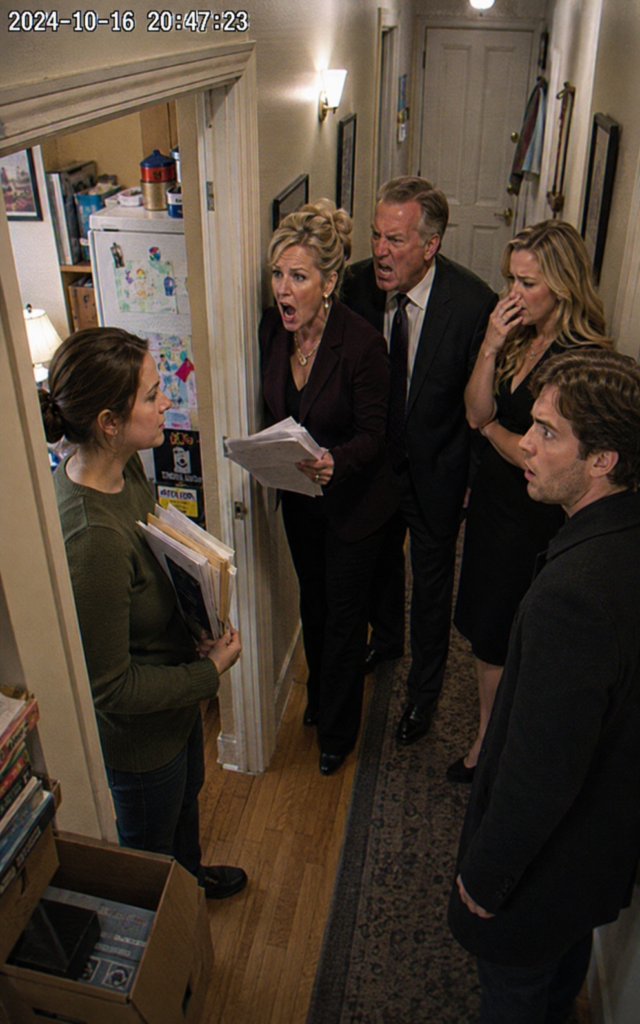
On Tuesday evening, they arrived at my apartment unannounced.
My mother knocked like she wanted the whole building to hear her outrage.
I opened the door and found my parents on the landing, Vanessa beside them with red eyes and rigid shoulders, and Jonathan one step behind them looking like a man who regretted every logistical choice that led him there.
“How dare you?” my mother began.
I leaned against the frame.
“Good evening to you too.”
My father’s voice was already raised.
“You made us look ridiculous.”
“No,” I said.
“You handled that yourselves.”
Vanessa’s mouth tightened.
“You kept this secret for years.
You let me bring him there without telling anyone.”
“You never asked me a single real question about my life,” I said.
“None of you did.”
My mother pointed into my apartment.
“You sat here pretending to struggle while you had all that money.”
I laughed then, once, without warmth.
“Pretending? I teach thirty-two third-graders every day.
I grade papers until midnight.
I know which students are hungry before lunch and which ones panic when they hear raised voices.
None of that is pretending.”
Jonathan stepped forward.
“Mrs. Pearson,” he said quietly, “with respect, this is not a deception issue.”
My mother turned to him.
“Then what is it?”
His eyes moved from her to my father.
“It is a value issue.”
No one spoke.
He continued.
“You excluded your daughter because she is a teacher.
The fact that she also happens to be the founder of one of the most significant education philanthropies in the state only reveals how little you understand about what matters.”
My father flushed a dangerous shade of red.
“Don’t lecture me in front of my family.”
Jonathan’s voice stayed calm.
“I’m not lecturing you.
I’m withdrawing from the fiction you built around this.”
Vanessa turned on him.
“So what, now you admire her? Because she’s rich?”
“No,” he said.
“Because she stayed a teacher when she didn’t have to.”
The silence that followed was enormous.
I had spent years assuming any revenge I took would feel triumphant.
It did not.
It felt sad.
Clarifying, but sad.
Because in that hallway, with my cheap lamp glowing behind me and my school tote
still by the door, my family was not shocked that I was generous.
They were shocked that the person they had dismissed possessed power they respected.
That was the ugliest part.
My father drew himself up, trying one last time to reclaim authority.
“Fine.
Enough of the theatrics.
If you have money, then you owe this family honesty.
We have supported you all these years.”
Something in me cooled completely.
“Supported me?” I said.
I stepped aside and walked to the small desk near my window.
From the drawer I removed a folder Mitchell had once told me to keep for exactly this kind of moment.
I handed it to my father.
He opened it with visible irritation.
The first page was the deed history for the Maple Ridge house.
The second was the original purchase agreement through Wright Holdings LLC.
The third showed the trust disbursements they had been receiving for five years.
My mother leaned in, confused.
Vanessa craned from behind.
Jonathan said nothing.
My father’s face changed first.
He flipped back to page one.
Then page two.
Then three again.
“What is this?” he said.
“It means,” I replied, “that when you were about to lose your house, I bought it.
Quietly.
It means every monthly payment that kept you comfortable came from my grandmother’s estate under instructions I approved.
It means you have been living off the daughter you call unimpressive.”
My mother made a sound I had never heard from her before—not quite a gasp, not quite a sob.
Vanessa looked sick.
My father’s hands trembled.
“That’s impossible.”
“It is paperwork,” I said.
“Grandpa always said paperwork matters.”
“I would have known,” he said weakly.
“You never asked.”
That landed harder than anything else.
Jonathan looked at me, then at the pages, then back at my father with open disbelief.
“He called her ‘just a school teacher,’” he said quietly, almost to himself.
“I am a school teacher,” I said.
And for the first time in my life, I saw my father understand that the word just had failed him more than it had ever diminished me.
My mother sank down onto the stairwell bench outside my door as if her legs no longer trusted her.
Vanessa started crying in earnest now, but not gracefully.
It was the messy, angry crying of someone who realizes she has built her identity on the wrong scale.
“I didn’t know,” she whispered.
“That’s true,” I said.
“You didn’t.
But you also never cared enough to find out who I was beyond what I earned.”
Jonathan cleared his throat.
“I think I should leave.”
Vanessa turned toward him desperately.
“Jonathan—”
He stopped her with a look that was not cruel, only finished.
“No,” he said.
“I think your sister has heard enough from people who only value appearances.”
Then he looked at me.
“The board meeting is Friday.
My recommendation stands, Ms.
Wright, unless you decide otherwise.”
I nodded once.
“Thank you.”
He left.

My father remained frozen with the folder in his hand.
My mother finally looked up at me and said the one thing she probably thought would fix everything.
“Why didn’t you tell us?”
Because you never loved people without measuring them first, I thought.
But what I said was simpler.
“Because the truth did not
matter to you until it became impressive.”
I did not slam the door.
I just closed it.
The next day, my mother called twelve times.
Vanessa texted apologies that were too frantic to be sincere.
My father sent one stiff message asking for “a private family discussion.”
I ignored all of it until Saturday afternoon, when I drove to Maple Ridge with another folder.
My parents let me in like they were opening the door to a bank examiner.
The house looked the same—same cream walls, same framed prints, same polished dining table where I had not been welcome.
Vanessa was already there.
She stood when I entered, but she did not come near me.
I sat down and placed the folder in the center of the table.
My father stared at it.
“What now?”
“Clarity,” I said.
Inside were revised trust documents.
I explained them simply.
The monthly support would continue for one year and one year only, enough time for them to reorganize their finances and sell the house if necessary.
After that, the trust would end.
I would continue any charitable giving I chose through the foundation, but there would be no personal subsidies hidden behind mystery paperwork.
My mother looked stricken.
“You would cut us off?”
I met her eyes.
“You cut me out first.
I’m just ending the illusion that you can depend on me while disrespecting me.”
My father tried anger again because anger was the only language he trusted.
“This is vengeance.”
“No,” I said.
“This is adulthood.”
Vanessa’s voice shook.
“I was wrong.”
I looked at her.
Really looked.
For once there was no performance in her face, only panic and shame.
“Yes,” I said.
“You were.”
She started crying again.
“Can we fix this?”
The question settled over the room like dust.
I thought about Bryson, about Kesha, about the Roosevelt cafeteria on Thanksgiving, about my grandmother’s hands wrapping around a teacup while she told me to let the work speak.
I thought about all the years I had spent waiting for my family to notice my heart before my usefulness.
“Maybe,” I said at last.
“But not today.”
I stood to leave.
At the door, my mother called my name.
When I turned, she looked smaller than I had ever seen her.
“Were you really alone on Thanksgiving?” she asked.
I almost answered yes.
But that was not true.
“No,” I said.
“I was with people who were grateful I showed up.”
Then I left.
Friday came, and the Metro Education Alliance board approved the partnership unanimously.
Jonathan called afterward, officially this time.
We spoke for nearly an hour about teacher retention, after-school mental health support, and how rural districts were being overlooked in every flashy statewide initiative.
He was smart, prepared, and careful not to sound like he was trying to repair something personal through professional admiration.
At the end of the call, he paused.
“I’m glad I found out the truth,” he said.
“So am I,” I replied.
He was quiet for a beat.
“Not because of the money.”
“I know.”
That was the beginning of a respectful working relationship and, months later, a friendship I had not expected.
Nothing rushed.
Nothing performative.
He had seen me first through other people’s contempt and then through my work.
There PREV PA was something steady in that.
At Roosevelt, life kept moving the way it always does.
Bryson improved.
Kesha got a better job.
The new grant funded a literacy specialist and expanded our family counseling hours.
One afternoon, I stood in the bright hallway of the arts wing my foundation had built and listened to children practicing violin badly and joyfully, and I felt my grandmother near me in the only way that mattered.
My family did not transform overnight.
People like my parents do not wake up humble just because paperwork has embarrassed them.
But the axis shifted.
My father sold the idea that he had been “misled by legal structures” for a while, then eventually stopped talking about it because no one believed him.
My mother began calling teaching “important work” with the strained tone of someone trying on a moral vocabulary she should have learned years earlier.
Vanessa ended things with Jonathan before Christmas; he told me kindly that no serious relationship survives a foundation of contempt and image management.
She later sent me a handwritten letter—her first honest communication in years.
I kept it, not because it fixed anything, but because it was proof she had finally stopped performing long enough to say one true thing.
As for me, I stayed exactly where I had always intended to stay.
In the classroom.
At the foundation.
In the life my family once called small.
The strange thing about being underestimated is that, if you survive it long enough, you stop craving the apology and start trusting the life you built without their permission.
That Thanksgiving hurt.
I will not pretend it did not.
Being excluded by strangers is rude.
Being excluded by the people who raised you leaves a bruise in the shape of your earliest hopes.
But I also think of that moment on my apartment steps—the one where Jonathan looked at me, then at my parents, and said he had been trying to meet with me for five years.
It was not satisfying because it proved I was secretly powerful.
It was satisfying because it exposed the poverty of my family’s imagination.
They had measured worth in titles, salaries, and polished dinner guests.
My grandmother measured it in lives changed.
I know which one built something lasting.
And sometimes, when I think back on that holiday, I wonder what hurt my parents more: discovering that the daughter they dismissed had been supporting them all along, or realizing that even with all my money, all my influence, and all the doors I could open, the thing I remained most proud to be was still the same thing they found embarrassing.
Just a school teacher.